
Sow & Pigs
By Malcolm Lambe
A rare chart of Sow and Pigs reef by John Gowlland with four sections of the bottom and soundings from 1847, 1857 and 1866. (See note at the end of this article)
You’re probably familiar with the tragic wrecking of the “Dunbar” at The Gap, Watsons Bay but maybe you haven't heard of these wrecks - on “Sow & Pigs Reef” which separates the eastern and western channels of the fairway leading to the main part of Sydney Harbour.
These days the reef is marked simply by an isolated danger mark (black and red bands and top-mark of two black balls) that is lit at night and is surrounded by four cardinal marks that warn mariners of the danger that lurks just beneath the surface - especially at low tide.
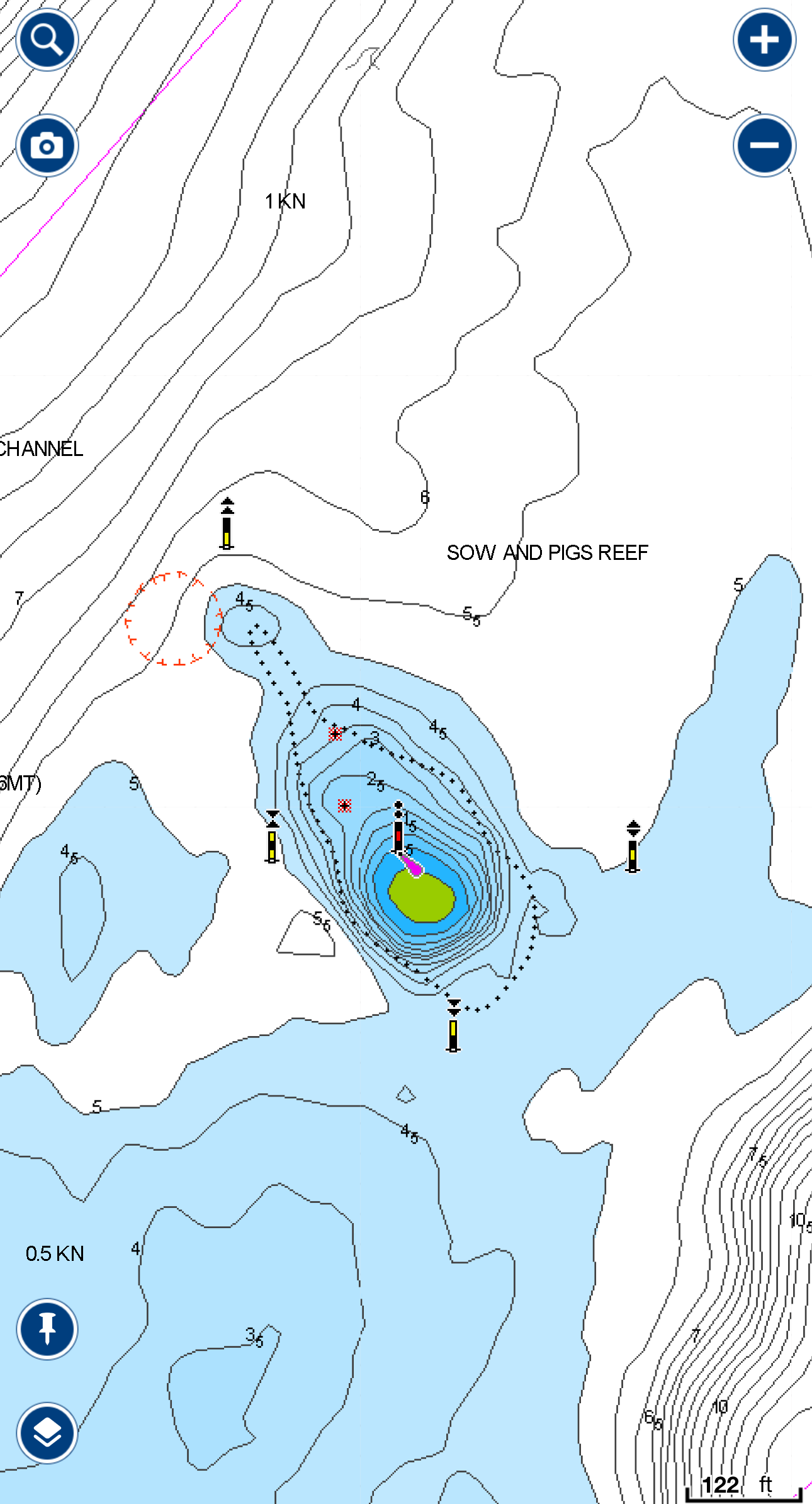
But in the 1820s the reef was only marked by an iron post with an open hoop topmark, thought to be the first navigational mark in Sydney Harbour, but was next to useless in the dark or bad weather.
In June 1821 the schooner “Joke” struck the reef and had to be beached to prevent her sinking, but was so badly damaged she was condemned. (Pity. Roy & HJ would have been all over it)
Three years later, in August 1824, the “Phoenix” flew too close to the reef at the end of a long voyage from London and her keel was destroyed. B*gger. She ended her life as our first prison hulk moored in Hulk Bay (Lavender Bay) for fourteen years.
Surprisingly she was considered a much better place to be imprisoned than on shore. Contemporary reports described her as having “a swimming pool, several bars and restaurants and a gaming room”. Not really. They reported she was “cleanly wholesome and ...spacious” and could house up to 200 reprobates.
The next year - in February 1825 - the small 20-ton schooner “William Cossar” - named after the Government master boat builder - came to grief on the reef and sank. Eight years prior a party of convicts stole her from Newcastle and managed to make it to Port Stephens where she was beached.
A search party found the rigging, sails, gaffs, booms, bowsprit and rudder were missing, as was most of the copper sheathing. There were no signs of the convicts. They may have been killed by aborigines although it was reported that one survivor returned to Sydney a couple of years later.
The ship was repaired and refloated but then capsized in Sydney Harbour in a squall in March 1824, and three men drowned. The ship was righted and repaired once more but then was wrecked on Sow & Pigs the following year. She obviously had bad ju-ju.
February 1827 the cutter “Emma Chisit”…uh sorry - “Emma Kemp”… struck the reef and was severely damaged.
But it was the loss of the 370-ton ship Edward Lombe (yes - “Lombe” not “Lambe”) in 1834 - twenty three years before the Dunbar disaster - that led the authorities to do something to warn mariners of the reef and its dangers.
The Edward Lombe had sailed up the coast from Tasmania through calm seas but near Sydney found itself battling a gale.
As the ship’s master struggled to keep the ship clear of the lee shore, the ship’s foremast and rigging were carried away and he decided to make for the safety of the Harbour.
Having rounded South Head the master ordered the anchor be dropped. Yeah you guessed it - right on top of the Sow and Pigs. (Hold that “10” sign up me hearties)
The anchor didn’t hold - well of course it didn’t - and the Edward Lombe was swept on to Middle Head, where she broke up and sank with the loss of 12 lives.

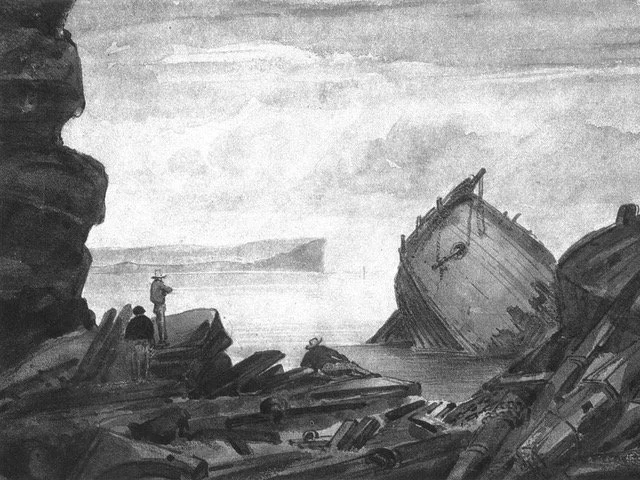
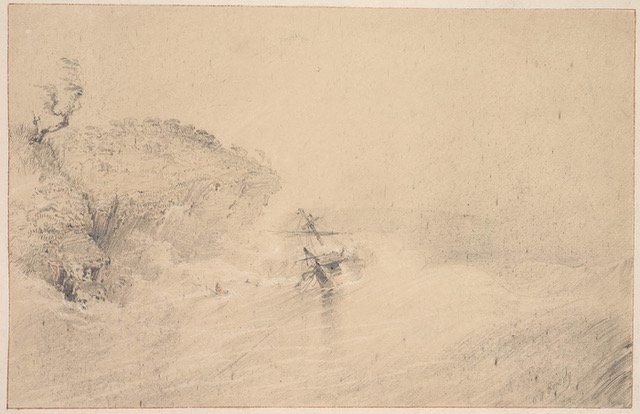
The tragedy led the authorities to moor a lightship just off the reef, not only to mark the presence of the rocks but also to act as a guide to navigation within the Harbour.
Details HERE - gruesome reading.
The lightship was the "Rose", which was moored near the reef from 1836 until 1856, when she was replaced by the lightship Bramble and two more.
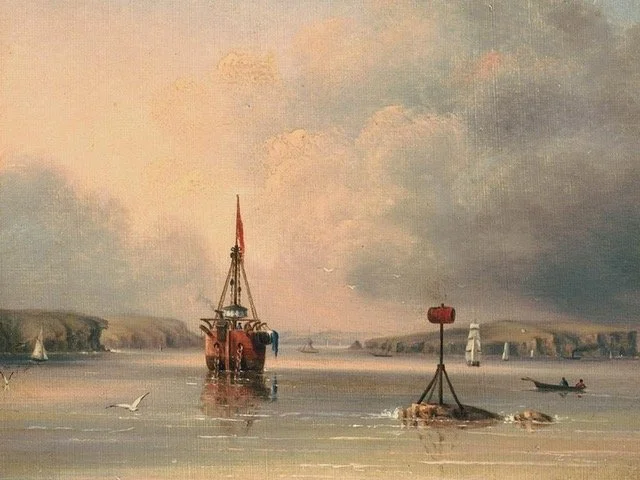
A painting of the lightship “Rose” off the Sow and Pigs Reef in 1846 by George Edwards Peacock. Courtesy State Library of NSW
By the way… whale oil was used to fuel the lights, which were visible for 24km.
The last lightship was withdrawn from service in January 1912 and replaced with a gas-lit buoy, called the Bifurcation Buoy, which showed a white flashing light and had a deep-toned bell.
Today the Sow and Pigs Reef is well-known and well-marked, presenting almost no danger to large ships but smaller vessels still come to grief on it.
At the start of the Sydney to Mooloolaba yacht race in March 1985, the yacht Thirlmere sank after striking the reef.
The yacht was travelling at eight knots under spinnaker when it "hit the bricks" and the power of the collision forced its keel through its hull.
There have also been half a dozen proposals to mount statues on the reef – a giant statue of Captain Arthur Phillip was proposed in the late 1980s. A mother whale and calf springing 9m out of the water was proposed in 1996. A 12-storey boomerang was proposed in 2007. And a giant head of Donald Trump in 2025 (nah - I made that up).
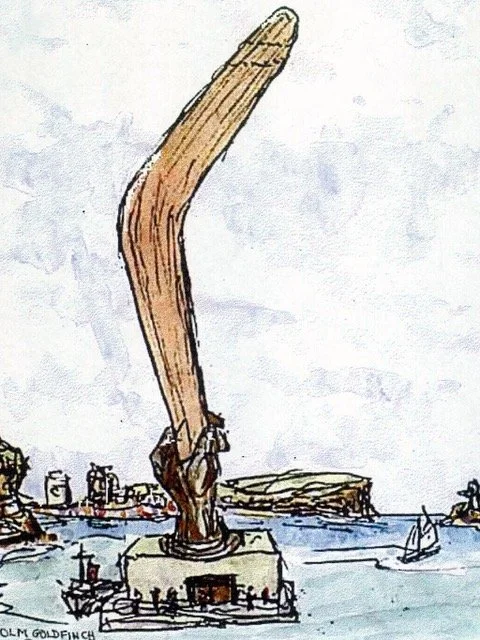
A sketch of the 12-storey boomerang sculpture proposed for the Sow and Pigs Reef. State Library of NSW
So...next time you're out on the Harbour...keep an eye out for the Sow & Pigs. Or you might join the eighty seven other wrecks within the Harbour.
John Gowlland, creator of the chart at the top of this page was appointed to the Australian survey as chief assistant in 1865 after Captain Sydney’s retirement and took command of the survey of the New South Wales coast, and compiling Admiralty charts of the coast. He carried out extensive surveys of Sydney Harbour and made the first plans of Garden Island.
He wrote several pamphlets on the winds and currents of the eastern coast of Australia and many press articles on marine subjects. He returned to the U.K. in 1873 but was back to Sydney the following year. While surveying Middle Harbour he was drowned in an accident off Dobroyd Point on 14 August 1874. Buried with full naval honours at the cemetery of St Thomas’s Anglican Church, North Sydney. You can buy some of his original 1870 charts online ranging from $850 to $2850