
Understated Extraordinary Achievements
To win any prestigious award these days, in whatever your chosen field, usually requires a high public profile… Things such as a massive social media presence , a regular gig on the speakers circuit, your own personally endorsed product range, all help. It’s a variation on the squeaky wheel getting the most oil.
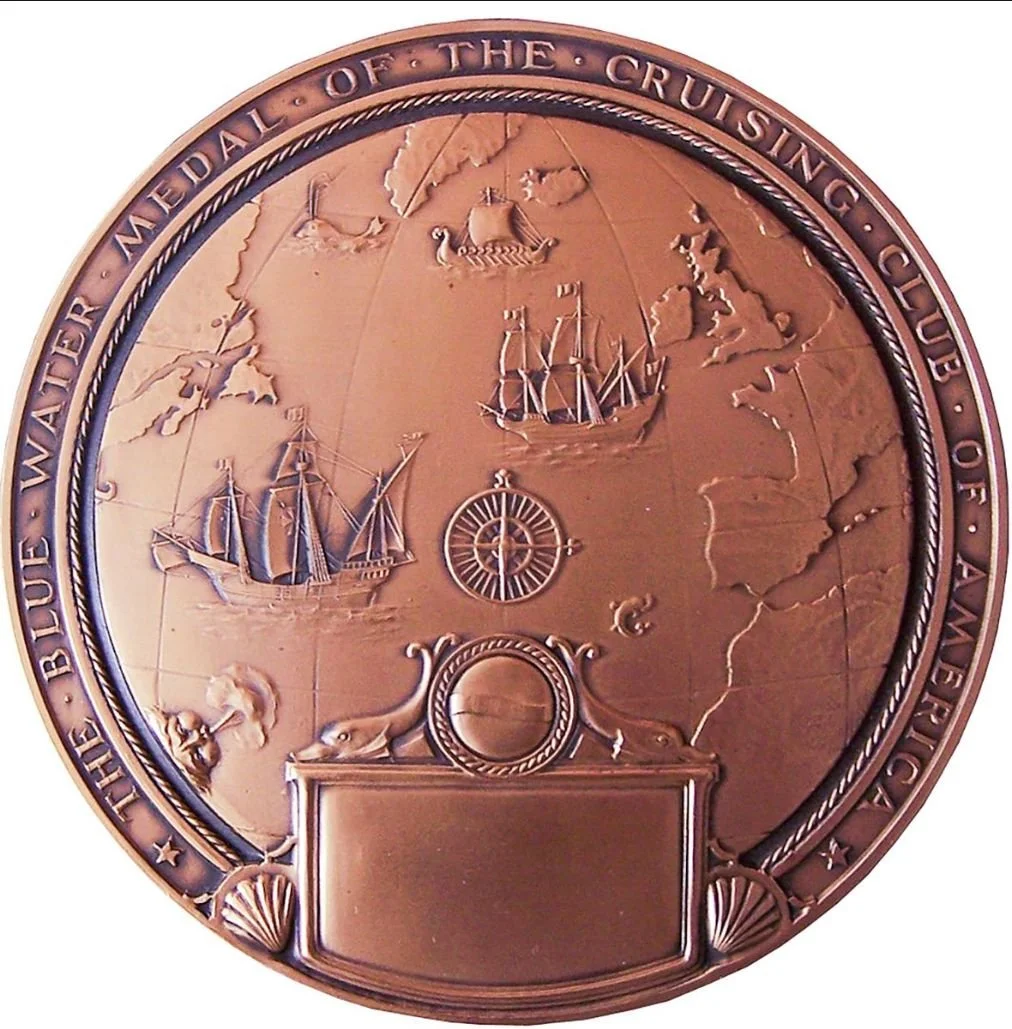
That’s why I always look forward to this time of year when the Cruising Club of America announce their awards headlined by the famous Blue Water Medal.
The Medal is one of the oldest and most prestigious honours in the sailing world, started in 1923 to recognise “meritorious seamanship and adventure upon the sea displayed by amateur sailors of all nationalities” — especially for achievements that might otherwise go unrecognised. The roll call of winners contains all the names you would expect from a centuary of cruising adventure… Eric and Susan Hiscock, Sir Francis Chichester, Bernard Moitessier, Sir Robin Knox-Johnston. But it also awards somer lesser known but equally extraordinary sailing personalities that are worth investigating. The author ALAIN J. GERBAULT aboard Firecrest, RODERICK STEPHENS, JR aboard Dorade, BRITISH YACHTSMEN AT DUNKERQUE, JOHN GUZZWELL aboard Trekka and Australia’s own Alex Whitworth
For over 100 years the Blue Water Medal has celebrated an extraordinary range of long-distance, high-risk, and pioneering voyages — from solo circumnavigations and explorations of remote polar waters to groundbreaking ocean passages undertaken with minimal technology. Because it honours amateur sailors rather than professionals, it’s more about personal dedication and an adventurous spirit, than empirical achievements such as fastest/longest/smallest /biggest.
And what’s most refreshing about the award is that its usually given to sailors who are at heart, uninterested in public acclaim. There just getting on with living extraordinary lives, in ways that should inspire us mortals!
The 2025 winner is no exception.
Pete steering Kokachin in a gale, 2022 (courtesy Linda Crew-Gee)
Pete Hill, of the United Kingdom, is the recipient of the 2025 Blue Water Medal of the Cruising Club of America (CCA). This prestigious award, recognises Hill for his more than 50 years of long-distance voyaging in the world’s oceans. His dedication to building or modifying his yachts to the simple junk rig and proving their seaworthiness has been inspirational to a yachting community of minimalists who find it most important to be at sea or with a community of like-minded sailors.
His independent philosophy of design and construction has allowed him to sail the world’s oceans without the burden of sophisticated and expensive systems.
Notified of the award while cruising in New Caledonia in the South Pacific Ocean, in emotional tones, Hill expressed profound gratitude. “I am blown away by this,” he said, adding “this is such an honour.”
Hill has accomplished remarkable voyages on a variety of boats using the junk rig. Starting out in a self-built 27-foot Wharram catamaran, he and his first wife, Annie (who received the 2009 Blue Water Medal with Trevor Robertson), completed an eventful North Atlantic Ocean circuit in 1975. They then built Badger, a 34-foot plywood dory, in which they explored the North and South Atlantic from Greenland and arctic Norway to the Falkland Islands, South Orkney Islands, South Georgia and Gough Island, then back north to Baffin Island with a return south to Cape Town and many ports between.
Hill then built a 38-foot, junk-rigged catamaran to his own design, China Moon. He and Annie went their separate ways, and for five years he cruised the high latitudes of the South Atlantic Ocean, including Cape Horn and a solo cruise of the South Shetland Islands, South Georgia and Tristan da Cunha.
China Moon at Elephant Island in January 2004
China Moon was sold; Hill completed the delivery solo from Baltimore, Maryland, to Brazil in 41 days. With the new owner, he sailed China Moon from Brazil via the southern Indian Ocean to Tasmania, almost 10,000 nautical miles, in 73 days. Hill also raced; he soloed in the 2006 Jester Challenge from Plymouth, England, to Newport, Rhode Island, in a Kingfisher 22, finishing second but last.
The next project was converting a Freedom 33 to a junk rig. With his second wife, Carly, he cruised extensively in Brazil over several years while writing a multi-part cruising guide to Brazil for the Royal Cruising Club Pilotage Foundation.
In between visits to Brazil, he returned to England and built Oryx, a catamaran, which like his other catamarans, contained a mast in each hull. Following the voyage south to Brazil, Oryx then crossed the stormy South Atlantic to Cape Town. Hill’s voyages were not without tragedy. After many years, thousands of miles at sea, and several ocean crossings together, Carly was lost overboard off the coast of South Africa in 2015. Hill’s response to tragedy was spending time at sea alone. He subsequently sailed singlehanded across the Indian Ocean to Mauritius and Australia.
Sail trials of Oryx, August 2012 (courtesy David Duval-Hall)
After further globe-girdling adventures aboard Oryx, Hill sold her and returned to England. He used his time during the pandemic to build Kokachin, a junk style schooner, with his new partner, Linda Crew-Gee. Kokachin’s first cruise was across the North Atlantic to the Caribbean and then north to Nova Scotia and a circumnavigation of Newfoundland.
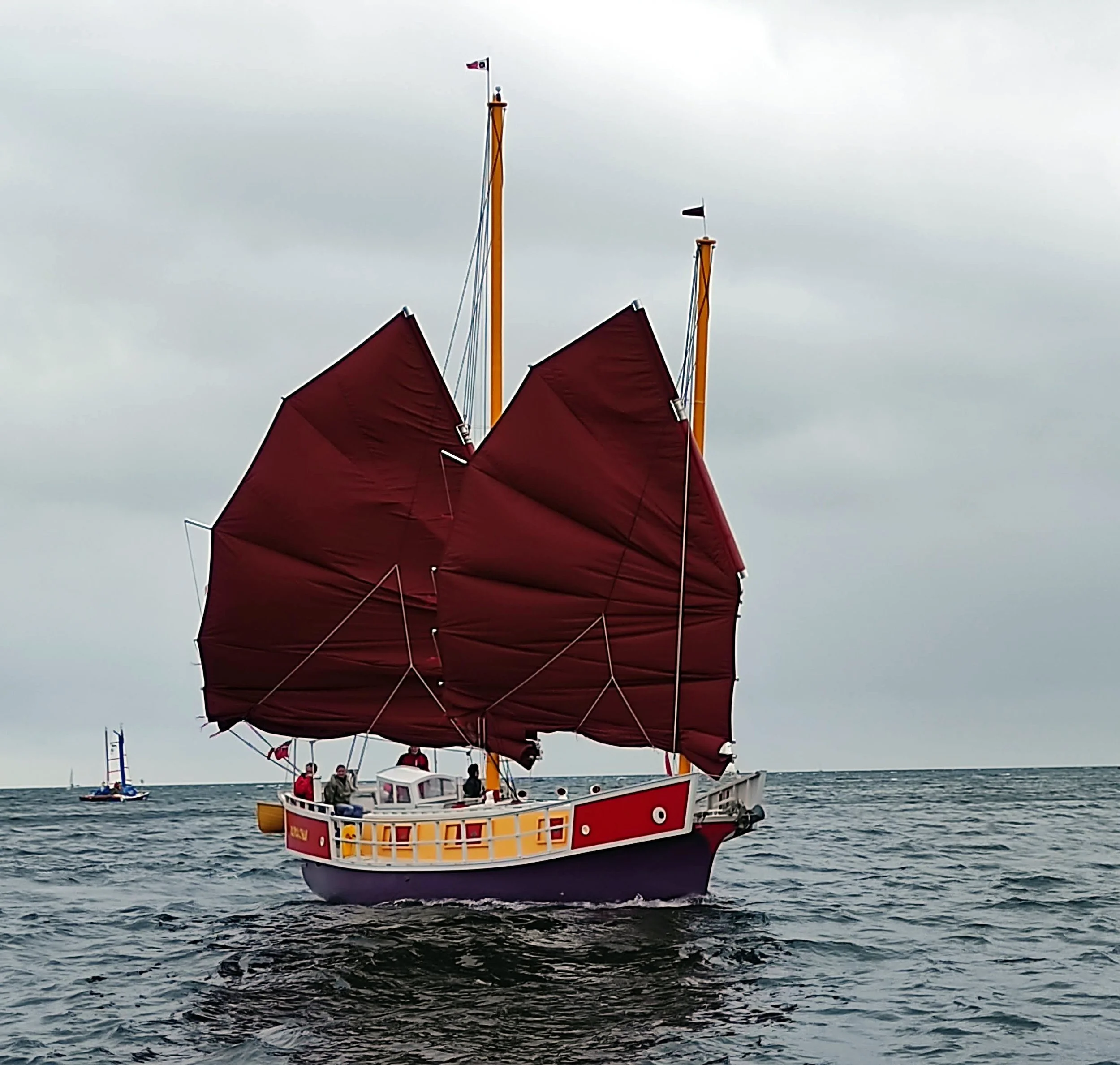
Kokachin in 2022.
Unexpectedly, China Moon came up for sale and Hill decided to buy her back. Storing Kokachin back in England, he and Linda flew to Tasmania, and after a four-month refit, set off toward New Zealand in 2025. They were caught in a violent storm in the Tasman Sea, during which a wave hit and damaged the boat, forcing the couple to hand steer for six days and nights in challenging conditions. They are now cruising in the Pacific.
For full details about Hill’s awards, boats, and voyages, log on to his website
In addition to the Blue Water Medal the Cruising Club of America made five other awards
Young Voyager Award—Tamara Klink
The Cruising Club of America (CCA) has named Tamara Klink, 28, of São Paulo, Brazil, the recipient of the 2025 Young Voyager Award. The award recognizes a young sailor who has made one or more exceptional voyages, demonstrating exceptional skills and courage.
Klink set sail alone at the age of 22 aboard Sardinha, her 26-foot sailboat, crossing the Atlantic Ocean from Norway to Brazil, a voyage of more than 7,000 miles in 90 days. This was just the beginning of her solo sailing career. In 2023 she sailed from France to Greenland in her 34-foot sailboat, Sardinha-2, and then overwintered in Greenland in the sea ice, becoming the first female sailor to overwinter in the Arctic alone. In the process of completing that voyage, Klink also became the first Latin American to solo sail the Northwest Passage.
Like a very small number of other adventurous voyagers, Klink’s accomplishments have attracted one of the largest social media audiences in the sailing world; some 200,000 users followed the real-time tracking of Sardinha-2 and read journal entries she posted.
“Sailing is always a collective endeavour, especially singlehanded,” Klink said upon being informed of the honor. “I rely on a team, as well as on the experience of more seasoned sailors who have paved and continue to pave our way.
“It is therefore a great honour to receive this Young Voyager Award from my bluewater colleagues in the CCA,” she added. “The previous experiences of others enable us to distinguish the essential from the superfluous and to remain ambitious while making fewer mistakes. I believe that going farther with less is the challenge of our time.”
This prestigious award is significant for its celebration of the spirit of adventure, courage, and seamanship. In announcing Klink’s accomplishments and honor, CCA Commodore Jay Gowell said, “Tamara’s achievements are incredible. She exemplifies the spirit of the founding of the CCA to make adventurous use of the sea, and she shows the spirit of the CCA in finding fulfillment in exploring the oceans and our own limits aboard small boats at sea.”
Born in 1997, Klink holds a master’s degree in architecture from ENSA Nantes at Nantes University. She has published four books about her experiences, presented more than 300 lectures in Portuguese, English, and French, and is a UNESCO Green Citizens pathfinder.
Rod Stephens Seamanship Trophy—Philip "Greg" Velez
Philip “Greg” Velez, of Saginaw, Michigan, is the recipient of the 2025 Rod Stephens Seamanship Trophy from the Cruising Club of America (CCA) for rescuing a sailor who fell off a competitor’s boat in trying conditions during the 101st Bayview Mackinac Race.
After close to an hourlong search in high winds and building seas in response to a mayday call, Velez and crew aboard his Amante 2, a Farr 49, were successful in finding and saving Pete Pryce, 72, who had fallen from Trident, a Santa Cruz 70.
The CCA annually awards the Rod Stephens Seamanship Trophy to a sailor for an act of seamanship which significantly contributes to the safety of a yacht, or one or more individuals at sea.
During the afternoon of July 12, the first day of the 259-nautical-mile race, a squall line came across Lake Huron with winds over 40 knots, laying flat several entrants. Pryce fell off Trident, which struggled to right itself for several minutes while he drifted away in the winds and waves.
Velez heard the man overboard mayday alert over the VHF radio and without hesitation put his well-trained crew into action. They identified where the boat in distress had been and sailed up behind its track, though not at first finding Pryce. After 50 minutes, Amante 2 retraced the path of the boat and spotted Pryce hanging on to an inflatable dan buoy. The Amante 2 crew deployed a Lifesling and retrieved Pryce, who wasn’t wearing a life jacket, on the first pass.
“I am unbelievably proud of my crew; they were not going to give up the search until he was found,” says Velez. “Once we found him, the retrieval was the easy part. The crew made it look like they were picking up a water skier.”
After Pryce was rescued, he was given dry clothes, foul weather gear, and an inflatable PFD. Pryce insisted on completing the race aboard Amante 2; the crew resumed racing to Mackinac Island and took third in their class on corrected time, after being granted redress for the time spent making the rescue.
“My crew was determined to catch every boat in our class,” Velez recalls. “This was a pretty significant declaration, considering that the lead boat was 12 nautical miles ahead and doing 13 knots. But we started reeling them in one at a time and over the next 30 hours we caught them all! I am blessed with an unbelievable crew!”
Velez possesses a lifelong passion for sailing. He is chairman of the board at BaySail, a nonprofit organisation dedicated to fostering environmental stewardship of the Saginaw Bay Watershed and the Great Lakes Ecosystem. Velez is also a member and former commodore of the Bay City Yacht Club, Bay City, Michigan.
Diana Russell Award—Peter Willauer
The Cruising Club of America (CCA) has selected Peter Willauer of Falmouth, Maine, to receive the 2025 Diana Russell Award. This award goes to a club member in recognition of innovation in sailing design, methodology, education, training, safety, and the adventurous use of the sea.
Willauer, who was 90 when he was informed of the honor before he passed away November 6, 2025, was a key innovator in experiential education over several decades. Perhaps his most important contribution has been the Hurricane Island Outward Bound School, and the subsequent Hurricane Island Center for Science and Leadership, whose mission is to “integrate scientific research and education to develop leaders prepared to address environmental issues in a rapidly changing world.”
“I always told the students at their last debrief before departing the island that their Outward Bound course was only just beginning,” he said. “I received countless communications from former students about how their course still impacts their lives many years later. On a transatlantic in the middle of the Atlantic Ocean 10 years ago, a sailor on a boat within SSB range of us heard me talking on the radio to our weather router and interrupted and asked ‘Is that Peter Willauer?’ When I said ‘Yes’, he said ‘I was on a course on Hurricane in 1972, and I’m out here now because of that experience. I just want to thank you.’”
In founding and leading programs that have become lasting institutions, Willauer innovated new ways of educating young people that incorporate seamanship, leadership, scientific research, and life skills. That these types of programs have become more widespread today is a testament to the creative energies of Willauer and his colleagues over the decades.
After working with the Leon Bean Mountain Center in Bethel, Maine, Willauer first established the Baltimore-Chesapeake Bay Outward Bound Center, as well as a sea program in the Florida Keys and, beginning in 1974, five Florida bases for programs for adjudicated youth. In 1986, he started the Thompson Island Outward Bound Education Center as part of Hurricane Island Outward Bound School (HIOBS). Willauer was the founder and president of the HIOBS and was also a key contributor to the construction of the school’s Rockland, Maine, base. The organization is known for its experiential leadership education, rock climbing, ropes course, sailing, and pulling boat programs.
A celestial navigator, Peter was nominated and joined CCA in 1959. He sailed extensively, both cruising and racing along the U.S. East Coast and in the West Indies, with two transatlantic crossings, 20 Bermuda races and another 10 passages to Bermuda. With his wife, Carol, he lived for 15 years aboard Eight Bells, their J/42 sailboat and logged 80,000 miles, and then for another five years on their trawler Eight Bells.
Far Horizons Award—Christopher and Molly Barnes
The Cruising Club of America (CCA) has chosen Christopher and Molly Barnes of Alta, Utah, as recipients of the Far Horizons Award for 2025. The premier sailing honor for a CCA member, this award recognizes the sailing achievements of an individual or couple who have embarked upon a cruise or series of cruises that demonstrate the broader objectives of the Club, including the adventurous use of the sea.
A three-year, 36,000 nautical mile cruise undertaken by the Barnes family from 2013 to 2016 included a circumnavigation of South America and rounding of Cape Horn, with stops at Easter Island, Chile; South Georgia Island in the sub-Antarctic Ocean; Arctic Norway, and a wintertime crossing of France’s notorious Bay of Biscay. Crew comprised their sons, Porter and Rabbit, ages 10 and 9 when they started.
When informed of the award, Molly and Christopher had just completed another summer season in Newfoundland and southern Labrador, Canada, and expressed surprise. “We are honored and a bit daunted to be in such esteemed company,” they said, noting that it is “a real thrill to receive the award on behalf of all four of us.”
Christopher and Molly co-founded the High Mountain Institute, a Colorado-based outdoor leadership program for high school students, becoming recognized experts on risk management. After taking other people’s children on adventures in the mountains and canyons for 18 years, they decided it was time to take their own sons on one. Having previously introduced them to sailing in Maine on a 35-foot Cape George cutter, they commissioned a Boréal 47 in France and departed on their first significant offshore passage, to the Caribbean, in 2013.
The Barnes’ approach with their boys was to start slowly and emphasize safety, fun, and learning. The boys were treated as crew, not passengers, and as their skills developed they took on increased responsibility while earning more freedom and independence. Within a year of setting out, they were mastering the electric autopilot and wind vane, trimming sails, and soon began standing longer watches on their own. During the long sail from South Georgia to Norway, the boys taught themselves celestial navigation. By now they had become a cohesive crew; in Porter’s words: “The four of us were on the same page, working toward shared goals and enjoying shared experiences in a way that I had never seen in a family.”
The Barnes take a professional approach to cruising. From weather analysis to risk management, from passage planning to “keeping things fun on board,” they are exceptionally competent. These qualities are evident in numerous articles they have written, including an engaging article Molly and Porter contributed to the 2019 CCA Voyages magazine, for which they were awarded the CCA’s Vilas prize.
The Barnes are a talented and delightful family according to those who have spent time with them. Their voyage, along with continued adventurous cruising to Canada’s treacherous Sable Island and the Canadian Maritimes, qualifies as a “particularly meritorious voyage or series of cruises that exemplify the objectives of the Club” as specified in the Far Horizons criteria.
Richard S. Nye Trophy—Doug and Dale Bruce
The Cruising Club of America has announced that Doug and Dale Bruce have been awarded the Richard S. Nye Trophy for 2025.
Given at the discretion of the Governing Board, The Nye Trophy was established in honor of the late CCA Commodore Richard S. Nye. It has been awarded since 1978 to a member who has brought distinction to the Club by meritorious service, outstanding seamanship, outstanding performance in long distance cruising or racing, statesmanship in the affairs of international yachting, or any combination of these accomplishments
The couple’s contributions over many years are numerous. Starting in 2009, they rewrote the CCA Cruising Guide to Newfoundland, then in 2010 began a seven-year role at the helm of Voyages, the Club’s annual magazine. Doug, elected in 2006, and Dale, elected in 2016, have continuously expanded their roles and contributions. Doug rewrote and revised the Canadian Maritime Cruising Guides, updating valuable cruising sailor resources. He followed with editing and development of the Viking Route Guide. He also envisioned the online CCA Cruising Guide to Maine, which has brought significant timely and in-depth guidance as well as favorable publicity and goodwill to the Club. He also contributed extensively as a member of the Awards and Communications Committees.
Dale, in addition to her editing, served as an officer of the Gulf of Maine Post and as Post Captain during the pandemic, developing a weekly Zoom call to keep members connected. It became a model for other stations across the club. A hallmark of both Dale and Doug is to enlist large numbers of members together to address a task; in so doing, they provide a model for effective and quiet leadership, gathering an ever-widening circle to advance the objectives of the CCA.
They have participated extensively in Club cruises and on joint cruises with other clubs in Europe and elsewhere. They have advanced the CCA’s connections internationally through their significant involvement in the Ocean Cruising Club. When they are not embarking on adventures, Doug and Dale reside in Camden, Maine.