
Sundance to Cairns - Part III
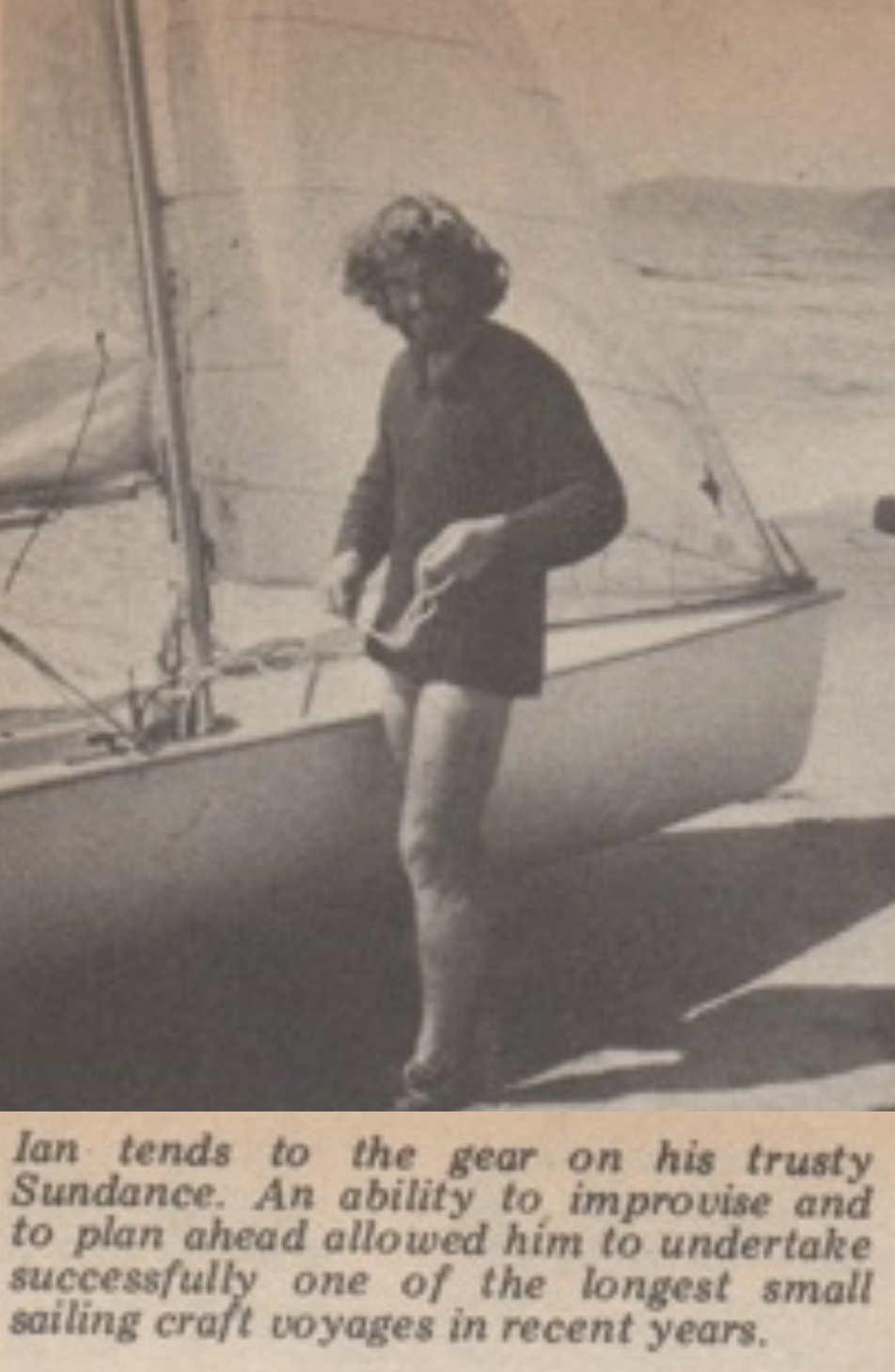
By Ian Marcovitch - Scarborough to Cairns
We were in Queensland, though I often thought we’d never get there as we’d lunged in the dark toward Tweed Heads. The next main objective was to get to the safer, more sheltered waters of the reef — somewhere north of Rockhampton.
During my stay in Brisbane the wind kept blowing from the south at 25–30 knots. It was provident that I had things to do, and didn’t have to wait it out unoccupied. When I left on Saturday, May 20, I rigged Sundance with two jibs — one in place of the main in case the wind should reappear. The wind didn’t blow, of course, but it was an interesting experiment, and even with such reduced sail we still made Mooloolaba.
The surf was rather small at Noosa Heads so I took Sundance in through the surf to the river mouth, and then back out again. That little detour completed there was plenty of daylight left, so we kept going to Double Island Point.
The colored sands are quite beautiful as they stand dramatically above a thin yellow stripe of beach. Miles and miles of sailing on the edge of an artist’s huge ochre palette — quite a sight until the sombre tones of late afternoon told me that black was soon to be the color of our sailing.
It was very dark as we approached Double Island Point lighthouse. The delightful swell upon which we’d gaily surfed now rebelled against us, rebounding off the steep rock point and slapping at us like hands at volleyball.
The swells diminished as we worked round the point heading for a sheltered beach. Next morning I found a cat and a tri moored together nearby. Over a mug of coffee aboard the cat, Windrose, Bill told me that they would be sailing the Tin Can Bay bar at high tide. He had crossed this bar before, and I was happy to be able to tag along.
Tin Can Bar is a series of bars that extend about four miles out into Wide Bay. It was reassuring that Bill had done this crossing before and he was able to set me on a compass bearing as we approached the “Fisherman’s Gutter”, a side passage shoreward of the main bars. Being quicker than the cat I found myself leading the way.
With a mile to go the regular swells became erratic — sometimes peaking — sometimes tottering into a collapse of white rubble. Windrose wasn’t far astern; he was still coming; so I kept going. The water was a luminous green, the sky grey, and the land was a drab nonentity. The sea’s luminosity created a nether-world atmosphere suspending us between the sea and the sky like a ball at the top of its flight.
A moment, a half mile of relief, then again the cloth of the sea flapped and rent about the mouth of Tin Can Bay. All around me the sea fabric was in tatters and only Windrose following pushed me forward to sew a course together from the untorn pieces of green. I dallied. I could see no way, but it was too late to stop. A lull, a space between sets, I sheeted her in and pressed Sundance for all speed. With a final flick we were shaken loose of the cauldron into the grey waters of Tin Can Bay. The sky rained down — we were through.
I don’t want it to appear that I am in the habit of taking big risks. I never planned to go out in big seas or high winds, but often the wind and sea becomes more than you would desire. At such times your experience, and the capability of the boat must be beyond doubt. But also at such times, fear will be a component, and a good component, for if it is used properly a bit of fear will give anybody the ability to overcome any reasonable challenge.
A good example of the use of fear came on the following day. It had been pleasant running easily before a moderate southerly breeze, when about three in the afternoon the wind changed to the south east bringing with it a heavy swell as well as an extra 10 knots. In a matter of minutes we were scorching along, but fear intervened and forced me to evaluate the situation. I realised that but for the swell I could have sailed safely enough and very quickly. The swell however introduced a dangerous component especially as it ran so short and steep - we could pitch-pole!
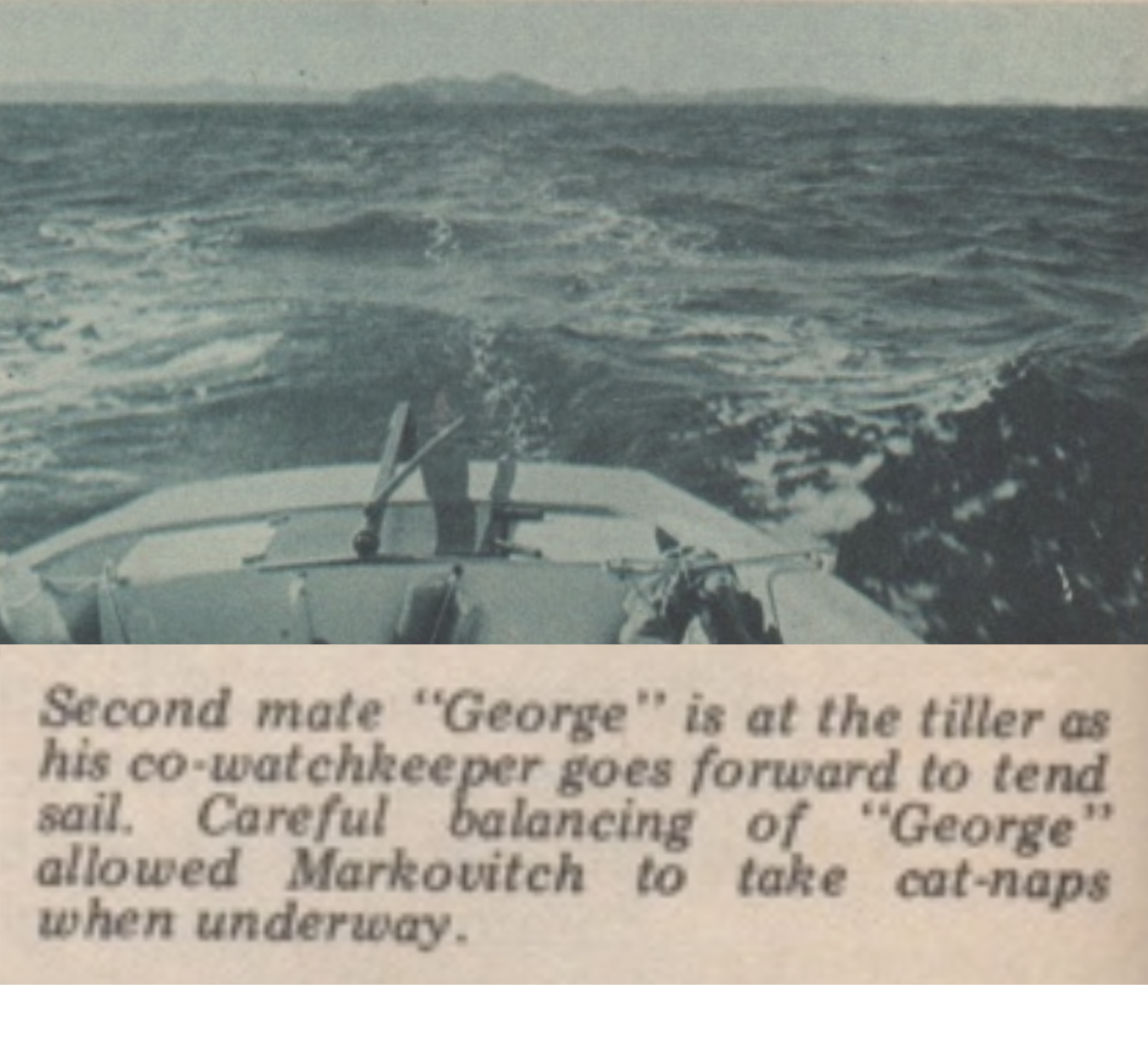
Within minutes of the wind change I had "George" hold Sundance to the wind while I dropped the main. We had shipped some water but the venturi disposed of it, and we sailed along with a good chance of reaching the Burnett River in a couple of hours.
This action removed the fear from our situation and therefore probably my concentration. Then a sudden sea tripped us over. I had no problem getting Sundance back on her feet, but I was horrified to find my hand empty as I grasped for the tiller. It took moments for the reality to hit me, there was no rudder! Why I don't know, if I'd forgotten one locking pin the other flip-lock should have held. Anyhow the rudder was gone.
This new situation had little fear in it for me - annoyance, yes, fear, no! I tried to hold Sundance on course by constant varying of the angle of the centreboard, but we were as controllable as was the sea. We had to have a rudder. A paddle wasn't big enough, and so I had to use a special formula vis: hatch-cover plus spinnaker-pole equals rudder! The bolt in the centre of the hatch-cover simply fitted through the parrot beak on the pole. I then lashed the pole to the spinnaker fair lead. It was successful, but I had to work hard. After a little while with the sun about to set I decided to eat while it was light. This would give me a bit of strength for the long haul ahead. As the night wore on the breeze eased taking the bite out of the chop.
Hours later the Burnett River channel lights led us in, and though the wind swung ahead of us I was able to keep Sundance between the markers as we moved upstream. By the time we reached the bulk sugar terminal we were trying to beat to windward. At least we went through the usual tacking manoeuvres, but it was the incoming tide which provided the progress. We beached at the first opportunity. My sleeping bag was quite damp after the swim, and so the Space Blanket again proved its worth by keeping me warm for the night.
Northern friendliness was much in evidence when the man from whom I bought the plywood for my rudder gave me the use of his slipway's building facilities. Though the new rudder didn't take long to build, I spent a full week in Bundaberg making friends with cruising crews and also some of the locals.
Incredible as it may seem I don't feel lonely while out sailing. It was only when I came to shore that loneliness would creep in, and this was especially true after a week in Bundaberg, despite the nice people I had met. The company of larger yachts only impressed on me how SINGLE handed I was, even at anchor. Somehow we never got round to congregating aboard my Sundance for one of those little harbour parties. After a week I sought the embracing company of the sea.
It was good to be back. "George" seemed to get on very well with the new rudder, and Sundance now sailed herself quite often. Despite his prowess, I had to warn "George" to be more watchful after we nearly ran down a large turtle, barnacles and all.
The sail from Gladstone to Keppel Island tested the new rudder. Firstly we knocked it over rocks, and then we surfed the swells around Cape Capricorn.
The simple course I chose to get out of Curtis Harbour took me between Curtis and a smaller island. With a gentle following breeze and ebb tide, we were leaving in fine style until the water suddenly became turbulent. Ahead it was boiling! Helplessly we were dragged over a tidal rapids. The centreboard and then the rudder thumped on rocks as we fell over the edge of Curtis Harbor. It was only about nine inches (228 mm) down to the sea from the waters of the harbor but the sudden crisis left me panting for breath as if I had just tumbled over Niagara Falls. The rudder was okay but it had lost a bit of varnish.
As for surfing swells there is nothing I like more than pumping the mainsail, moving my weight forward only to slide back as we romp down, sails trimmed, weight out, steering across the face of a wave. The rudder not only stood up admirably to my constant demands upon it, but also because of its heavier section and slightly larger size it gave me more positive control without cavitation.
Then, a couple of days later, the steering ability of "George" on the new rudder was proved beyond doubt. We were heading for the Percy Islands and the sun set as we sat stranded in doldrums miles from land. After sunset a NE breeze came in very steadily at six or seven knots, and I rigged up "George" to hold course while I ate tea. But it soon became apparent that Sundance was sailing herself better in the conditions than I could hope to do. I took this opportunity to take cat-naps.
Dawn whispered and blossomed during the early hours into a feather-petalled orange-pink sky. The Percy Islands were now not so far away though the wind was now heading us. We worked to windward over and through incredible seascapes near the islands.
The clear green of the waters would lap easily in the sun until a hidden current rolled up from some purple reef, or the lime green over a sand-bar would contrast the bright orange streaks of plankton riding the sea.
I’d been told to make a special effort to visit Percy Island while I was in Sydney, now here we were!
The visitor’s shed with its sign in bold letters proclaiming TELEPHONE grabbed my immediate attention as I approached the beach. Inside I found a note which said, “Hey, the telephone doesn’t work.” But that wasn’t the only note – the shed was lined several layers deep with placards, name plates, the mementos of various yachtsmen who for years had visited. First duty was to sign the large visitors’ book – already half full.
Andy Martin came in from his workboat and invited me to the homestead. I spent four days with Andy, Lil, Hilda, Bob, and John. I hadn't planned to stopover, but such was the hospitality and style of Percy Island, to which many yachtsmen can testify.
I also met Ted and Marg Meyer who showed me over Pine Island lighthouse adjacent to Percy Island.
Someone should write a book about these island outposts which seem to be so cut off from the world. They are vital worlds of their own as well as being more part of the wider world than an outsider could visualise. Andy Martin sees more of the world at Percy Island in his visitors, than people who are insulated from personal contact by the isolation of urban existence. I left Percy Island knowing that I would always be welcome there.
After Mackay we began navigating the famous Whitsunday Passage. First port of call was Brampton Island followed by Lindeman, Daydream, and South Molle Islands. Each island had its own character, but they were all pleasantly similar. The area is very beautiful, and with sheltered beaches and bays it makes an ideal cruising ground.
We'd just come through the Gloucester Passage on our way to Bowen when the wind took a rest. Most of the time I was too busy sailing to worry about fishing, but here was a golden opportunity. For the third time on the voyage I rigged up a lure to troll astern. The first time I trolled for a fish I caught one but he got away with my lure. The second strike twisted my line so badly it was useless. Third time lucky? The breeze came in from the NE and as Sundance lifted her skirts to plane I forgot all about my fishing. A chance glance astern, third time lucky a mackerel!
After talking to family acquaintances at Rose Bay near Bowen I returned to the beach and soon had my fish cooking in the embers. A young man emerged from the dark into the firelit circle of my camp and said, "I saw the fire and the skiff and wondered "This couldn't be some mad fool sailing around Australia or something, camping at Rose Bay! Well, are you?"
"Probably," I said.
"What, sailing around Australia?" he asked.
"No, a mad fool sailing to Cairns from Sydney," I replied.
"Really, well whatever you are you might like to come over to my place when you have finished tea and have some coffee," he said.
Peter's wife, Heidi, epitomised the yachting wife. Interested and understanding, but hardly in the race to keep up, once a pair of diehards warmed up to their favorite topic.
Late night, late start, and the wind was kind to us. "George" had no trouble taking us toward Cape Upstart as I read the SEACRAFT magazines Pete had given me for kindling.
Barely 10 minutes after landing at Cape Upstart, Bill, a pensioner holidaying there, invited me to baked dinner and a mattress, as well as seeing to it that I met the "old people", Fred and Ruby Ward. Fred and Ruby had recently moved out there, and already had a visitors' book which I was delighted to sign. This warm reception was the last thing I expected as I sailed along the barren rock wall that is Cape Upstart.
We enjoyed following winds to Cape Bowling Green and then on through to Magnetic Island and Townsville. I had barely unrigged on the beach in Townsville when I was whisked away for a shower, lunch and tea. I would have been given bed and breakfast, but didn't want to leave Sundance unattended for the night. The best part of the escapade was being given a momentary share in the happiness of the Bates' family.
The breeze out of Townsville was quite gentle until we had cleared Magnetic Island. I was heading out to have a look at the Palm Island, and the freshening southerly breeze whipped up seas bigger than any I had experienced since the New South Wales coast. The excitement and tension of concentration soon took their toll and when at last we blasted around Palm Island, I was glad of the respite in its lee. Being an Aboriginal reserve, unauthorised entry was not permitted, so I cruised around looking for beaches on the other islands. Coral congested the approaches to all the beaches I looked at.
The chart indicated a sand beach on Fantome Island - and there was. As I rounded the northern tip of the island I saw the beach, and also to my surprise a church and some buildings. As we came in a man came down and told me that this was a leprosarium, that permission was required to land. While I waited he went off to check, then, on returning invited me ashore.
The man who lent me a hand to get Sundance up the steep beach, turned out to be Bishop Faulkner of Towns-ville, out here on a visit. I was made most welcome, and fed by the sisters as if I'd been a ship-wrecked invalid.
On my way to Dunk Island, I sailed past Richard Island but doubled back. Here I found a truly delightful hide-away, a genuine get-away-from-it-all holiday haven. Peace and natural beauty enveloped you as you strolled either the immaculate bush gardens, the virgin forest, or sloshed along the water's edge.
Then there were Bruce and Joanne on Tamarra Island, living and creating in wool, beauties which must in part have come from the paradisaic surroundings.
After this, Dunk Island itself was like a ferry to a yacht.
The prospect of the voyage ending made us want to dally, to do anything except admit that the trip was done.
So it was with mixed feelings I sent a telegram from Flying Fish Point to my parents who live in Kuranda, near Cairns, saying I'd arrive "sometime late in the afternoon of June 22'.
I worried during the night lest the breeze fail and I’d be overdue. So about 2 am the wait became too much and we pushed off into a night of dark swells.
The wind was strong and I could see the glow of squall clouds coming up from astern. My answer was to brace myself and with total concentration, run it out. Run we did – up and down the seas, phosphorescence flying, sailing rather by feel than sight.
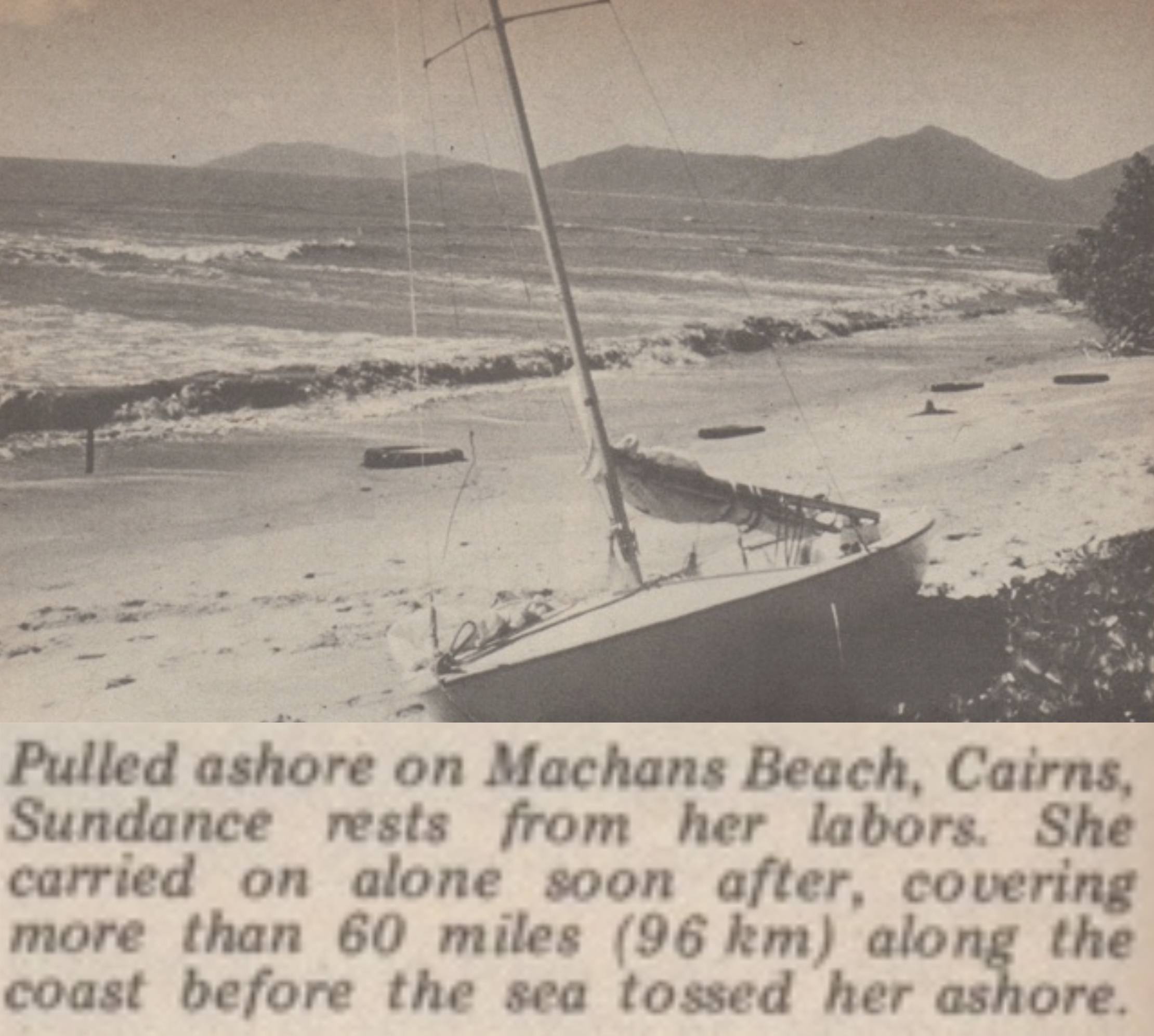
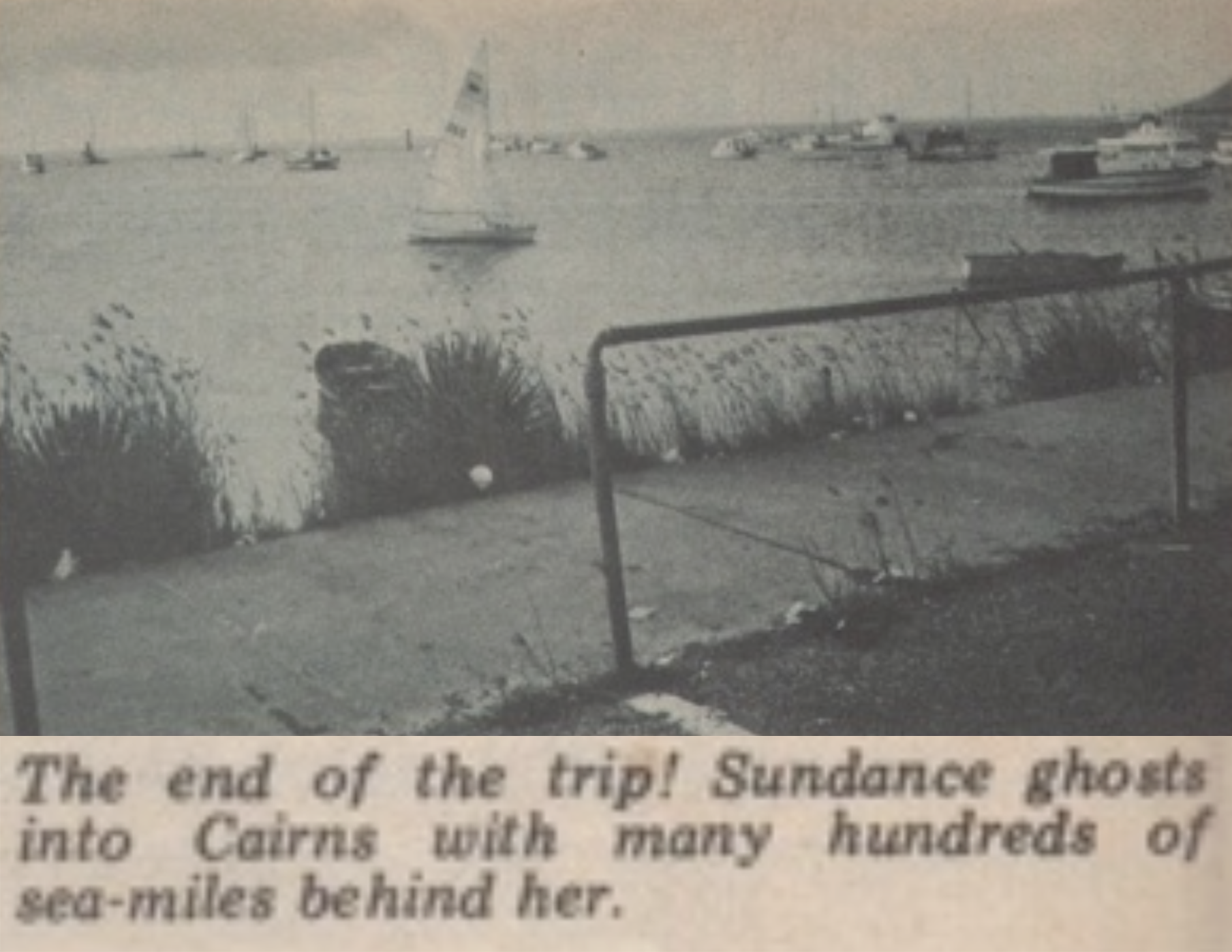
I enjoyed it immensely: it was a total effort with a total reward – safety, exhilaration, and the final fulfilment of the whole trip. Perhaps I was very foolish, but we beached safely at Machans Beach, Cairns in the morning. That was it – done, finished forever, but never to be forgotten.
I hitched home to Kuranda to find, as is typical of life in the north, my parents having lost track of time, weren’t expecting me until next day.
As for Sundance, I had underestimated how attached she had become to this trip. I shouldn’t really have been surprised when a few days later she quietly slipped her mooring in Cairns and continued her voyage north. Through some foul trick of wind or tide her adventure was cut short and she was washed up having covered only 60 miles (96 km).
Many Thanks to Ian Marcovitch and Redhead Sails for allowing us to republish this great adventure!