
PETREL’s Renovation
By Malcolm Lambe

I’d seen the bum of the boat sticking out from the shed a few houses up from the aptly-named Paradise Beach as the barge brought my mast in to Larry Eastwood’s wharf. I thought it an 8 metre at first – another Defiance. I’d never met the man. A mutual friend, Kelly Holder, who races a Couta Boat against Larry’s Couta had arranged for me to burn, sand and varnish my timber mast from my Laurent Giles classic on his wharf. A very clean newish wharf I might add. I remember thinking “Either I’m held in high esteem by this Larry character, he’s crazy or just very generous”. It was the latter of course. And yes he is a character. One of these guys that takes life by the scruff of the neck and gives it a bloody good shake. “Never give up” is his creed. Happens to be mine too – as “Her Indoors” often reminds me.
Lawrence “Larry” Eastwood is the younger brother of the Hollywood actor Clint Eastwood. No he’s not. I made that up. But he could be. Like I said – he’s a character. “You’ve got to ask yourself one question – Do I feel lucky?”
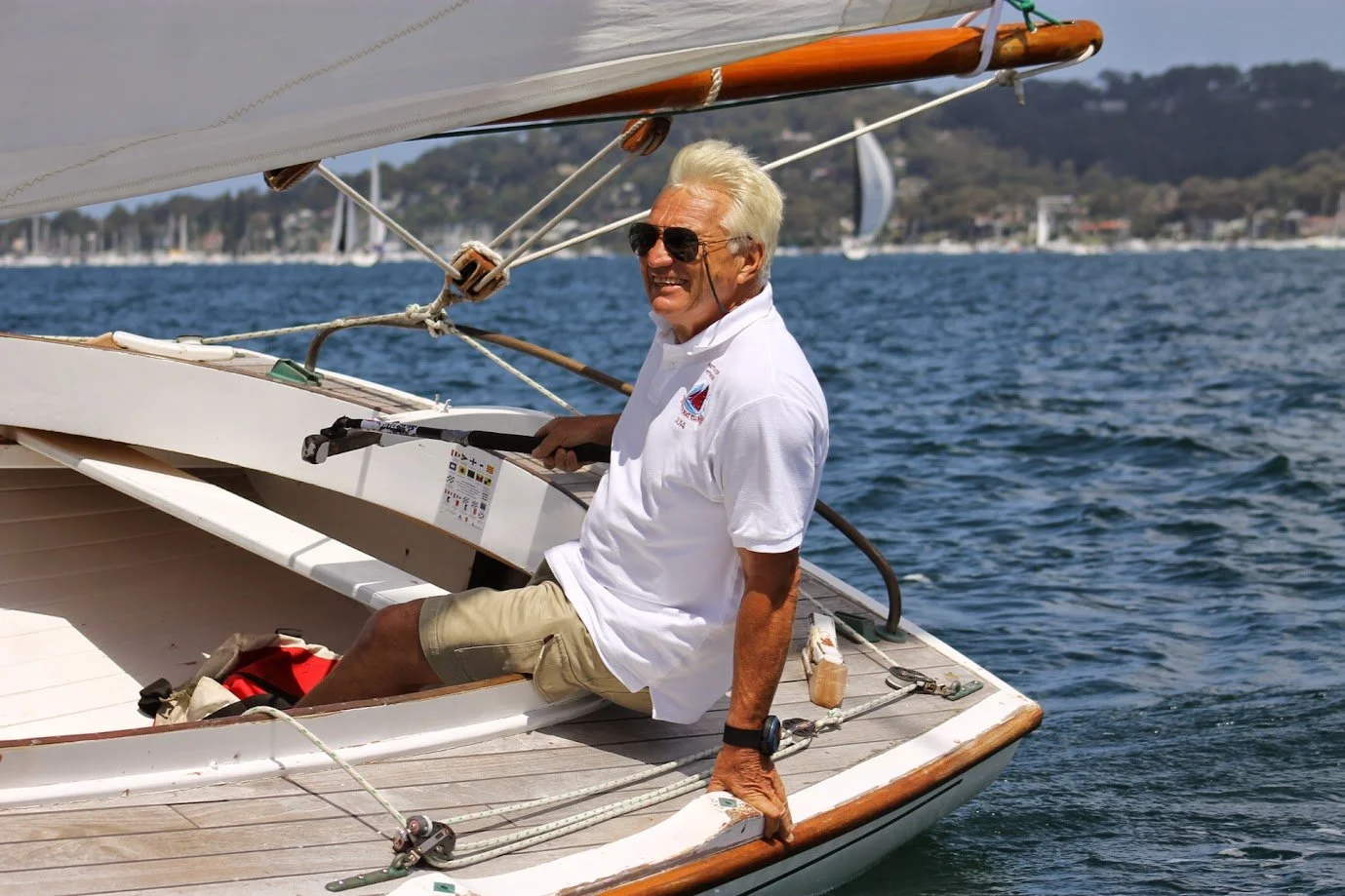
Larry Eastwood aboard SYLVIA on Pittwater- photo by AJ Guesdon
“I’m a big picture guy” Larry said to me once. Meaning he thinks big. And he’s certainly thinking big with this project as you’ll soon find out. I just Googled “Big picture guy” and got this –
Big Picture Thinkers often: Think strategically – focusing on the larger goals and overarching strategies and the future implications of their actions. Feel energised by possibilities and potential. See patterns in complex problems. Enthusiastically come up with new ideas and projects.
I get the feeling Mister Eastwood is constantly and enthusiastically coming up with new ideas and projects. His head would be bursting with ideas. More about his latest project in a minute. First some background. As a schoolboy in the U.K. , Eastwood had a part-time gig with a wine merchant so he got to sample some of the world’s best wines and even visit chateaux and vineyards in France. What that has to do with yachting I don’t know. But I found it interesting. Maybe he could have been a wine producer. After he left school his father got him a job in an architect’s office in London. Sitting in an attic room drafting all day wasn’t that exciting for a young man going places so he joined a mate at Drama School and studied set and lighting design.
In his final year he got a letter from one of his ex-teachers, Richard Wherrett, who was in Australia to set up a theatre company with John Bell and Ken Horler. None of them were practical and they needed him.
So he hightailed it to Sydney and ended up in the surf at Whale Beach – not that far from where he lives now. “I was a ten pound Pom” he told me. I find that hard to believe. I don’t think he was being literal. I see him arriving with a crate of Margaux and a vintage Morgan sports car with a set of plans for a beach house in the boot. (These days he has an immaculate Austin Healey 3000 stashed under the house)
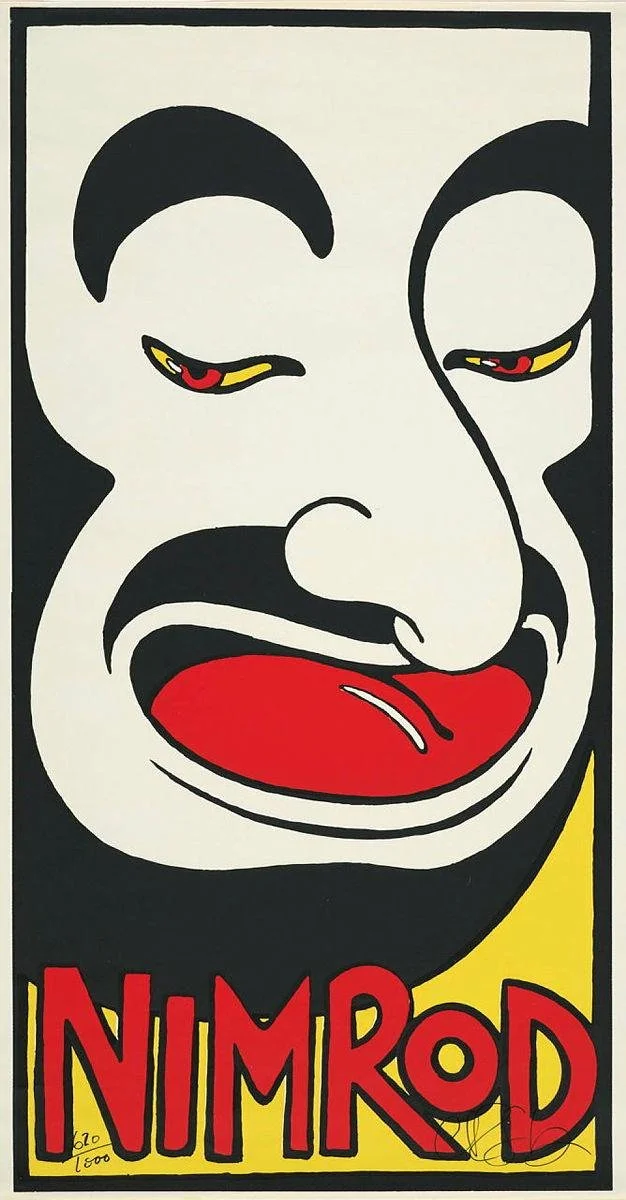
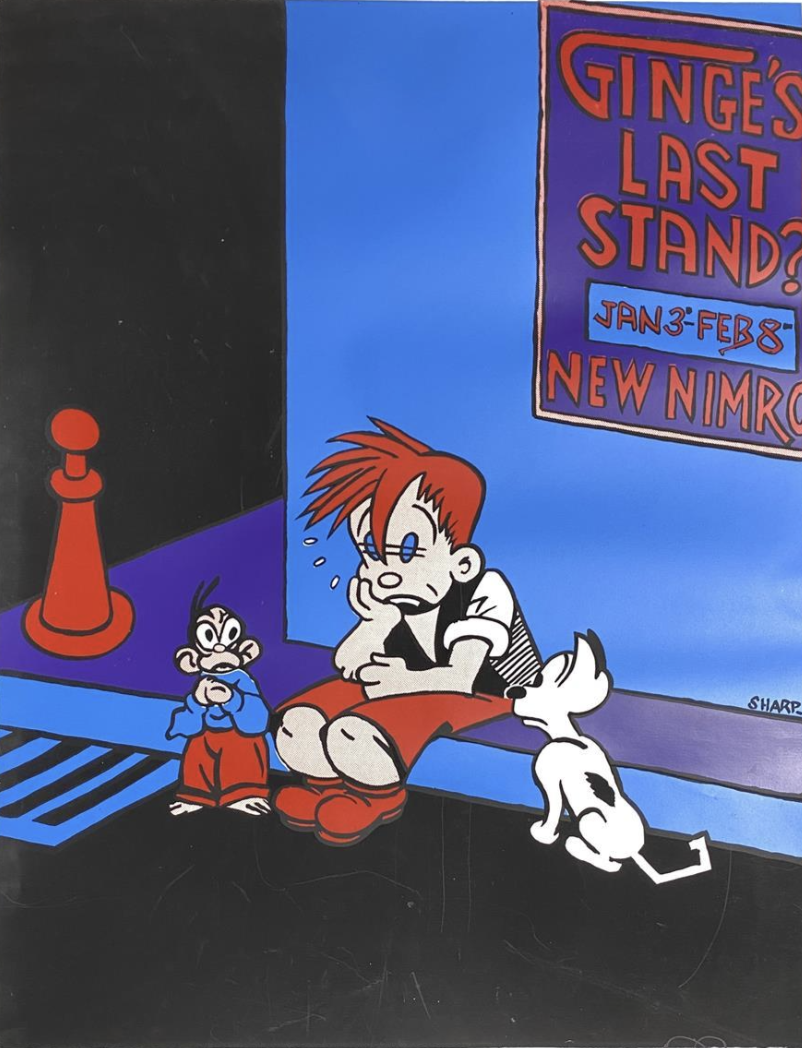
So...at 22 he arrived in Syd-den-knee in 1970 to become a co-founder of the Nimrod Theatre Company. (Remember those great posters that Martin Sharp did?)

Twenty years of set design and production management followed; Then thirty years as Art Director for film and television working on productions such as Newsfront, A Town Like Alice, Phar Lap, The Empty Beach and Crocodile Dundee II. Including a stint as Head of Art & Design at The Australian Film & television School.
David Stratton described him as “Australia’s most distinguished production designer”.
So how did he segue into boatbuilding? you ask. And become a ”building designer” a.k.a. architect along the way. He won the 2006 Pittwater Council’s “Urban Design” Award with one of the judges, Peter Stutchbury, commenting “Somebody is going to love this building a hundred years from now”.
Larry learnt to sail on a Uffa Fox designed dinghy. (Uffa Fox – father of the planing dinghy and raced a Dragon with the Duke of Edinburgh.) In Australia – after his career in Theatre and Film - Larry had several vessels before setting up a wooden boatbuilding school at Mona Vale with shipwrights Simon Sadubin and Ian Smith. Along the way he competed in nine Sydney-Hobarts.
And yes he’s eminently practical. 5O years of set design and hands-on building has left him in good stead for boatbuilding. I saw him turn a piece of Oregon into a shaped spreader for my mast. It was cut out on the band-saw...put through the thicknesser...shaped with a plane and router then finished with a sharp chisel. Took him 40 minutes.
You only have to look at the work he’s doing on PETREL – the 30 Linear in his shed – to realise he’s a true craftsman. Self-taught. I think Eastwood is one of these guys that no matter what they turn to they are going to excel at. Would you call that driven? Or just plain bloody clever and talented.
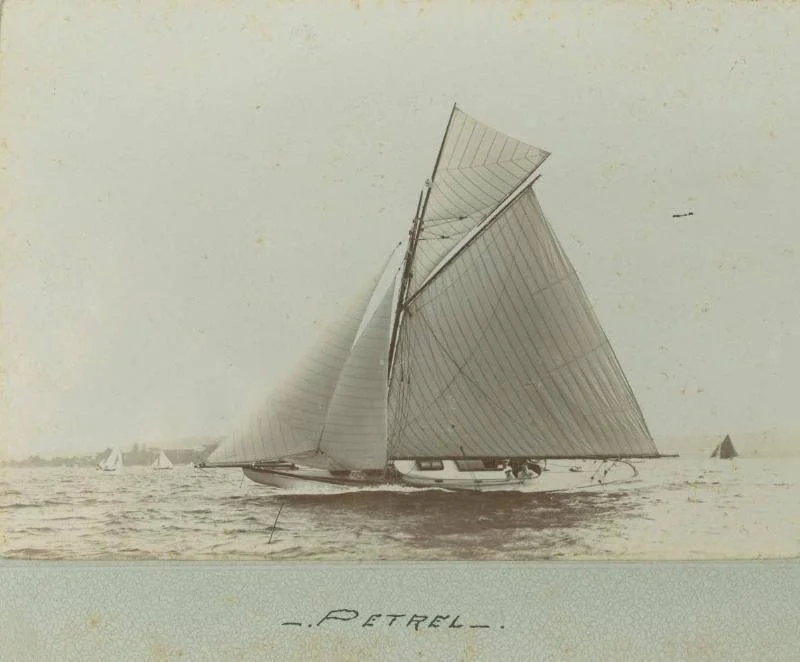
Anyway – the boat. PETREL is a 30ft Linear Rater designed by Arch Logan, and built in 1900 by the renowned Logan Brothers boatbuilders in Auckland, New Zealand. She is 40ft in length overall, 29ft on the waterline, with a 7.9 ft beam, and 5.6 draught. And is out of Kauri – Agathis australis.
The first thing I did after securing my mast on Larry’s wharf was to check out his project. I ran my hands over its flanks of kauri strips. I bet everyone does the same thing.
PETREL was built with two layers of Kauri, one diagonal and one fore and aft, with stringers and no ribs. Larry has added another diagonal layer of kauri and it will be finished in a further layer running fore and aft.
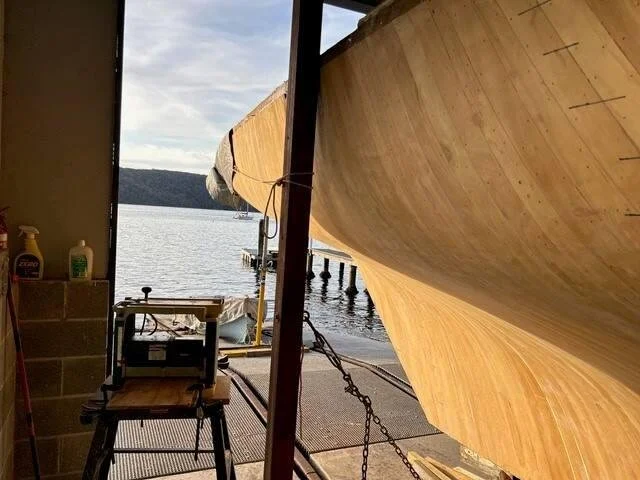
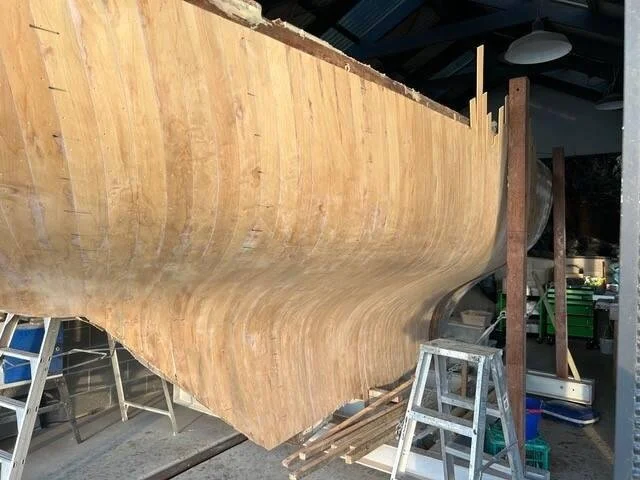
Actually the latest layer is not New Zealand kauri but Fiji kauri - which is very similar in appearance but lighter in weight. Very little New Zealand kauri is now sold. It is estimated that today, there is only 4 per cent of uncut forest left in small pockets in New Zealand.
The hull was sheathed in fibreglass at one stage of its 125 year life and when that was stripped away they saw that the fore and aft strips had been splined – leaving the hull quite fair and ready for the third layer – which it should have had anyway – like the other Logan Brothers Linears.
Before I climbed up to look inside the boat Larry had told me there were no ribs. There were laminated timber floors he’d made to replace the original Kiwi timber floors which were in a bad way. But no ribs – just stringers and the kauri sheathing to hold it in place.
So it’s a cold molded design, with a full keel and keel hung rudder (originally), and tiller steering. It was rigged as a gaff cutter - again originally.
You know...the technique of laminated hulls began in New Zealand in the late 1800s and builders there were, and continue to be, experts in the method.
They say that Auckland, in 1890 to 1910, had a group of highly skilled yacht builders and designers who still had access to stocks of superb-grade long lengths of Kauri.
Under the influence of Scottish immigrant Robert Logan Senior, these builders had developed a three-skin diagonal monocoque construction which was immensely strong. The hulls produced were extraordinarily long-lived, being highly resistant to rot and damage. Hulls of more than 100 years old are therefore unremarkable in New Zealand.
When Simon Sadubin found PETREL nine years ago in Berrys Bay, Sydney Harbour she was in a pretty shabby condition. First impressions were of a badly neglected boat under rotting make-do covers with resident nesting seagulls. The boat had undergone many alterations and additions over its 116 years. The original gaff rig had been changed to Bermudan. The floors were cracked and compromised with multiple fastenings. The interior was unfinished. The original coach house was changed. A new laid deck and heavy sponsons were built onto the boat.
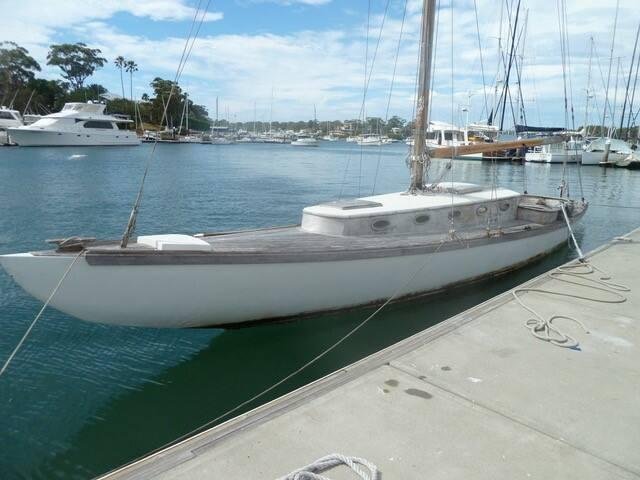
But it did have some pluses. At some stage the original laminated Kauri hull had been sheathed in fibreglass. The hull seemed fair and was not leaking. And a Volvo motor had been recently installed.
The 30 foot Linear Rating System was introduced in the 1890s to develop a rating for boats accounting for beam, sail area, and the mid-section profile. The intention of this rule was to return yachts to a more seaworthy manner. This rating system was eventually superseded by the metre boat system.

Many 30ft Linear Raters were built for Australian owners at the turn of the twentieth century. Only two other boats of the same class remain in Australia. They are, after all, now 125 years old.
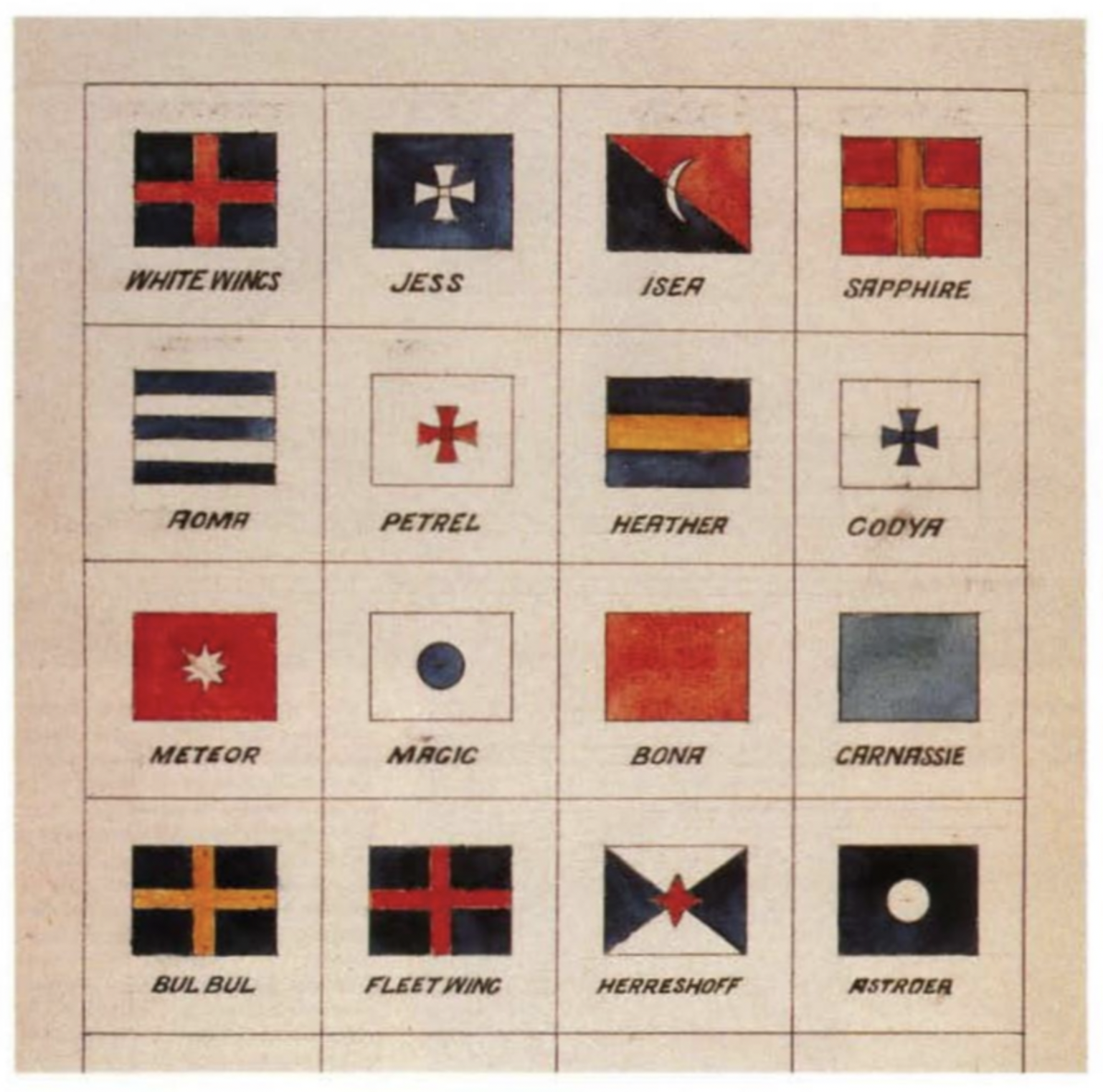
30ft Linear Raters - exported Auckland-built yachts - dominated racing in their class for several years at the turn of the century. Not just dominated – they blew the competition away.
PETREL was an outstanding example of this brief trade, closed only when the new Australian Commonwealth Government put punishing tariffs on imported yachts after 1901.
“Tariffs” you say? Hmmm.
Logan Brothers built Petrel for Sydney Mackenzie Dempster – a prominent Eastern Suburbs real estate agent and member of the Royal Prince Alfred Yacht Club (RPAYC) at Pittwater. The Petrel Cup is on display there.
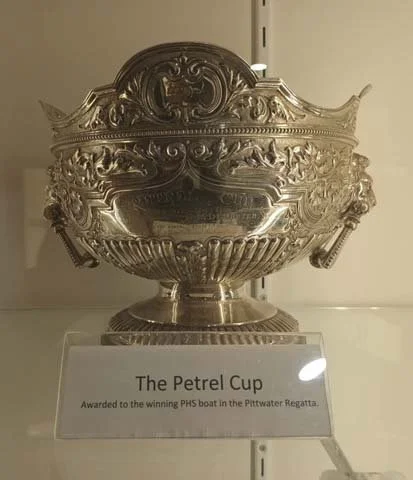
Dempster had a high level of success racing PETREL on Sydney Harbour and in 1905 became Commodore of RPAYC and won the club’s Championship that year and again the following year with PETREL now regarded as an “8 Metre” under the new Metre Rule.
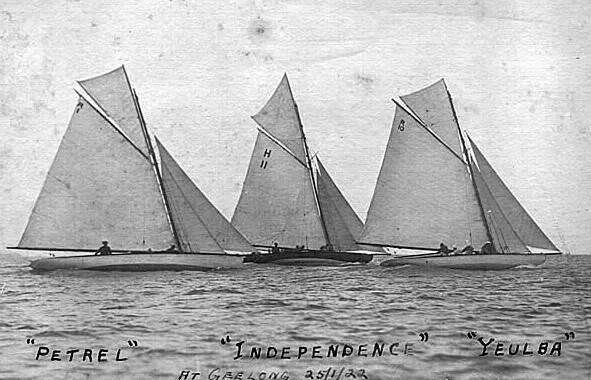
By 1927 PETREL had won, under various owners, 165 Firsts in Sydney, Hobart and Melbourne waters. In 1934 she was “modernised” with a raised sheerline, Marconi rig and different coachhouse.
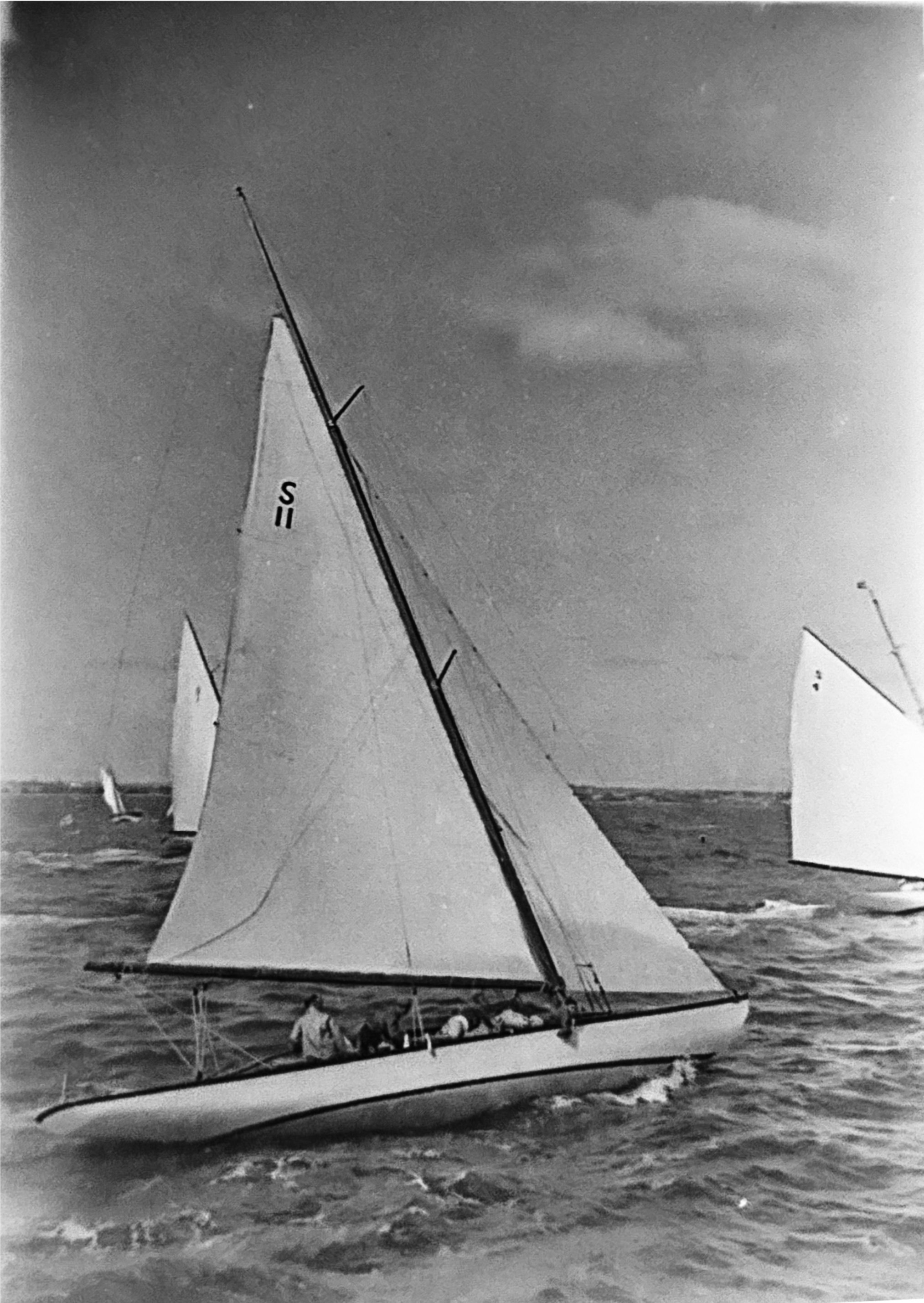
In her postwar years PETREL was the crack boat of the Royal Geelong Yacht Club. Her later years are somewhat obscure until Simon Sadubin and Larry Eastwood found her languishing in Berrys Bay.
BTW...”The Australian Star” of June 12th 1903 carried this story –
“On Tuesday evening last, at a dinner tendered to Mr Syd Dempster, owner of the yacht Petrel, by his cruising and racing crews, he was presented with a stuffed petrel nicely mounted on a stand. A petrel it will be remembered, alighted on the yacht’s stern during an ocean race some months ago, which the yacht won after a tedious contest lasting until midnight. It refused to move during the hurry and bustle of the crew in setting extra sails etc. and was put in the cabin when the yacht was moored that night and the door was left open, so that it might escape. The petrel never left the yacht, but sickened and died and this was the same seabird which the crew had stuffed and prepared for presentation to Mr Dempster.”
I wonder what happened to that poor old stuffed petrel?
So what’s the plan for PETREL? Current custodian Larry Eastwood writes –
“PETREL was lifted at RPAYC and the lead keel and motor removed. Having stripped the hull inside and out, Simon Sadubin and I reviewed the condition of the bare hull. The removal of the fibreglass revealed that the outer skin of the Kauri hull had been splined. This had done much to keep the hull in shape. The general condition of the two kauri skins was good. However there were a number of of areas where additions had been where the kauri was rotten. There were also splits and bows as well as a collision repair that was suspect.
In 1913 she went ashore at Bradley's Head and was badly damaged. Then in 1934 she was rebuilt after a collision with TE UIRA. Her topsides were raised 102 mm and her beam increased by the same amount.
The condition of the floors was not good. Many had multiple fastenings, were split and had some rot. All floors would need to be replaced. However, luckily the stringers and fastenings were good.
The big question was what to do with the basic 2 kauri skin hull. Given that the fibreglass sheathing was not going to be replaced as a structural element, it was thought that the best resolve to take the hull into another 100 years was to add the missing 3rd skin – most Logan yachts were built with three skins – two diagonal and one fore and aft. PETREL was built with just two skins.
The proposal was to laminate/epoxy glue a new ¼” diagonal skin over the exterior 5/8” planking. A further ¼” laminate was to be epoxy-glued in a fore and aft direction to replicate the original planking. The epoxy glue strips were fastened with Polymer nails. These are inert and don’t need to be removed.
The original gaff rig and deck layout is to be restored. We still have a long way to go.
The Plan is to see all three of the remaining 30' Linear Rater yachts – PETREL, CULWULLA and AOMA restored to their 1900 configuration and to race against each other on Sydney Harbour and Pittwater to once again contest for the famous trophies of the era. To do this we need to create a Trust or a Syndicate or Crowdfunding or attract an Angel Investor... or something... to finance the restoration of the three vessels. I’m open to all suggestions. These boats are too good to be left to rot away.”
A Big Picture indeed but wouldn’t it be fabulous to see three of these Logan Brothers 30 foot Linear Raters racing against each other again.
BTW if you’re an old fart like me you may remember WAITANGI on Pittwater. Owned by Denis and Jann Pilkington it was in survey and used as a charter boat – including as a floating hearse taking her passengers out to sea for their final sail. She’s a Logan-built boat built using the same frameless three directional kauri timber construction as PETREL. WAITANGI was launched in 1894 as a gaff rigged cutter and was the last major yacht built by Robert LoganSnr. Still afloat and fully restored back in New Zealand.