
Rethinking the Wreck
The International Journal of Maritime History may not be on your weekly reading list, but its a serious, fully-refereed, quarterly publication which addresses the maritime dimensions of economic, social, cultural, and environmental history.

The remains ofThe BATAVIA on display at the Western Australian Maritime Museum in Fremantle.
The Journal has just published an article by a Dutchman called Jaco Koehler which revisits the story of the Wreck of the Batavia in Western Australia.
The accepted thinking to date is well expressed HERE on the National Museum of Australia’s website. In summary it posits that an “evil” man took advantage of a shipwreck to lead a mutiny that caused the death of more than 100 men, women and children. The claim is that the tragedy was a mix of megalomania, ideological extremism and opportunistic cruelty — all under the leadership of a charismatic but dangerous individual Jeronimus Cornelisz in an isolated and lawless environment.
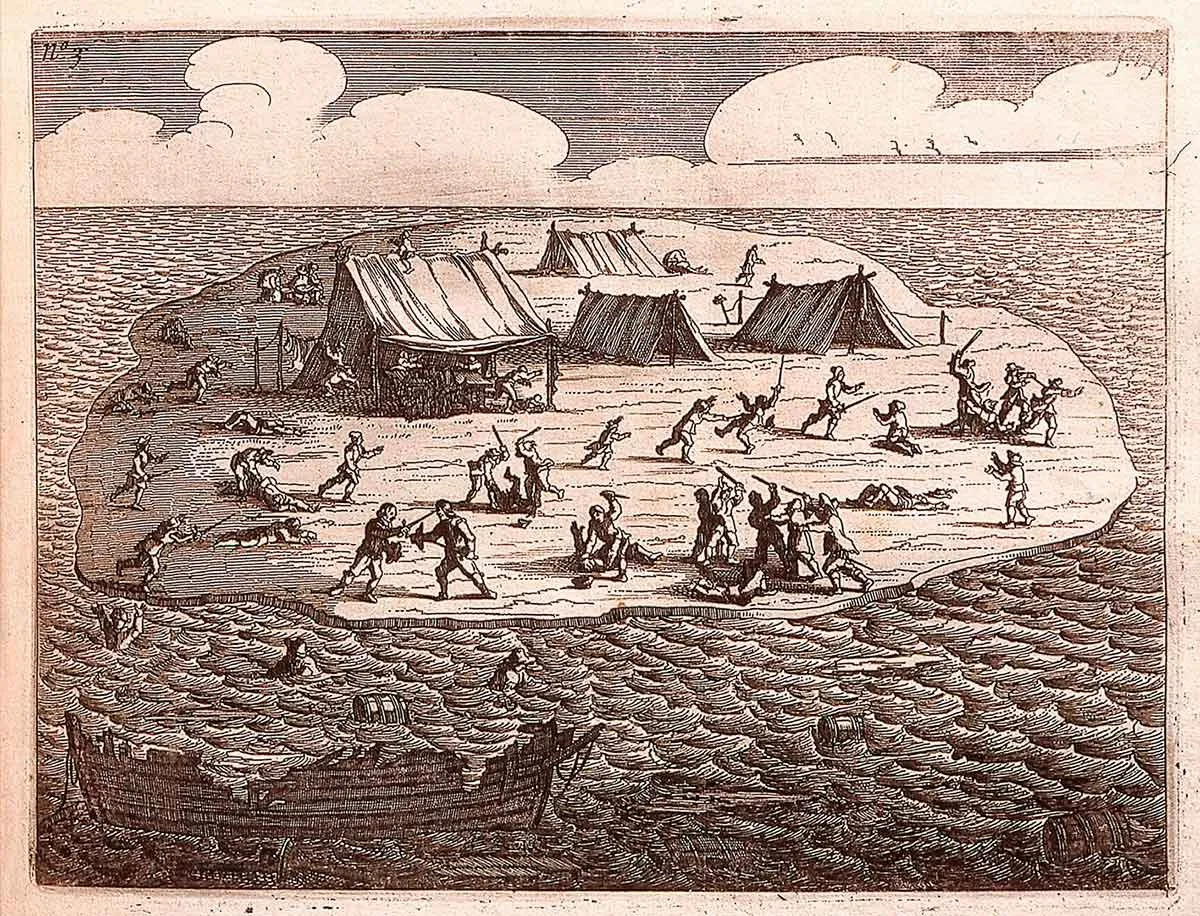
Engraving of Beacon Island from the Unlucky Voyage of the Ship Batavia, a book published in 1647, based on Pelsaert’s journal. Western Australian Museum
Jaco Koehler in his article puts a different slant on the story.
On 4 June 1629, the Batavia was wrecked at the Houtman Abrolhos. After the shipwreck, more than 100 survivors were murdered. The senior merchant Francisco Pelsaert prosecuted the murderers and presented evidence that the murders were planned before the shipwreck. In this article, the trial against the murderers is re-examined using a scenario approach, which provides a framework for rational thinking about evidence and proof in a criminal case. Based on insights from this approach and findings on the impact of waterboarding, the reader learns that another scenario provides a better explanation for what happened. In that scenario, there was no premeditated mutiny. Instead, famine and water scarcity served as catalysts for mass murder. The collapse of existing forms of authority and social organization allowed a group of survivors to seize power and start a massacre. In the final section of the article, the potential of the scenario approach for analysing historical trial records is discussed.
“It is remarkable that an unlikely story about a mad heretic plotting a massacre has been repeated uncritically for almost 400 years,” Koehler says. His alternative scenario describes “extreme violence driven by famine”. There were too many people and not enough food. There was a “power vacuum”. Some formed a gang, thieving food, intimidating survivors and raping women. Eventually people were willing to kill to survive, he writes.
And since then, confirmation bias – “the tendency to favour evidence that supports existing beliefs, while paying little attention to evidence that is inconsistent with those beliefs” – may have played a role in the enduring belief in Pelsaert’s story, Koehler continues.
Read Jaco Koehler full article HERE but be warned its expensive!
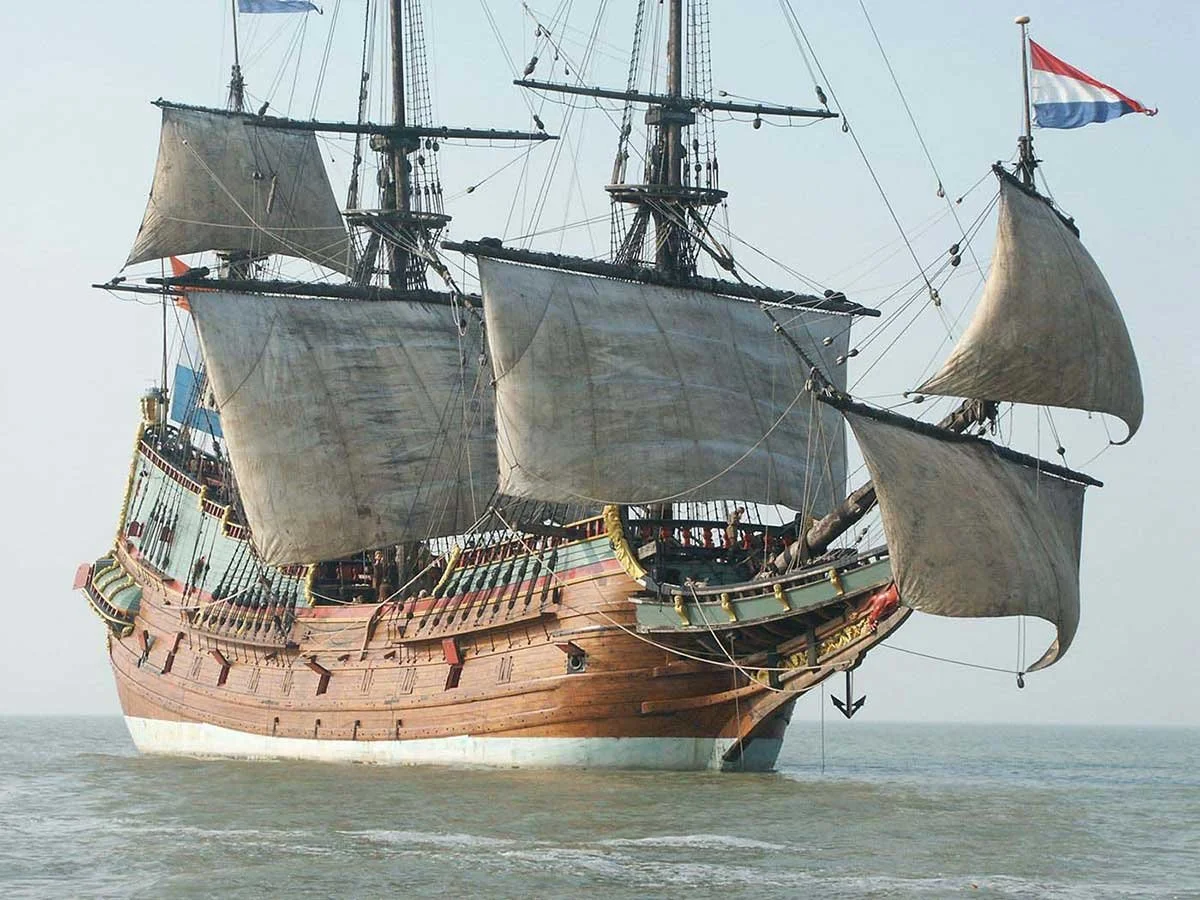
The BATAVIA replica
As a footnote from The FreeMantle Shipping News
There is a replica of the BATAVIA languishing at Leystad in The Netherlands. Her topmasts have not been stepped for years. Willem Vos, the great shipwright who crafted the magnificent vessel, is at his wit’s end and turning the ship into a seabird habitat has been talked about. The challenge of raising money to build a replica ship is minor compared with the cost of keeping a ship afloat, but the Batavia Replica deserves a better fate.
There is an opportunity to give the Batavia Replica a second life in Western Australia, particularly as the 400th anniversary of Batavia running aground on the Abrolhos Islands few hours before dawn on 4 June 1629 is now only four years away.
It is time that Western Australia grabbed onto the Batavia story as its own.