
Sundance to Cairns - Part I
(Many Thanks to Malcolm Lambe for alerting us to this story)
Ian Marcovitch, the author of this three part article which first appeared in SEACRAFT Magazine 52 years ago, has kindly given us permission to reproduce it. Ian comments…
“I used to teach beginners how to sail on Pittwater north of Sydney in the then new Corsair dinghy designed by the famous Alan Payne. This boat loaded with raw beginners would absorb totally incompetent handling and come up for more. After one forgettable session I found my self thinking, wow you could sail anywhere in this boat, and it would look after you. Eight years later I took the opportunity to sail a corsair dinghy named Sundance North from Sydney.”
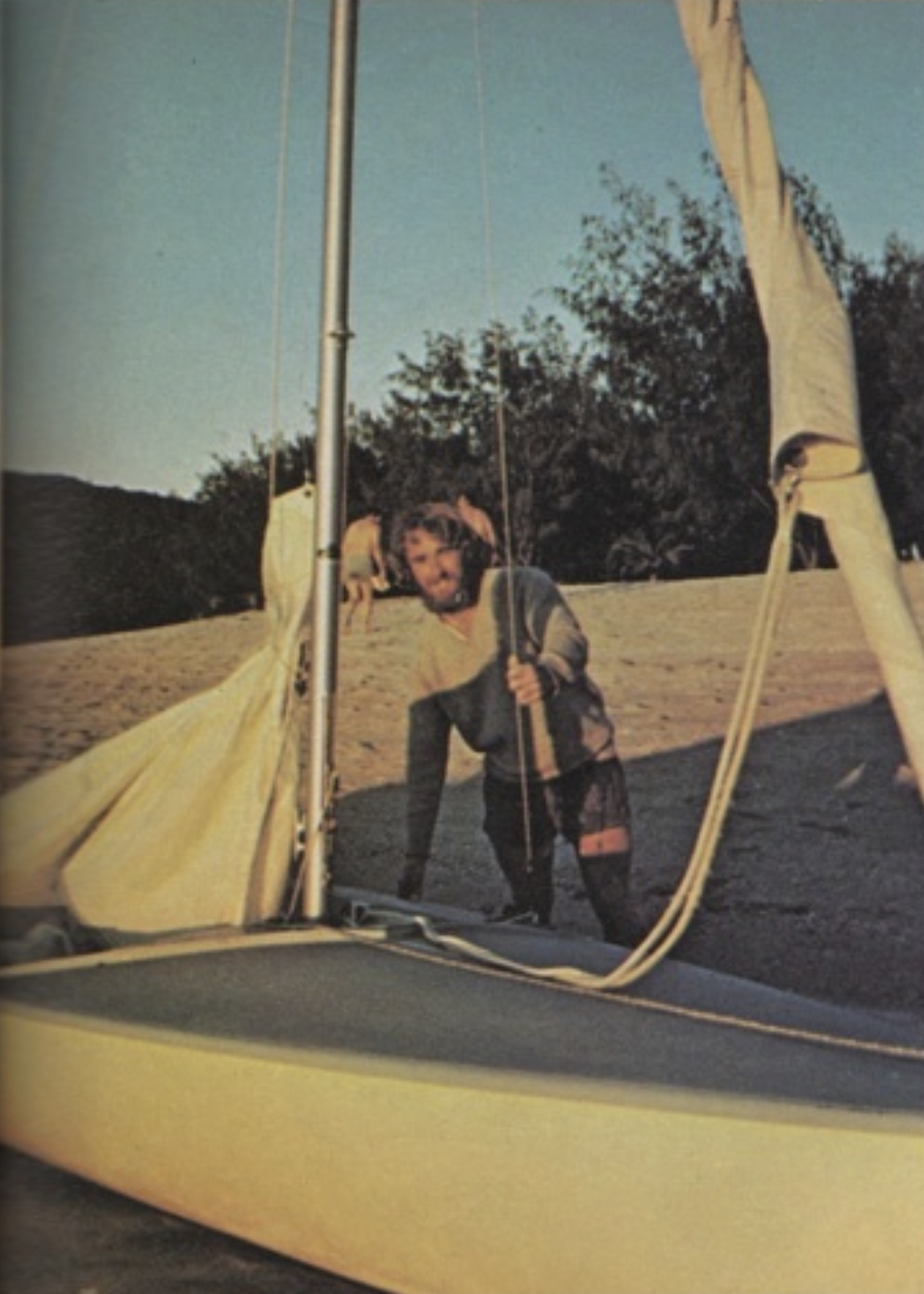
It’s an extraordinary story that should remind us that in this hi-tech world, you don’t need a lot of money or complex equipment to have your own life defining adventure! Scans of the original layout are available on Ian’s website www.redheadsails.com
Part One-Pittwater to Crowdy Head
Ian Marcovitch is a 24-year-old sailing instructor (in 1973) who sailed a fibreglass Corsair from Sydney to Cairns. The engineless, centre-board 16 footer (4.8 m) could be the smallest and most unlikely craft to make the trip. He tells the story.
My confident air often caused bouts of lip biting or nail chewing while my inquisitors looked again at the sleek form of my faithful boat, Sundance. Sometimes their apprehension was infectious, and I too began to wonder if perhaps the present reality was only a dream. Then perhaps they’d see the compass nestling in its plastic cone (ex-ice-cream) and they’d ask, “You don’t go out of sight of land do you?”
— that panic returning.
“No, not often,” I’d reply; and then, answering the question in their stare, “the compass helps me fix my course on the charts, or when I’m in rain, or caught at night.”
“Ah, I thought— I thought you said you pulled into shore for the night,” they’d challenge me.
“Well, sometimes I have to keep sailing. I see a protected beach or bay. It’s hard enough, torch in hand, trying to see if the shore of a mill pond is safe, without shooting waves at night.”
By this time, my mental energy would be draining and fortunately so too would be the curiosity of my acquaintance. My answers had come quickly with practice and their minds now numbly accepted something they could never understand.
Other people accepted me on sight, and after a few interested inquiries would invite me home for a shower and meal. One of the most rewarding parts of the trip was the hospitality and generosity of so many people all along the coast — those showers and meals meant much to me.
The reason for my trip was simply a consuming desire to sail day in and day out. To do this I needed a boat which incorporated safety, strength, and performance. For safety, stability and full flotation were imperative. The boat must be strong enough to withstand not only the buffeting of the seas, but the hazards of uncertain landings. I was not looking for race-winning performance, but good “sailability” under a wide range of conditions, bearing in mind that I would be alone. A swinging oarboard and rudder blade was essential for beaching and for solo operation.
The only boat in my experience which filled all these requirements was the de Havilland Corsair. At 16 feet (4.8 m) its large size worried me a little but I needed the room for stowage and for an anti-claustrophobic sense of space. Size also meant weight for punching into head winds and seas — and could also mean too much boat for one man to handle at sea and on land.
This was not the case. At sea I perfected the art of feathering to windward, and on land a boat roller converted Sundance into rolling stock. It wasn’t easy — I didn’t expect it to be, though I found that I could cope more than adequately with any situation which arose.
To increase stowage capacity, and to balance the weight in the boat, I built a water-resistant locker to fit in the stern across the side seats. In this I stowed food, tools, camera, and charts. Up forward I fitted hatch covers to enclose sleeping bag, clothes, water bottles, utensils and other items. Though neither the aft nor forward spaces were completely waterproof, items such as the camera were kept dry through all mishaps by double plastic bags.
THE TYRANNY OF THE TILLER!
To combat this I fastened a line between the spinnaker fairleads at the stern. This line, looped around the tiller and tensioned by a slip knot was “George,” my assistant helmsman. “George” was indispensable to me on the spinnaker, or in a squall while I was tending the main down. Because of his limited intelligence however, I wore a life-line, lest in blind obedience “he” sailed Sundance away without me.
The day came to leave from Clareville Beach on Pittwater. No sooner had I waved goodbye to my friends than doubts gnawed at my stomach, taking large bites whenever a gust heeled us over. “Just a trial short hop to West Head would be a good idea,” I thought.
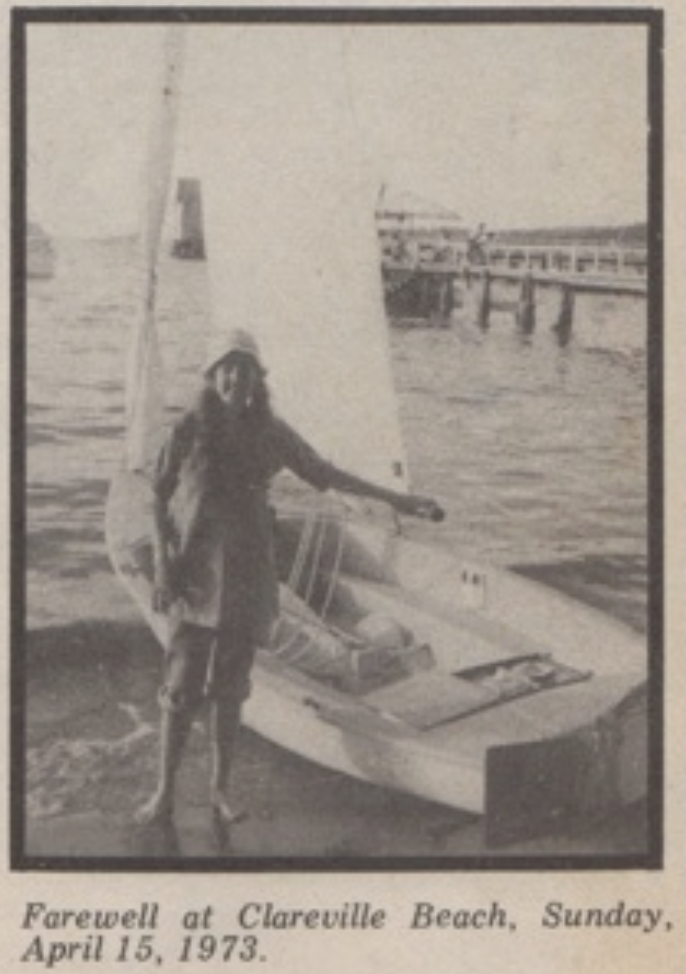
This was a good idea as it gave me a chance to rearrange everything properly, including my mental possessions, which many thought I had lost long before.
I had notified the police of my intended journey, and given details of the boat and the name and address of my contact on shore before leaving.
The next day, Monday April 16, saw Sundance and I heading off in earnest, my eye and jaw set for any situation, Sundance eager for a bone in her teeth. Drifting wasn’t quite what we had in mind, but drift we did. But there was a great sense of achievement as we landed at Terrigal late that afternoon — I’d covered an acceptable part of the trip.
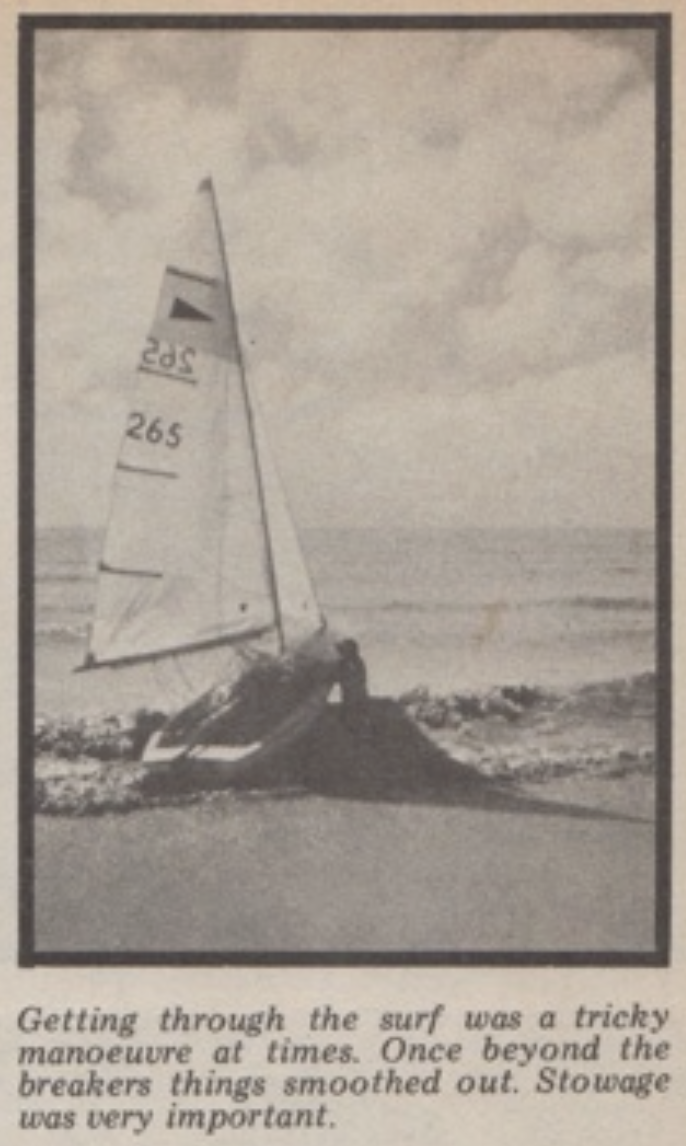
“Light winds and local thunderstorm activity,” came the weather report as we slipped out of Terrigal early next morning. And the weather came as predicted. By afternoon the vagrant breeze rounded steadily from the south and for a while we lifted to the pull of the spinnaker.
I kept an eye on a clump of clouds coming our way, and doused the kite when the breeze started to show too much energy.
As the clouds closed in it was obvious that it was only one of the localised storms predicted. There was no sign that the wind would rise dramatically, so we sailed on and readied for a wetting.
The wind strengthened to about 15 knots giving us an exhilarating ride over the rain-flattened sea. I was quite enjoying myself until a bolt of lightning struck the sea close by. Bang — and another clap set my nerves jangling. “Vulnerable,” that’s how I felt. I told myself, “You either get hit or you don’t.” My philosophising afforded some relief until I considered the construction of my mast. Aluminium!
Wednesday found me watching my wind vane swing round and round in circles. I passed quickly from curiosity to nausea and frustration.
There I was, wallowing helplessly on the sea, drowning in self-pity when, “schowshh!” — a large whale blew two lengths astern. Once again, talking to myself, I said, “It will hit us or it won’t!” It didn’t.
That afternoon we landed a few miles south of Port Stephens on a beach sheltered from the swell.
I’d had a whale of a time on Wednesday. On Thursday we met dolphins as we sailed north past Port Stephens.
The moving along became slogging along when in the afternoon the wind veered to NE as we approached Seal Rocks. Wind and tide seemed determined to impede us and I was scandalised to find that in the pure open delights of the sea I could sink to swearing and cursing. Every tack we made seemed to return us to our last point of tacking.
Boiler beach at Seal Rocks proved the steepest than I had so far experienced. The steep slope and the softness of the sand gave me a real struggle to get Sundance clear of the surf, let alone above the high water mark.
With the sand on the beach well disturbed by the muscle manoeuvres necessary to get “Sundance” above high water mark, I wearily set out to look for firewood.
In my log I wrote “Good Friday, what an incredible day!” The weather report told of westerlies to 60 knots at Newcastle, 50 miles (80.47 km) to the south. At Seal Rocks the breeze was from the west, and was very light. It was fairly early in the morning so I decided to wait for a couple of hours, write some letters, and see what would blow up. During this time the breeze increased only slightly, so we departed. We moved along quite nicely until a few miles later, we tried to “take off”.
The wind began to howl down from the hills, pummelling the sea into frenzied ripples. “George” had his first taste of front line action holding the tiller down while I lunged forward to disarm the rioting mainsail. The jib strained, I pulled her away and we were away. “Sundance” planed, quickly draining out through the bailer whatever water she’d shipped. Forster soon came up, but didn’t go, for the wind died.
Gee you feel stupid — there you are, sitting on a quiet, windless sunny sea, with your main furled, waiting for a cyclone. But even so, I waited another hour before raising the main. No sign of action from the west, and then a repentent breeze from the SE drigned in. For the remainder of the day the breeze wafted and wandered until at sunset it was coming once more from the NE.
It wasn’t just the beauty of the rising moon that made me goose-pimpled. The autumn evening attacked with winter wickedness, and the few hours that it took to drift onto the beach at Crowdy Head numbed me to the bones.
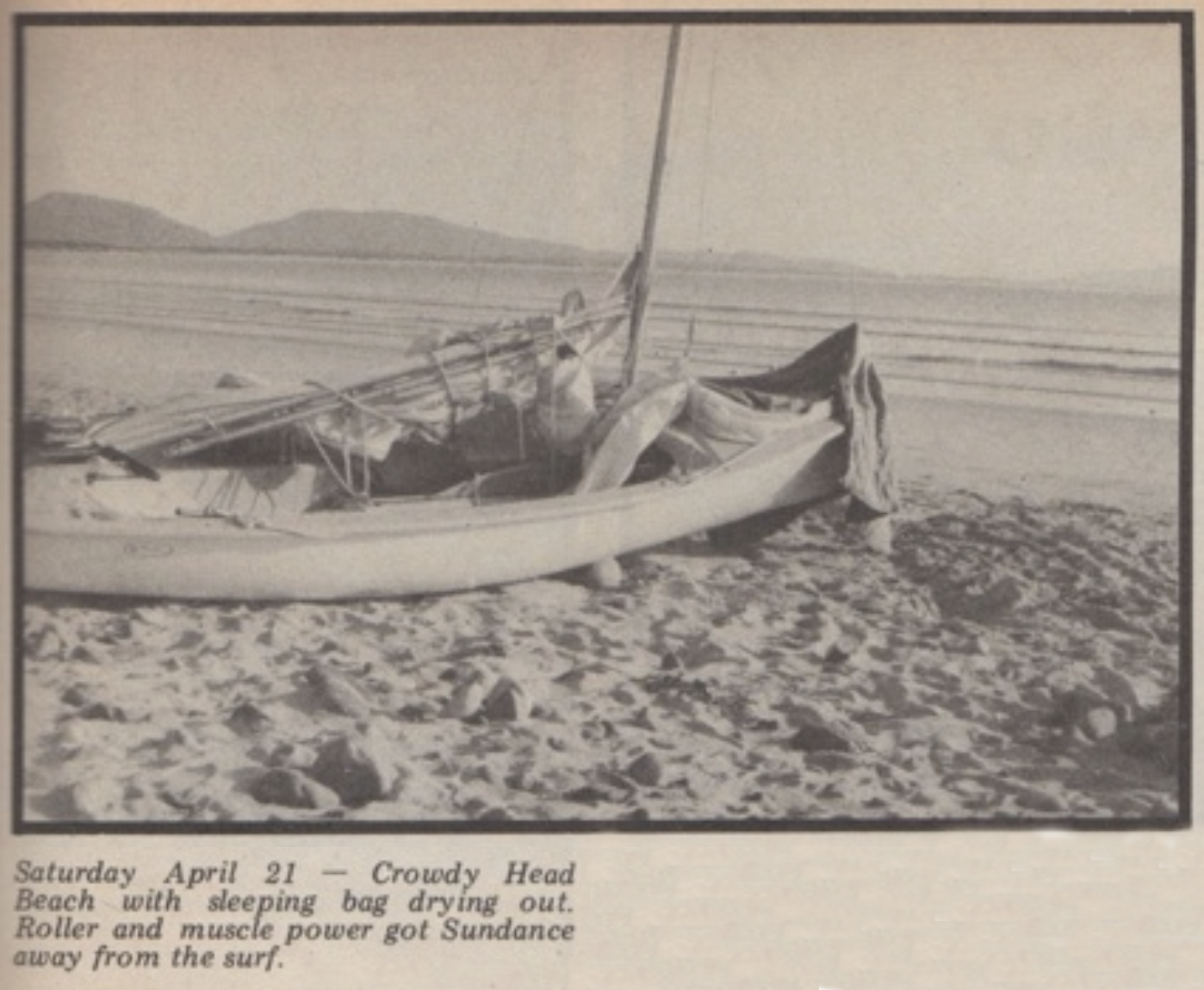
When I was planning the trip I knew I’d have to leave the decision as to how far I could go until I’d spent a few days at sea. That night at Crowdy Head I knew that if I wanted to I could sail to Cairns. I decided to do just that.
Next Week Crowdy Head to Scarborough