
The Boxer, The Boatbuilder, the Shark Arm and Coke
By Malcolm Lambe
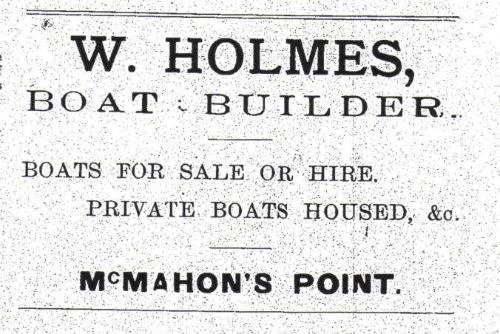
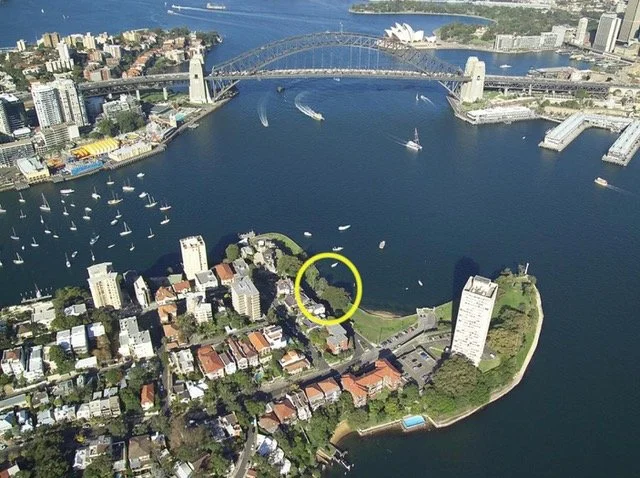
It was the mid 1930’s. Reginald Holmes was an interesting cove, an apparently respectable boat-builder with a boatshed at Lavender Bay and a prestigious residence at McMahon’s Point.
He was married, with two children, and dined at the Royal Sydney Yacht Club and was a pillar of the local Presbyterian Church. (His father William Holmes, also a boatbuilder, built, amongst many other vessels, “Boomerang” - part of the Sydney Heritage fleet. He also launched ten foot and fourteen foot racing dinghies. And his eighteen footer, “Arawa”, won three championship races in one season. William Holmes was also building speedboats - probably one of the first sheds in Sydney to do so. At the turn of the century he was winning speedboat championships with the splendidly named “Gee-Wiz” and “Fairbanks”. His son Reginald continued this tradition of building launches and speedboats.).
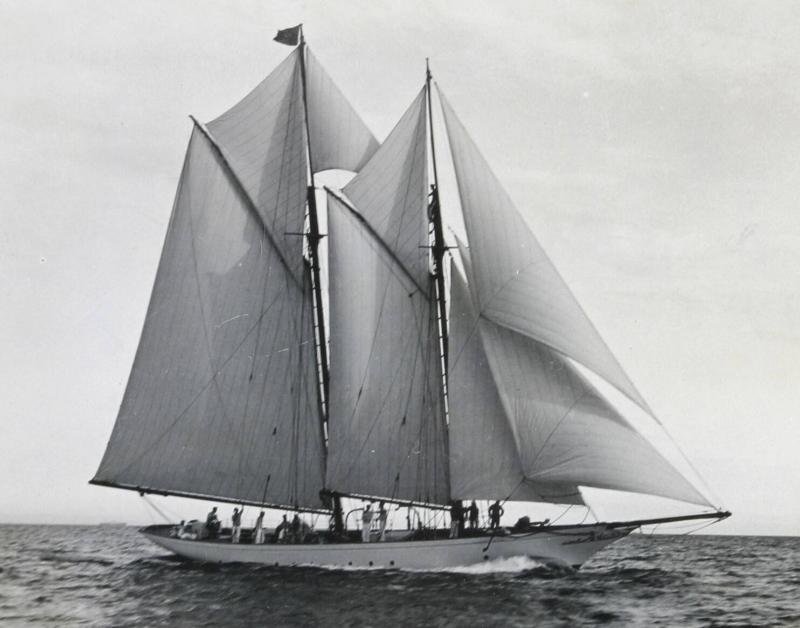
BOOMERANG

ARAWA
At this time - the early Thirties - The Harbour Bridge had been completed and Sydney was just dragging itself out of The Depression. People were looking for cheap entertainment. Fun piers and aquariums were all the go.
Anzac Day was fast approaching. Not just any old Anzac Day, either, but the 20th anniversary of the day when British generals started throwing wave after wave of brave Aussies and Kiwis into the remorseless meat grinder of Gallipoli. People were pulling out all stops for this one. There would be memorials and parades and parties galore.
For Charles and Albert Hobson, owners of an aquarium and swimming baths at Coogee Beach, that meant one thing: they needed a shark.
Sydneysiders couldn’t get enough of sharks, in spite of (or possibly because of) a decade-long series of grisly shark attacks in the area.
So on Wednesday, April 17th, 1935 Bert Hobson and his nephew Ron took a boat about 2 km off the beach and put out a few fixed line traps baited with mackerel. The next day they returned to see what they had caught. Turns out they’d hit the jackpot. One of their traps had snared a small shark.
That wasn’t the jackpot part.
While that small shark was struggling to free itself from the hook it was, in turn, swallowed by a much larger tiger shark that then got tangled in the line.
Bert and Ron hauled up the monster 4.4m shark, still alive, towed it back to shore, and dumped it into the aquarium. Over the next several days sizable crowds turned up to see their catch, but the shark wasn’t playing along. It refused to eat, and was alternately listless and irritable.
It all paid off on Thursday, April 25th. After the Anzac Day parades wound down, tourists thronged to the aquarium in record numbers. As the afternoon went on, though, they started to wander off to other amusements. By the end of the day there were only fourteen paying customers left in the building.
At 4:30 PM, the shark suddenly became agitated. It started battering itself against the side of the pool, working the water into foam. Then it swam into the shallow end, circled a few times, and started thrashing around and throwing up. The pool began to fill with shark vomit, which was mostly sea slime and bile, dead birds and rats.
…and a human arm.
One of the witnesses to this horrible event was Narcisse Leo Young, a proofreader for the Sydney Morning Herald. He called his bosses and let them know there was something at the aquarium worth seeing. The reporters arrived about the same time as the police did.
The Police Report reads - “saw floating in the water the left arm of a human being, which had apparently been wrenched from the body at the shoulder joint. We retrieved the arm from the water and on examining it found that it had two large incised wounds on the upper and lower parts respectively. We also found that on the inside forearm there was a tattoo mark of two men in the fighting attitude. There was tied around the wrist in a half-hitch knot, a piece of cheap manila 3/4 inch rope. The arm is in a fair state of preservation except that the skin on the heel and palm of the hand has crumpled and become detached.”
The reputation of the Holmes family was about to be tarnished.
Boat builder, Reginald Holmes had a modern use for his speed boats. They sometimes did a night run, out through the Heads and along the coast to collect packages that were dropped overboard from passing ships. Homes had a secret life as a drug runner and dealer. He imported Cocaine and distributed it amongst the young crowd of Sydney. Well naughty.

Reginald Holmes
Reginald and some of his mates also indulged in a little insurance fraud. In 1932, Reginald mortgaged a life insurance policy to Albert Stannard for £4000. Stannard was a friend and fellow boat builder. Holmes, Stannard and two other friends purchased an ocean-going motor yacht "Pathfinder" - built by Norman Wright on the Brisbane River. They had a business venture involving the Pathfinder. The caretaker of the boat was James Smith.
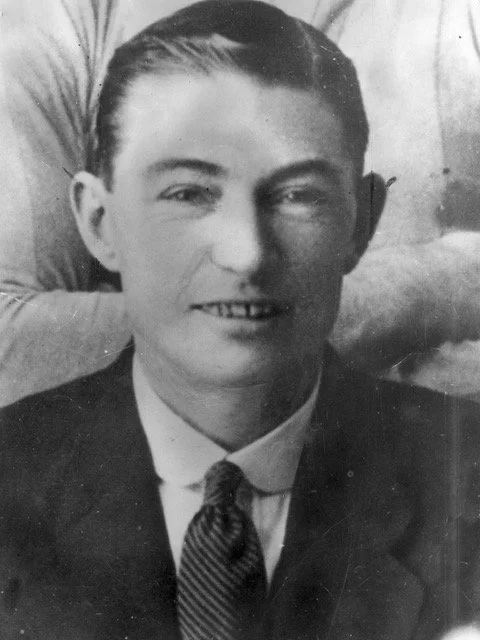
James Smith
Smith was a part-time boxer, who lived in Balmain. Throughout the 1920s he owned a series of billiard parlors but they were mostly fronts for Smith’s small-time bookmaking operations. In 1930 he opened a slightly higher-class establishment, the Rozelle Athletic Club.
In September 1932 the police raided Smith’s operation as part of a statewide crackdown on illegal gambling. As part of the process Smith was arrested and fingerprinted. He got lucky, though, and didn't receive a jail sentence. Just a very large fine.
To try and pay it off, Smith expanded his business into unlicensed pokies. The cops didn’t take too kindly to that, either, and this time they shut the Athletic Club down for good.
After this Holmes and Standard kept Smith busy piloting boats and working as a fishing guide. As the caretaker of the "Pathfinder", Smith took the boat on a trip up the Central Coast in April of 1934. It sank off the coast near Terrigal. "Scuttled" is probably a better description. The boat was insured for £8,500 - a fair bit of dosh in those days.
Unbeknown to Holmes and his friends, Smith was a police informer and the police were very interested in the Pathfinder. They thought it was involved in the smuggling operation. After it sank, Stannard, Holmes and his cronies were vigorously interviewed by the police. The insurance company was also suspicious. The claim for the sunken yacht was not settled.
A police informer cannot remain undercover forever and by April 1935, Smith’s days were numbered.
The arm in the shark caused a sensation in Sydney. A photograph of the arm featured widely in the press and it was not long before the owner was identified by its tattoo of fighting boxers. The arm belonged to James Smith.
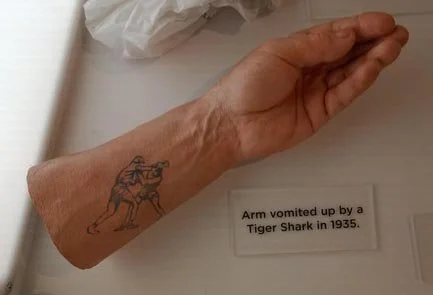
Examination revealed that the limb had been severed with a knife, which resulted in a murder investigation. Three days later, the aquarium owners killed the shark and gutted it, hampering the initial police investigation.
Once identification was made, it did not take police long to trace Smith’s last movements. He had been drinking in a pub with Cronulla local, Patrick Brady. A taxi driver remembered Brady. He recalled that, very late one night in April, he had taken Brady to Reginald Holmes house in Lavender Bay. The police had their connection.
Initially Holmes denied knowing Brady. Then he took one of his speed boats into Sydney Harbour, and in full view of people strolling along the shore, Reginald Holmes shot himself in the head with a .32 pistol and tumbled into the water.
Miraculously he survived. He climbed back into the boat and sped off. Witnesses called in a maniac zooming around the Harbour with blood streaming down his face. The water police gave chase and for four hours they zigzagged in and out of ferries, large cargo ships and other harbour traffic. Eventually Holmes surrendered. He confessed that Brady had visited him.
Bearing the severed arm, Brady had tried to blackmail Holmes. Later, Holmes agreed to be a witness at the inquest into the death of James Smith.
In the early hours of the first morning of the inquest, Reginald Holmes was found dead in his car in Hickson Road, under the newly constructed Harbour Bridge. He had three bullets in his chest.
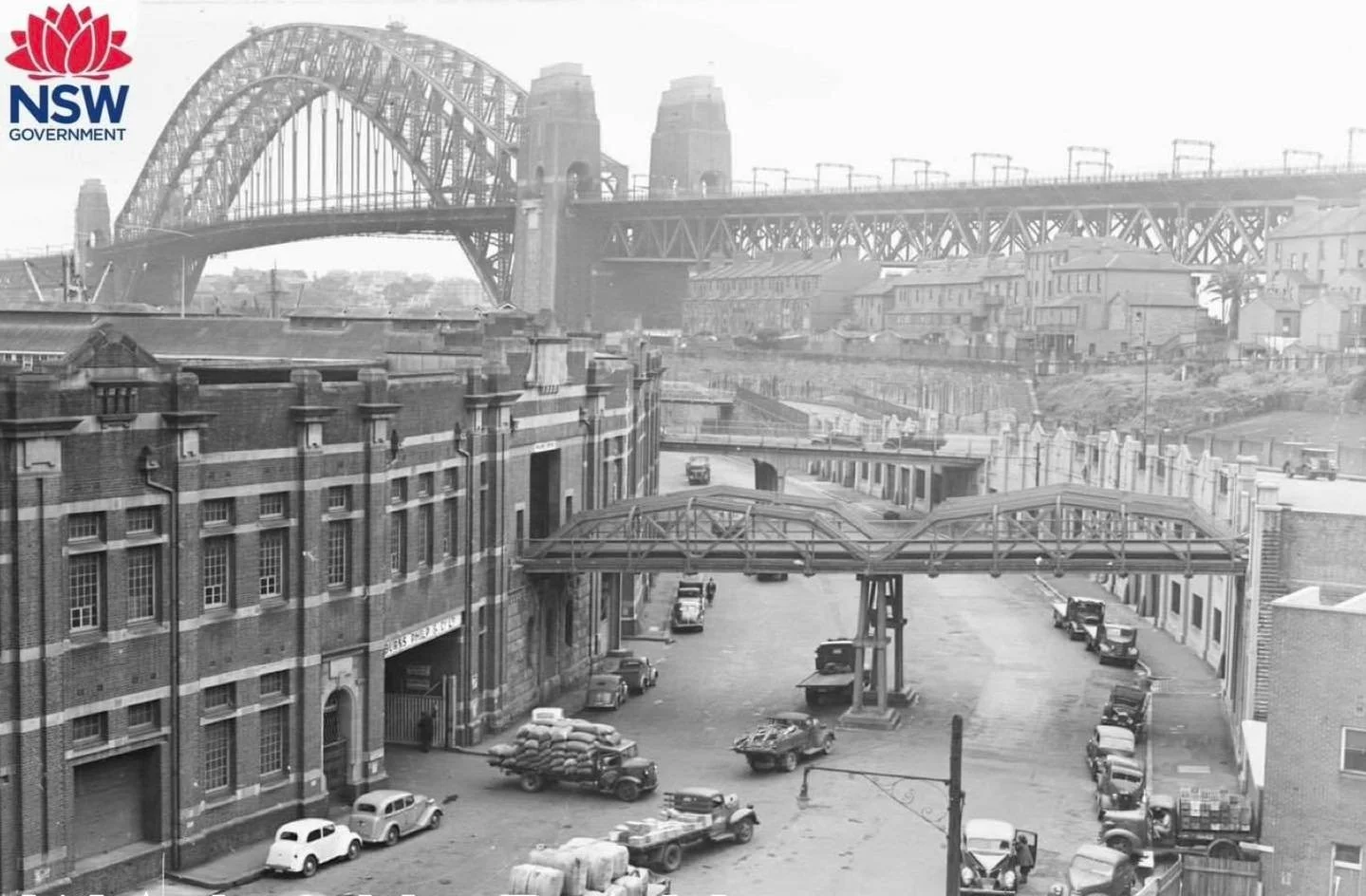
Hickson Road in the 1930’s
At his inquest, his wife testified that, on the day of his death, Reginald had withdrawn £500 from his bank account. When he had left home he had told her that he was meeting Albert Stannard at 2 o’clock. Another witness identified Stannard, as the man who walked away from a car in Hickson Rd, on the evening that Holmes had died.
In the end, Reginald Holmes’ killer was never identified. It was thought that Holmes had ordered his own death and paid a hit-man to do what he failed to accomplish. But forensic police had no doubt that he was murdered. Holmes had been due to give evidence at Smith's inquest later that morning.