
Well Written - Part IV

In this the fourth of our six part series bringing you under-rated maritime texts, we move into a more modern era, but it shocked me slightly, to realise that “Coasting” is approaching its 40th birthday!
The book is about so much more is than a literal circumnavigation of the UK. It’s arguably Raban’s most politically charged book. While framed as a solo sailing journey around Britain during the Falklands War, it’s really a profound criticism of nationalism and Thatcher’s Britain.
And there’s an underlying sense that “Coasting” is about exile—self-imposed, yes, but also symptomatic of a wider cultural alienation.
Raban, who died only a couple of years ago, shows us that cruising stories don’t have to be about bravery and adventure. Modest journeys of self discovery can be just as rewarding to the reader as an account of surviving a Southern Ocean gale. If you find and enjoy “Coasting”, move on to “Passage to Juneau” where Raban's polished prose masks, but doesn't hide, a life in quiet disarray.
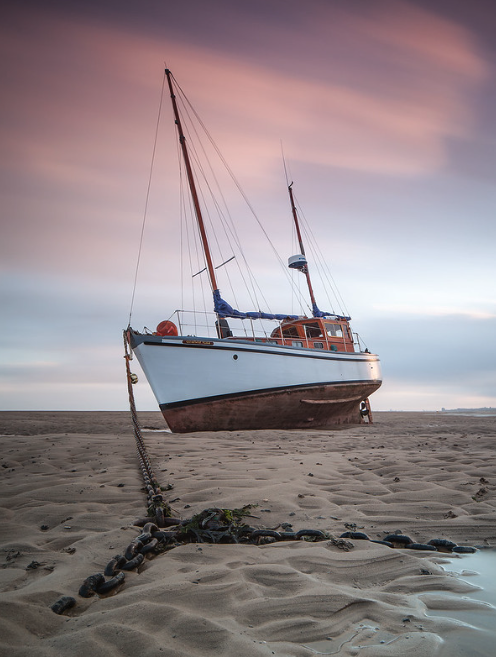
Gosfield Maid Image byJamesWallace
From Chapter 4 “Hunting for Fossils”
It is a mistake to let a priest go on a boat. Maritime lore has it that priests bring bad luck because their chief purpose on board ship is to perform burials at sea. So if you do have a priest on hand, leave him ashore.
I argued that my priest was at least semi-retired, and therefore only half a threat to the voyage. One has to take risks sometimes. My parents and I sailed from Lymington in Gosfield Maid.
It was a foolish thing to do, as I realised within minutes of leaving the quay. In front of the popping gas fire in Southampton, whisky in hand, I had been a bit too eloquent about both the hazards and the enchantments of my new life. Much had been made of the natural magic of navigation, of tides and tide-races, of heavy weather when the sea scowled ferociously at the boat, of the trancelike passages of reflective solitude. As the level sank in the bottle, I changed from the son my parents knew to someone who combined all the essential properties of Joshua Slocum, Captain MacWhirr and a Guernsey slaver.
Prepared for a slice of heroic adventure, they found themselves in the middle of a floating vicarage garden fête. The sun shone. The salt in the air glittered like tinsel. In the enclosed water of the Solent, the stiffish southerly wind did no more than prettily tousle the sea. Though I had made an important fuss of laying compass courses on the chart and calculating tidal streams, there was no navigation since everyone could see exactly where everywhere was. There was no solitude, either. There was hardly any room at all in which to move.
White yachts went sobbing and strumming past our bows and stern, their crews decked out in daffodil PVC and braided captains’ hats. The whole Solent was a crazy-paving of interlaced wakes as I did my best to thread us through the pack of charging motor cruisers, fishing parties, ferries, dinghies, yachts. The entrance to the Beaulieu River was hidden behind a bright fleet of sailboards. A big container ship, leaving Southampton Water, scattered the small fry ahead of it like a pike in a pond.
“Racing!” shouted a furious Saturday admiral from his cockpit, “We’re racing!”
“He seems cross,” my mother said.
I hauled Gosfield Maid round in a shamble of flapping sails and gave way to the Isle of Wight, which steamed briskly off to starboard. This was not how I had planned things. My idea, sketched out long ago, had been that I would pilot my parents across the lonely face of the sea in a neat reversal of rôles; the son would turn father, with all a father’s air of calm and baffling expertise in the world.
The trouble was, I didn’t know the ropes. Learning to manage the boat single-handed, I hadn’t bothered to take in their names. In any case, I was vain about not going in for the sort of salty talk which the amateur sailors liked to sprinkle over their prose in Yachting Monthly and their conversation in yacht club bars. Let them keep their vangs and kicking-straps and stays’l halyards — I meant to live in ordinary daily English. What I hadn’t reckoned on was that this made me perfectly unable to communicate the simplest instruction to my anxious-to-help father, who had done a bit of sailing in his time.
“No, not that rope. The other one. The one next to it — the one that’s tied to that cleat thing.”
“The topping lift,” my father said, producing a surprise trump. The points of his beard glinted in the sun. In his white cricket sweater, grey flannels and plimsolls, still as long and lean as he had been in his twenties, he looked comfortably in command of the occasion. The passing yachtsmen would have nailed me as the unhandy passenger on this outing.
“So this is what you call research?” My father grinned, showing teeth that were as much in need as mine of restorative work. His grin took in the swarm of pleasure craft, the little waves, the high, holiday sky, the smell of suntan oil in the air, the waterskier in her scarlet wetsuit who was zipping by on the beam.
It certainly didn’t look much like a voyage of discovery, this weaving passage through the weekend crowds, with my father now at the wheel and my mother getting up a picnic in the galley. It was only too obvious what I was really up to. In my mother’s phrase, I was “going boating.” The waterskier ran a needlessly fast circle round Gosfield Maid and hared off towards Cowes.
“Anyone for pâté?” my mother said.
“We could lie hove-to . . . perhaps?” my father said, smoke from his pipe mingling with smoke from mine. “Back the jib and tighten up the mainsail . . . ?” The deferential question-marks in his voice almost, but not quite, concealed the fact that these were captain’s orders. We backed the jib, we tightened the mainsail, and the boat fossicked about on the water while we lunched in the open cockpit.
“It’s not usually like this,” I said.
“No, it must get very rough sometimes,” my mother said encouragingly. “But she’s a lovely little boat.”
I saw my entire voyage being wrapped up in a tarpaulin and buried at sea.
We floated through the afternoon, a family among all the other families who were playing about with their expensive toys. Off Spit Sand Fort I tried to save the day with a solemn disquisition on the changing sociology of boat ownership, the emergence of a new leisure class, the conspicuous excess of fat in this southern quarter of Mrs Thatcher’s England. But the argument was rather spoiled by the sudden intrusion of a madman in a brand-new Princess motor cruiser with a flying bridge and tarpon deck, which he was using as a ballistic missile against Gosfield Maid.
“If to starboard red appear, it is YOUR duty to keep clear!”
I yelled as he roared past our paintwork. He banked, waved and shot away to carve up someone else.
"We're a bit worried about getting into Hungary, with Daddy being a priest..."
"It may be a wise move to get a new passport. With just 'Retired' in it. What do you think, old boy?"
These were the voices of serious adventure and exploration. I'd always seen myself as the man most likely to disappear under armed guard at some frontier post with barbed wire and machine gun emplacements, but now it was my father who was going to get the interrogation and a spell in the slammer. "You're not planning to go in with contraband bibles and prayer books, are you?"
"No, just bird guides."
"Wear your CND badge," I said, wondering whether my father would catch the echo from a quarter of a century back. "They're very keen on CND badges, but you have to spend a lot of time explaining that you mind their bombs just as much as you mind ours."
At the approach to Chichester Harbour I took over the wheel. Here, at least, there was need of some fine pilotage. I brought the Nab Tower behind us into line at 184° and headed for the beacon on the bar at 004°. The course was clearly enough marked by the evening stream of returning sailing dinghies, but I was determined to cling to every last bit of expertise that I could lay my hands on. There was a gratifying lumpiness in the sea as it shallowed over the sand, and the boat lurched just enough to rattle the plates in the galley and dislodge the odd book from the shelves. Leave the beacon half a cable to port ... watch the shoal of broken water to starboard...
"You always used to do that when you were a little boy, when you were concentrating," my mother said.
"Do what?" The incoming tide was sweeping us through the buoyed channel; a tufted sand-dune whizzed past the window to starboard, looking as yellow as butter in the low, cold sun.
"Stick your tongue out between your lips. Like you're doing now."
Recalled to infancy, I moored the boat at the end of a pontoon in a hideous marina. Fenders out, ropes tight, we were exactly two and a half miles short of 1951.
