
Slow and Dangerous
I don’t have any particular qualifications to make these recommendations, apart from having sailed many miles in a long keeled heavy old boat, so take what you will, with a grain of salt. (That’s a sort of disclaimer!)
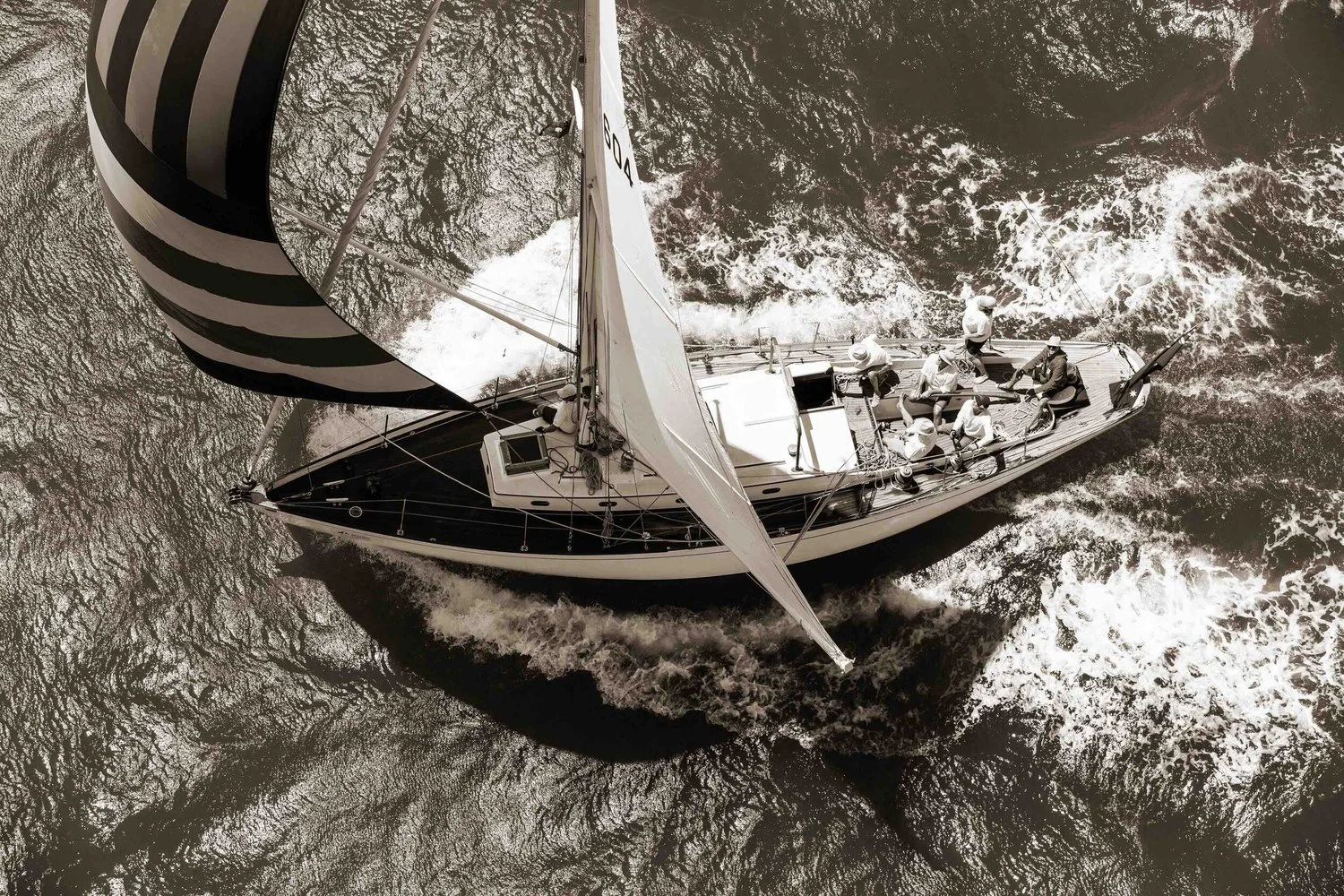
The subject is heavy air downwind cruising, and I was inspired to give my tuppence worth following a few recent incidents. I’m not party to the details of these occurrences, and I dislike speculation, so instead I’m going to explain three techniques that might make things a little safer when the conditions are fresh and the wind is coming from where you’ve just been. And because cruisers generally don’t beat out of choice, and are more likely to wait in harbour for winds to move aft of the beam, then techniques for running safely are very important, as they are frequently needed.
Reef Early
The first point I’d make is that reefing early creates fewer negatives when running, compared to beating or reaching. While an underpowered long keeled yacht might struggle to make ground to windward in a chop, and a reaching yacht might become horribly unbalanced, the loss in performance when underpowered going downhill is negligible. And the benefits are huge. Easier steering, less loads on all the gear, a more relaxed motion and a more relaxed crew. So if you are talking about putting in a first/second/third reef then stop talking, and do it!
Rig a Preventer.
I don’t like the term preventer, but as everyone will know which bit of rope I’m talking about, I’ll stick with it. I see the preventer’s role as not to “prevent” an accidental gybe but to buy the helmsperson a few seconds to get back on course if they have been thrown around by a wave, or perhaps lost concentration for a few seconds. If the boom is as far out as it can be, and the preventor is rigged tightly, a boat needs to be a long way past “just by the lee” before the full force of the wind is on the back of the main sail. Having the preventer well rigged should keep the boom on the proper side for a few moments longer as the mainsail leech flutters and helm is thrown over.
Speaking of which, it’s a good idea, at the start of a steering spell, to remind the less experienced helmspeople which way to unthinkingly turn the wheel (or push the helm) if the shit looks like it’s about to hit the fan. If you are cold and tired and maybe a little scared, then the few seconds between a flutter and a full on gybe is no time to be rationally trying think about the water flow on the rudder and resulting boat direction. You just need to react…in the right way.
There is a difference of opinion as to where to attach the preventer to the boom. Many cruising manuals say to attach it as near the aft end as possible. I disagree. The sweet spot in terms of load, according to my shipmate of 35 years and practising civil engineer, is two thirds of the way along. He produced some complicated formulas involving cantilever effects and bending moments, but for a non-physicist’s gut feel, this seems to be about right; far enough away from the mast so the end doesn’t want to fold back on itself, yet close enough to the middle of the boom to stop it bending.
Another reason not to rig to the end of the boom is that once running it’s hard to connect the preventer as the attachment point is a few metres away from the stable deck. And remeber you are going to have to unclip it everytime you gybe…or at least let it run.
Now perhaps onto the most controversial matter… how to attach a preventer to the boom. As mentioned earlier, we don’t want the prevented to stop a fully-fledged gybe, as this will either break to boom or pin the boat on its side at right angles to the waves. If it gets to this, we want the preventer to release. So we are looking at a “fuse” situation. On FAIR WINDS, a 43ft, 14 tonne sloop we reckoned that three small loops of 3mm VB cord though a fastening point on the bottom of the boom was about right to produce this deliberate breakability. Not very scientific I know, but it was tried and tested and seemed to work. When not in use, the loops hung a few inches below the boom ready for a snap shackle to be attached. And don’t use rope with zero stretch such as dyneema for your preventer. If it has a little give and bounce, it’s going to reduce any snatch loads if the gybe does happen. It’s the same reason your mooring lines should be nylon!
Once attached to the boom, the preventer needs to be led forward, ideally at right angle to the boom, through a strong turning-block on deck and back to the cockpit. The fastening point in the cockpit is also important. Multiple turns on a cleat and heaven forbid a locked hitch is a bad idea as a quick release might be essential. If you have an unused winch I like the idea of a couple of turns and into the self-tailer, as its quick to undo and the turns offer a little friction to slow the boom if it is going to go across.
Sail a Better Course
This one is a no brainer, but somehow we all at some time get sucked into trying to sail dead downwind at one time or another. Perhaps it’s because we want to avoid the work involved in two extra gybes, or because it’s fun to feel the rush of surfing square to the waves but really there’s no good reason for a cruising boat to sail at 180deg TWA.
Here’s a couple of scenarios for you, again from the engineer.
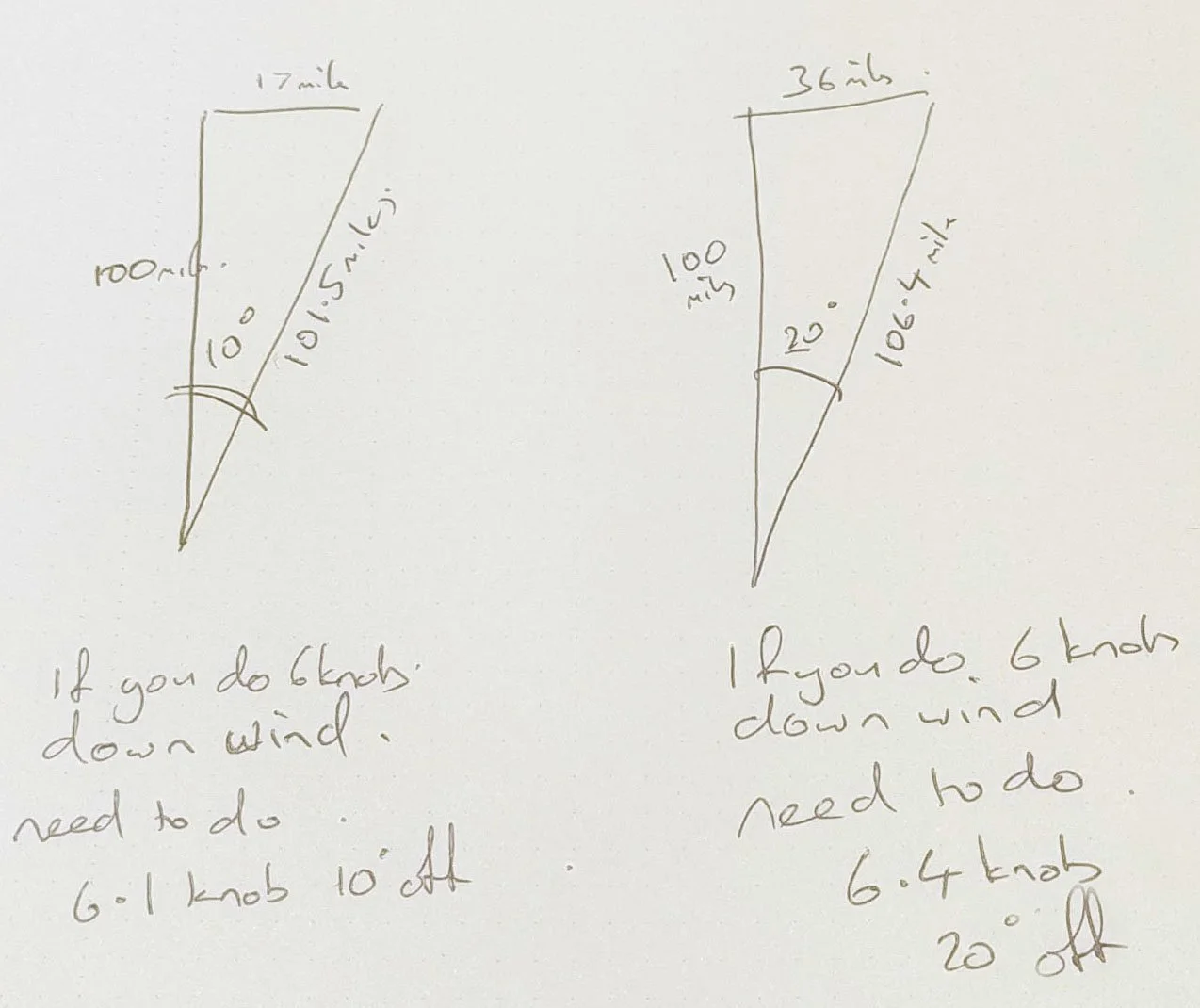
Imagine I have to sail 100nm dead downwind. If I sail 170deg. TWA with a deliberate(!) gybe in the middle I will only end up sailing a total of 101.6 miles. But I’ll be going a little quicker as I’m not sailing dead square. If the boat averaged 6 knots dead downwind, I would only have to do 6.1 knots to make up that time difference and I would have had a safer, more comfortable passage.
If we extrapolate that out to a 160deg. TWA the distance I would need to travel would be 106.4nm and the speed I would need to go at would be 6.4 knots to arrive at the same time as 100nm dead downwind at 6 knots. Sounds entirely achievable and a much better plan!
Summary
There are a hundred other things you can do to make your downwind sailing safer, but if you start with reefing early, fixing a preventor properly and sailing a better course you will be a long way to eliminating many of the risks, and that allows more time for enjoying the ride!
There are a lot of sailors out there reading SWS each week with far more experience than me, so if any of the above sounds wrong, or might be improved upon then drop us a line. Conversation like this, are how practical knowledge is shared.