
An Island Inheritance -
A Review of "Sea Room” by Adam Nicolson
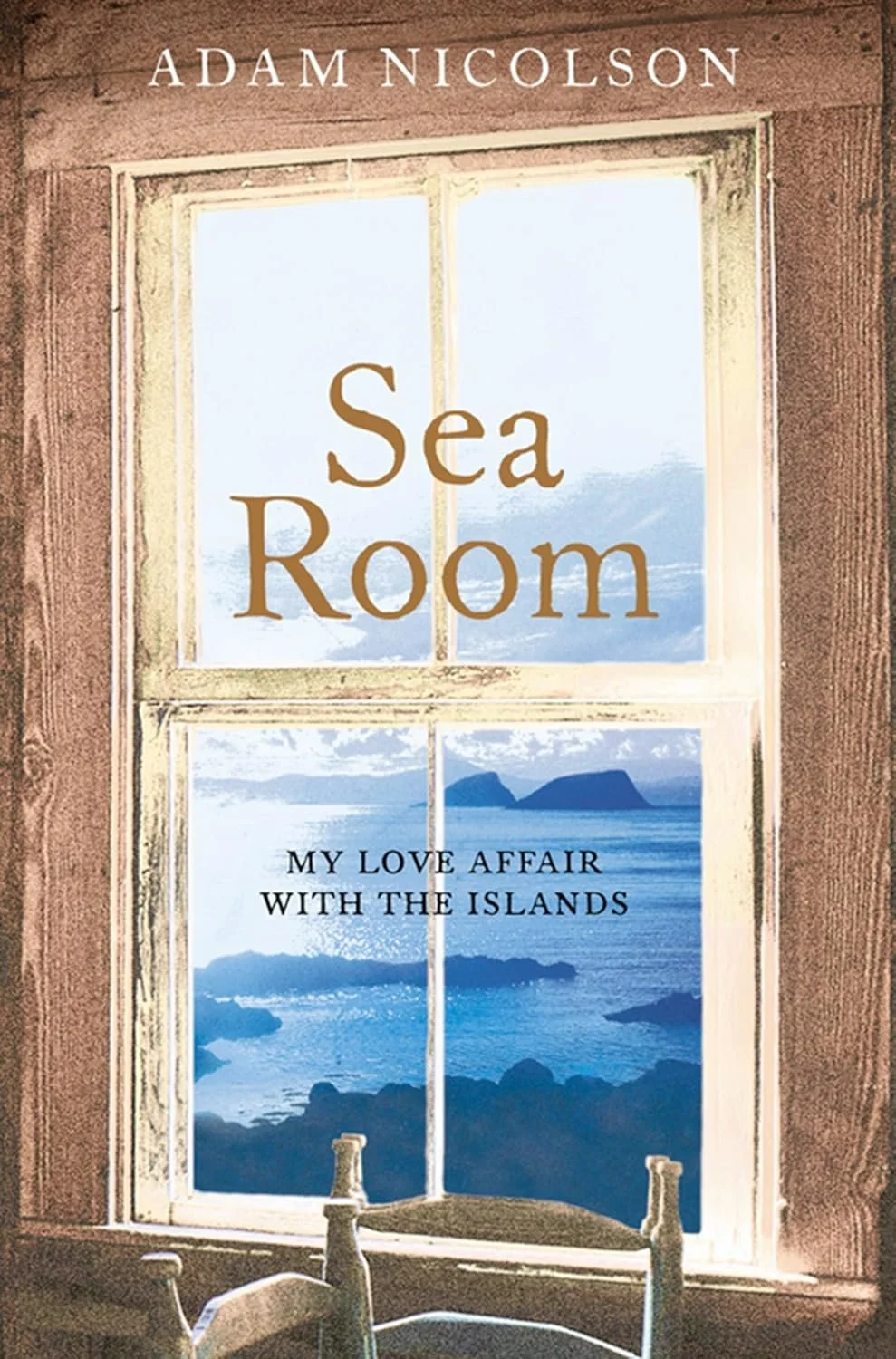
“Early April and a cold wind was cutting up from the south-west. Freyja was anchored in the little rocky inlet at the head of Flodabay on the east coast of Harris. A seal watched from the dark water. Acid streams were draining off the moorland into the sea. The boat swung a little and the reflected sun glinted up at the strakes of her bilges. I was shivering, not because of the cold, but because I was frightened at the idea of sailing out alone in this small boat to the Shiants. The halyard was slapping against the mast and the tiny waves clucked as they were caught against the underside of the hull. The shores of Flodabay were sallow and tussocky with the dead winter grasses and the boat was washed in late-winter sun. Freyja is sixteen feet from stem to stern and looks from the shore as slight as a balsa wood toy. She and the Minch are not to the same scale.
It was the first time I was going to sail to the Shiants on my own. Always before, I had allowed myself to be carried out by fishermen from Scalpay or boatmen from Lewis, travelling as I now see it like a man in a sedan chair, gracefully picked up, carefully taken over and gently set down. That could never be enough. That was not being engaged with the place. An island can only be known and understood if the sea around it is known and understood.
Six months previously, I had read a history of the birlinn, the sailing galley descended from Viking boats that was used in these waters by the highland chiefs, at least until the seventeenth century. They raided and traded with them. Their lives were as much bound up with them as with any land-based habitation. The book described the carving of a birlinn surviving on the tomb of Alasdair Crotach, Hunchback Alasdair, the Macleod chieftain of Harris in the mid-sixteenth century. He was a violent man, the mass murderer of a cave-full of Macdonalds on Eigg, men, women and children, three hundred and ninety-five of whom he suffocated with the smoke of a fire lit at its narrow mouth.
This killer’s birlinn is an image of extraordinary beauty. The form and curve of each strake, the fixings of the rudder, even the lay of the rope in the rigging: everything is carved with exactness, clarity and what can only be called love. Around it are the relative crudities of angels, apostles and biblical stories. Their forms never escaped the stone but the carved ship shows the panels of cloth in the bellied-out sail. It even shows the way a sail can be creased against a forestay that is faintly visible through it. Above all, though, it lovingly described the form of the hull, the depth of its keel and the fullness of the bilges. All of this was carved in millimetre detail, testament of something that mattered. The birlinn was shown at full stretch and fully rigged, but out of the water, so that the swept beauty of the hull could be seen. Only a shipwright or a sailor could have carved such a thing: it is the mental, not the actual image of a ship at sea, a depiction of what you can imagine of a boat at its most perfect moment, made by a man who knew it. The author of the birlinn history had set a Gaelic proverb at the head of his central chapter:
’S beag ’tha fios aig fear a’ bhaile,
Cia’mar ’tha fear na mara beò.
The landlubber [literally the man of the village] has no idea
How the sailor [the man of the sea] exists.”
Adam Nicolson writes beautifully about boats. In particular the way in which they are created and formed by the waters in which they sail. It’s the concept of “Vernacular”… an idea that we have flagged a few times in SWS.
Despite the self-deprecating tone of this passage, it’s obvious that he knows, and more importantly feels, what it’s like to handle a small craft with competence, in conditions that deserve the upmost respect. But sailing isn´t really what this book is about.
In 1973, when he was 21 years old Adam, an undoubtably aristocratic Englishmen (his Grandmother was Vita Sackville-West) inherited the Shiants, a small group of wild, uninhabited islands off the coast of the Outer Hebrides in Scotland, from his father the writer Nigel Nicolson. He in turn, had bought the islands from the novelist Compton Mackenzie (author of Whisky Galore) in the 1930s. The book tells of his deepening relationship with these remote islands over many years — how he explores them, researches their history and geology, and reflects on what it means to own and care for such a place. It ends with him passing them on to his own son Tom, creating three generations of custodianship from the one family.
Central to the book is Nicolson´s struggle to understand what it means to actually “belong” to a place. He rejects the idea of “possession” in a material sense, seeing ownership instead as a stewardship or conversation between generations, in very much the same way as many of us, reject the word “ownership” when it comes to our boats.
The meat of the book is giving over to understanding three recurring themes. The tumultuous wildlife on the islands, (they are alive with puffins, guillemots, razorbills, seals), the recent human history of the place, and the geology of the deep past, that formed the spectacular landscape.
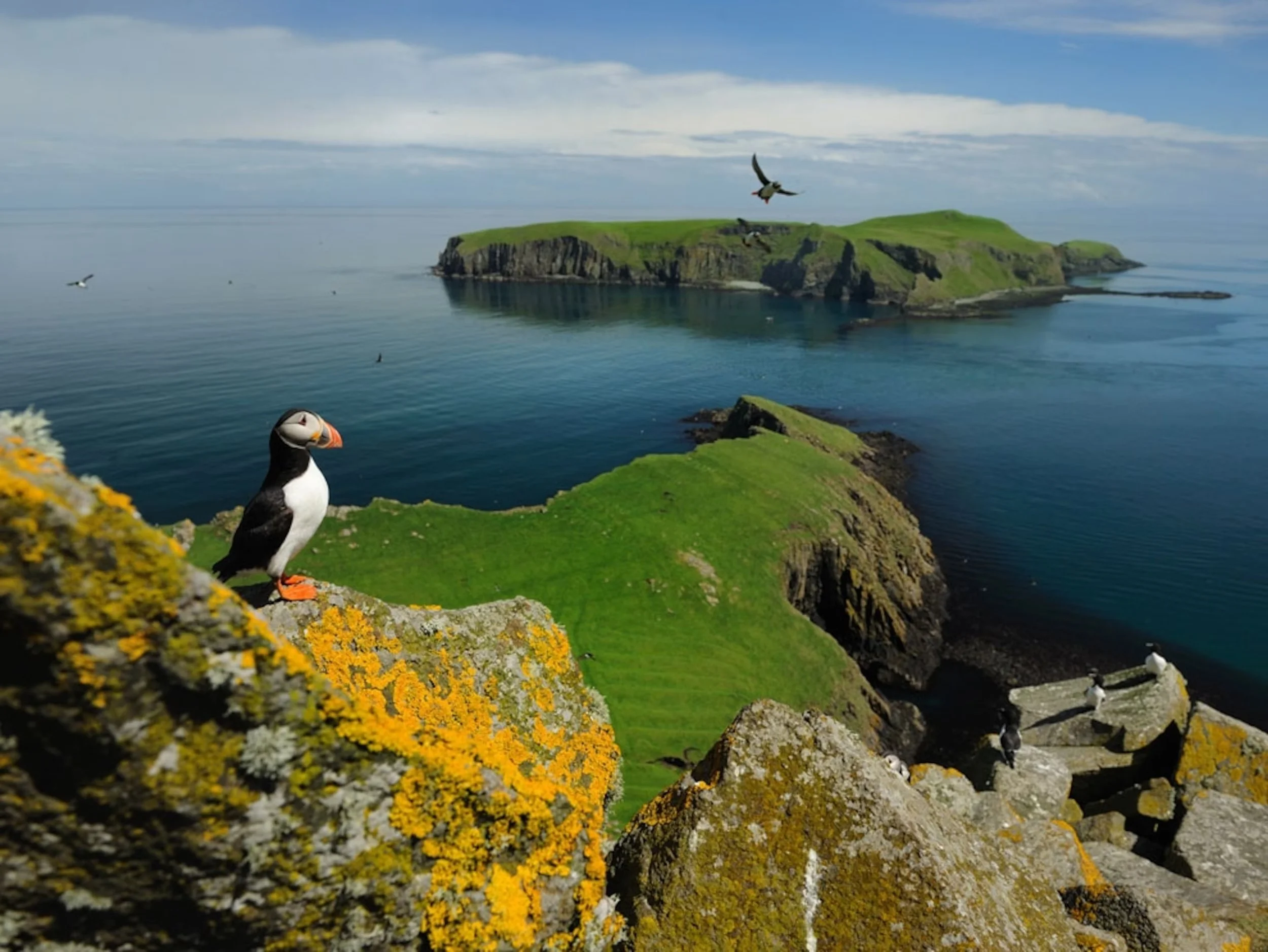
A puffin on the Shiants- Photograph by Jim Richardson
I got a bit bogged down in these details. Some passages sprang to life, but others relied on a level of interest and knowledge well beyond my capabilities. But where the book really catches fire is when it is at its most personal.
Sea Room is not about events but about encounters — between man and place, past and present, nature and meaning.
It’s part memoir, part history, part love letter to the wild edges of Britain and definitely worth a read.
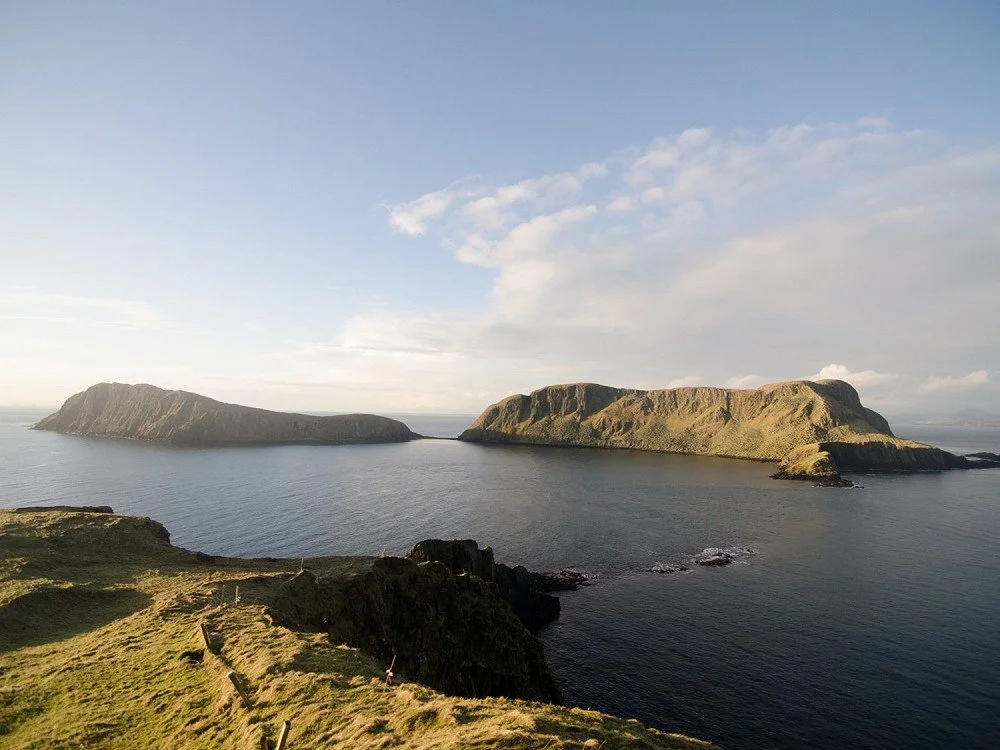
Winter view of Eilean an Taighe and Garbh Elian taken from Eilean Mhuire Photo: Tom Churchyard