
Well Written - Part VI
This is the final part in a series of extracts from underrated texts about wooden boats.
First, some background- In 2017 I travelled to the USA and made a pilgrimage of sorts to Martha’s Vineyard
The rain slanted across the deck of the ugly little car ferry as it surged out of Woods Hole harbour, across Vineyard Sound. May had just begun, but the icy cold and 25 knot north-westerly was telling me that spring had not yet arrived. As the horn on the ferry sounded the Cory’s Shearwaters passed the bows with wings fixed solid. I stood alone on the steel foredeck, and stared into the greyness wondering how this uninspiring land on the horizon could possibly be the famous Martha’s Vineyard, playground of the rich and famous. But I wasn’t here to visit them.
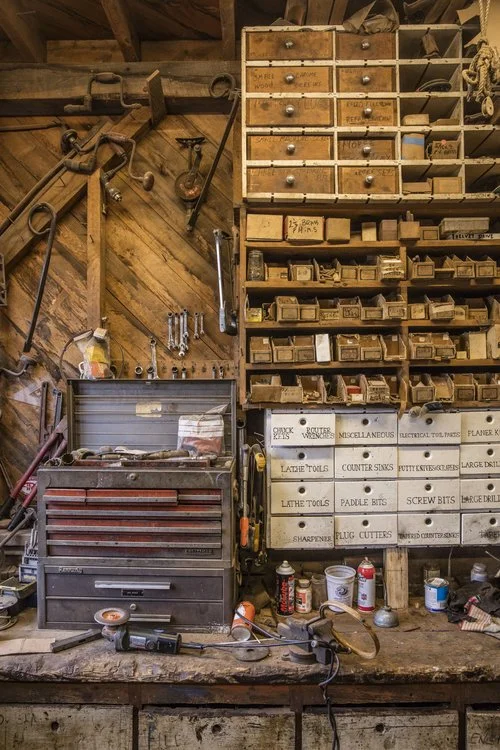
As the ferry swung into the open bay at Vineyard Haven on my right behind a short breakwater a selection of interesting wooden boats tugged at their moorings in the chop, but on my left a schooner stood out proudly away from the others, looking confident and comfortable just off the end of fragile pier coming off the beach. On her masthead pennant was the single word JUNO, and I knew I had come to the right place.I got off the ferry and walked the hundred yards up the beachfront street to a wooden building. There was no name board or sign but the rack of varnished masts and the singing of a bandsaw inside showed me the way and I slid open a barn door and the smell of cedar and oak and the warmth of a pot bellied stove greeted me. The first part of the shed was only small, big enough to hold an upturned dinghy a few bench tools and rows of draws clearly labelled. You couldn’t call it tidy but everything belonged, and the mood was one of quiet but focussed intent. No radio was playing….the sounds of the tools and the sea only thirty yards away filled the silence. Beyond this first area I could see the hulls two boats in a second larger shed even closer to the water….but more of these later. A young shipwright invited me in to stand by the stove and said Nat would be here shortly. I few minutes later the door slid open again and the room lit up as an unassuming bearded man in a dusty cable knit jumper walked towards me. He moved through the shed, feet wide as if crossing a moving deck, held his hand out and with a beaming smile and a soft Hudson Valley lilt said, “Mark? I’m Nat…a pleasure to meet you”
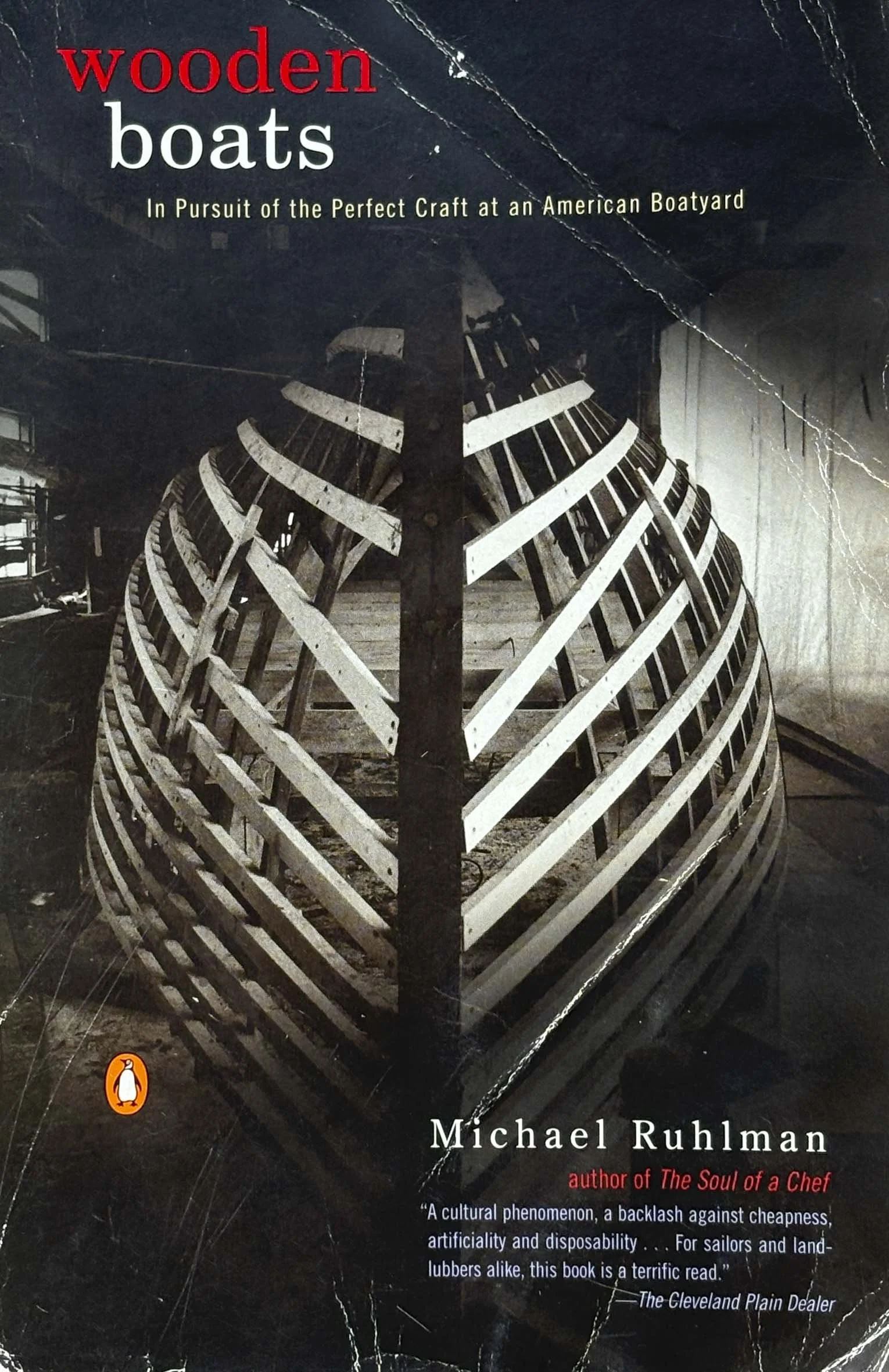
In 2002 I read a small book called simply “Wooden Boats” by Michael Ruhlman. It’s the story of the Gannon and Benjamin Marine Railway in Martha’s Vineyard and it is also the best explanation I have yet read of the fascination of making and owning timber sailing boats. Having cherished and re-read the text for the last fourteen years I was a little nervous to meet the men who create such majestic vessels, but that nervousness soon vanished as Nat showed me round his sheds and yards, talking to his colleagues about details of their work and taking a genuine interest in my limited knowledge and the state of wooden boat sailing in Australia. The temptation to romanticise the yard is strong. The methods are strictly traditional not out of any obligation or purist fervour but because this works best. Its progeny are some of the most beautiful craft sailing the oceans, and the restoration projects are usually on boats from the most elite of designers. Stephens, Rhodes, Herreshoff and yet there is an underlying practicality to what they do that makes the place remarkably normal. And although he is best known for the three larger schooners that have sailed the world, Juno, Rebecca and Charlotte, of his 86 designs to date, most are small, unassuming but perfectly formed gems.
The book is not an easy piece to absorb and may require a couple of reads. But at its core it explains one of the most important aspects of the culture of wooden boats the genuinely bespoke nature of a creation made by hand…and why that’s important!
The passage I have chosen begins on page 232 in a chapter entitled “The Workmanship of Risk”
Often visitors to the boatyard will see Nat or Ross making a pattern out of wood for a piece eventually to be cast in bronze. In addition to planking and searching for a tiller, Ross is now constructing parts for Liberty’s boom gallows—a stand for the boom when the boat is at rest. The boom gallows comprises two posts that rise out of the deck and have curved, forked ends to hold a 2-inch slab of teak that supports the weight of the boom. The base, where the posts will attach to Liberty’s deck, the posts, and the curved, forked pieces that will connect the posts to the teak slab are to be of bronze. The forked piece has no right angles, is all rounded. If you took a baseball bat and sawed a U shape out of the fat end so you had what looked like a giant, old-fashioned clothespin, then bent the bat just above the base at about an 80-degree angle, you’d have something similar in shape to what Ross is fabricating out of various scraps of cedar and pine. He will sand this model smooth as soapstone, and it will appear, in his hands to be in itself a beautiful sculpture.
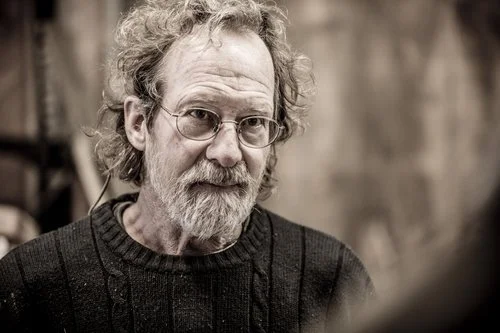
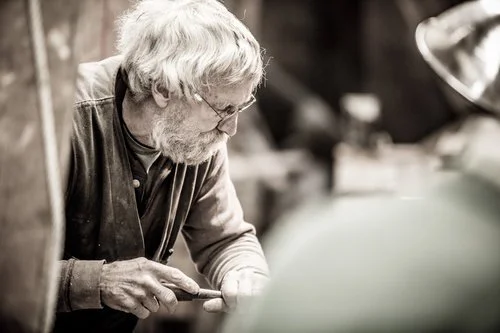
This work is relaxing and meditative for Ross; he is silent, solitary, and focused as he toils, and he looks forward to the alchemy that will occur when this piece is transformed to solid bronze at the Edson Foundry in Taunton, Massachusetts.
Most bronze pieces on G&B boats are created this way; almost nothing is ordered out of a catalog. Nat doesn’t design his boats so that, for instance, the sheer can contain a chock found in this or that marine supply store. The bow chock, a long slot through which the anchor line feeds, is built into the Bella’s toerail and is unique to that specific sheer, and so it must be individually fashioned. Even some of the blocks, those most common of pulleys—for the Bella, one particular block must contain two wheels or sheaves—are fashioned out of wood, sanded, and sent to the foundry.
Almost nowhere in America anymore can you find a place where people put together large objects made out of natural materials, each piece of which is fashioned by hand. All of G&B’s work—the patterns to be cast, the lazarette hatch, the planks, the sawn frames and massive keel timbers of Elisa Lee, the rebuild of Aquilon and, one day, perhaps, its new tiller—can usefully be called workmanship of risk, according to the definition suggested by the late David Pye, a British professor and craftsman, in his book The Nature and Art of Workmanship.
Workmanship of risk is, generally, the making of anything individually by hand, the creation of a product that is never exactly the same twice. Its opposite is what Pye called workmanship of certainty—broadly defined as anything made by machine, each item the same every time. Pye distinguished the two types of work using an easy example: Writing with a pen is workmanship of risk; modern printing is workmanship of certainty. A plank-on-frame hull is workmanship of risk, a fiberglass hull workmanship of certainty. Creating the pattern for a boom gallows is work of risk; transforming that pattern into bronze is work of certainty. Because the outcome of workmanship of risk is never certain, the quality of it is determined by the care, dexterity, and judgment of the worker, qualities that are unnecessary in workmanship of certainty.
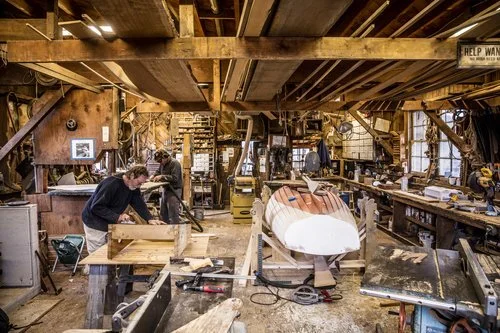

Images -Mark Chew
Pye’s book is a clever discussion of the two types of work. The distinction itself has long been obvious and may be said to have inspired an entire intellectual and design movement, the arts and crafts movement of the late nineteenth and early twentieth centuries, which began in response to the awesome -and to many - ominous forces of the Industrial Revolution and mass production. Pye’s language and observations, however, brought to the distinction new power and meaning in the age of plastics and so-called high technology (the book was written in the 1960s), and they have only gathered force as humankind has begun to dwell increasingly in the ether world of the Internet, where workmanship of certainty is removed even from itself, reduced to representations on a screen.
The subject is important because, as Pye argued, “all the works of men which have been most admired since the beginning of history have been made by the workmanship of risk.”
All workmanship of risk is only an approximation of a worker’s intent, Pye said, carried out with whatever skill that worker may possess. We can imagine a perfect result, a designer can create the perfect design, but its execution can only approach that perfection, like a line approaching zero into infinity. The quality of the result, according to Pye, is judged by how near to or far from the intended design it is. Such work is defined by two criteria, soundness and comeliness—it’s got to work, and it’s got to look good, and the longer it does both, the more durable it is, the better it is deemed to be. Good workmanship carries out or even improves upon a design; bad workmanship fails to do so and “thwarts the design.”
Pye championed the workmanship of risk—what we tend now to call craftsmanship, all those rare, handmade things like furniture and Shaker boxes—but he did not at the same time condemn mass-produced goods or mechanical regulation. For him, industrial automation was a good thing. Mass production was a good thing. Imagine, he said, having to build every automobile by hand, fashioning each piece as you needed it. There’s not a soul at G&B who wants to make every bolt and screw by hand—they all make enough of their own as it is. All those thousands of identical 1½-inch screws that are fastening planks to the frames of Elisa Lee are each one of them a gift of mass production.
Pye’s book also reminds us that the machines that make the screws, that perform work of certainty, were themselves originally created by workmanship of risk, could not exist without it.
“In the Science Museum in London,” Pye wrote, “can be seen the first of all lead screws, which Maudslay chased for the first screw-cutting lathe, and one of the first planers, whose bed Roberts chiseled and filed flat. How many generations of screws and plane surfaces can those two machines have bred?” (The Maudslay Pye refers to here is Henry Maudslay, 1771–1831, the father of the machine-tool industry. He invented the metal lathe, perfected a measuring machine accurate to a millionth of an inch, and fabricated other precision tools, most of which his firm needed in its work building engines for the British Navy.)
These facts are important to reiterate because so much time has passed since the early days of mass production and the Industrial Age that we tend to take boxes of screws and buckets of nails for granted, as if they grew like almonds and we needed only to shake the tree for more.
Pye seems to have been moved to write not simply in order to lay down a stern paternal reminder to appreciate whence we came (“When I was a lad . . .,” the wheezy voice admonishes), but to voice his practical, even urgent, concern that because the quantity of workmanship of risk—individually handmade things—is diminishing for obvious commercial and practical reasons, we are as a culture losing not only our capacity to perform such work of risk but also our capacity to distinguish good from bad workmanship, and thus stand to lose potentially good workmanship forever. The danger is not that such workmanship will die out—some people will always be moved to make things by hand and to own things made by hand—but rather that, for lack of standards, “its possibilities will be neglected and inferior forms of it will be taken for granted and accepted.”
This certainty was once a real fear in the construction of traditional boats, one that was in the forefront of Jon Wilson’s mind when he started his magazine. It was all too conceivable to him that traditional boats—not small craft, the rowboats and dories that a suburban guy clever with wood could fashion in his backyard, but rather bigger boats, requiring more advanced knowledge and heavier timbers—would cease to be made for, say, thirty or forty years, a generation. Conceivable also, then, was the scenario that when those thirty years were up, the value and sense of traditional construction would be reconsidered, people would change their minds, want wooden boats back, but there would be no one around who knew how to build good ones, and we’d have to learn it all over again, or more likely accept and take for granted poorly constructed wooden boats.
Pye’s main concerns, though, seem to have been aesthetic. Workmanship of risk should continue, he argued, because it creates a range of aesthetic qualities that mechanical or regulated work, which is always ruled by the marketplace, can never achieve. And Pye further wanted to acknowledge and illuminate the worker.
“The judge, the pianist, and workman,” he wrote, are interpreters. “Interpreters are always necessary because instructions are always incomplete.” The workman can do with his eye what the judge does with intuition and logic, what the pianist does with intuition and ear: he or she can measure with astonishing accuracy those things that can never be specified, isolate nuances that are too subtle to be described. No law book could be complete enough to handle the specifics of every individual case; no musical score could possibly convey how long each note must hang in the air, or precisely how loudly it should sound out; no boat design could determine a single, absolute outcome of every curve. Which is why we have lawyers and judges, why some musicians are better than others and some are considered great, and why there are a pair of Malabars in Vineyard Haven Harbor, both classic 42-foot Alden schooners, of which one is powerfully built and one has exquisitely rendered lines—two very different boats from the same design.
Not coincidental, I think, is how often Pye used the “old-style shipwright” to provide examples of his ideas. “The old-style shipwright with his adze,” Pye wrote, “can get a nearly true flat surface or fair curve without any apparent guide, simply by coordination of hand and eye. . . . The shipwright with his adze does not finish off the surface by removing handfuls of wood at each stroke, but in short light strokes taking off the wood in shavings.”
And: “Many lives on many occasions must have depended on their timing in forging the iron work for sailing ships. A ‘cold shut’ weld or a weld with dirt in it could remain undetected for years and then perhaps bring down a mast, or, if in an anchor, put a ship ashore.”
Pye ultimately addressed the art of such work, looking to John Ruskin, the nineteenth-century writer, a critic of art and architecture, for a definition: “Art is the expression of man’s pleasure in labor,” asserted Ruskin. It was precisely this pleasure—and a very particular kind of pleasure it is, making things with your hands—that Ruskin isolated as what was lacking in the new society of the Industrial Revolution. He suggested that the masses were fundamentally unhappy because first, they didn’t enjoy their work, and second, they believed that they would be happier not if they found work they enjoyed, but rather if they made enough money to pursue more pleasures outside work, as soon as they could get away from their miserable jobs. “It is not that men are ill-fed,” Ruskin said, “but that they have no pleasure in the work by which they make their bread and therefore look to wealth as the only means to pleasure.”
Certainly, as Ross Gannon stands in the dark shop, alone, sanding the pattern for the boom gallows, this kind of pleasure seems very close to the surface. It is not his solitary pleasure, but rather a pleasure of a more general and independent kind, a pleasure independent of Ross, that he simply connects to. This fact becomes clear when, a week later, a black-locust tiller dangles from the overhead wood rack between table saw and planer, fastened into a galvanized tiller head, turning slightly in the air, a couple coats of varnish on it and several more to go. In the empty shop, the nearly completed piece is a compelling sight, as if blossomed from out of nowhere, grown like a seed pod from the building itself.
Nat Benjamin takes this notion of workmanship a step further, beyond the pleasure that it is: when workmanship is focused on the task of fastening planks to frames and fairing curves, it can transform and elevate the worker.
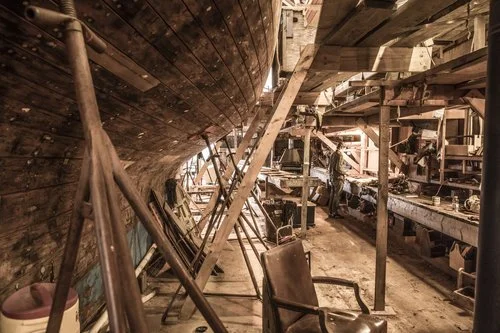
Image - Mark Chew
“After nearly thirty years of continuous involvement with wooden sailing craft,” he writes when asked to contribute a short essay to a picture book on classic yachts, “I am more convinced than ever that a plank-on-frame vessel is the ultimate in yacht construction. Not only does this method produce an enduring vessel with integrity, heart and soul, but it also requires a process that is so ancient and noble as to inspire the builder to work above his ability, to continue challenging himself in his expression of the rarest combination of science and art.”
Perhaps this is why ordinarily purposeful people find themselves, unaccountably, loitering in boatyards. Just hanging around. They can sense it here, this pleasure, this inspiration, this elevation. They can smell it. It smells like wood. Sawn cedar, damp, steaming oak, even angelique that stinks like where the cows are on the farm. They can touch it, this wood—it feels good in the hand. It’s actual. It’s true. They can see it bent into curves, and they can imagine sailing away on it.