
LEARNING FROM LAMU
The DFAT website clearly states that if you are planning to go to the Northern Coast of Kenya you should “reconsider your need to travel”. It goes on to say “The borders with Somalia, Ethiopia and South Sudan are high-risk areas for kidnapping. Armed groups from Somalia kidnap and target foreigners in Kenya, including aid workers, particularly along the Somalia border region. Foreigners have previously been the target of kidnappings. If, despite our advice, you plan to travel to these areas, get professional security advice.”
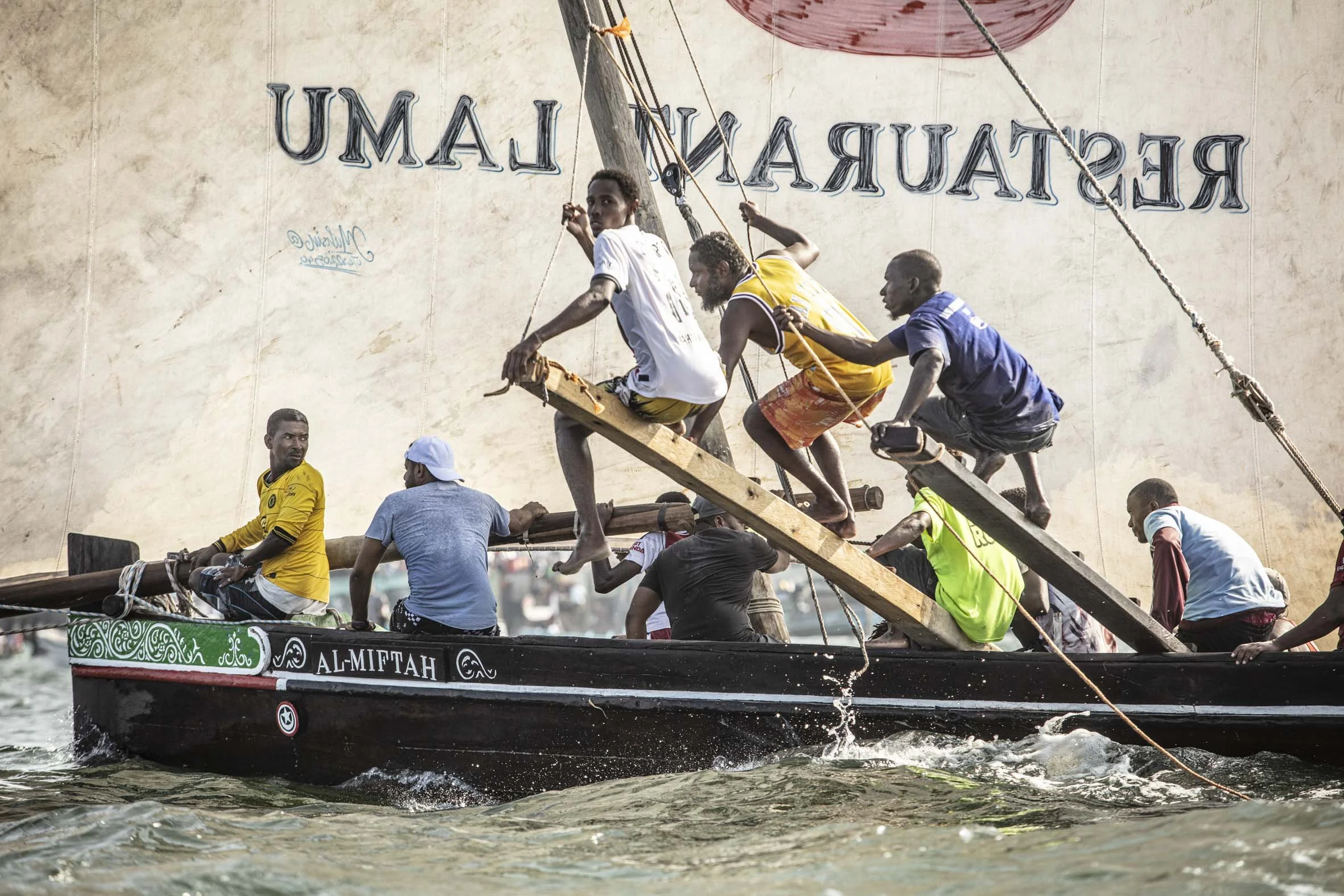
The Mozambique style SHABA puts men in the water to help tack the massive sail
I considered the advice… and then ignored it. I had been given a precious invitation to sail in the spectacular regatta for the local dhows in Lamu and it was an opportunity too good to miss.
After forty years of mildly competitive sailing, on three different continents, I would list my few days of racing on the Swahili coast as an all-time highlight. Much of the event would be familiar to people who sail in “rich world” regattas. Considerations such as weather, sail choice, tidal movements and crew roles are almost identical but then the sailing is infused with pure joy, where physical prowess, respect for tradition and experience, and the love of the practical act of moving a wooden boat through the water, transcends the importance of the final results. But don’t misunderstand me. They push their boats hard.
A shattered lateen boom ends the hopes of one of the favourites HUSNA
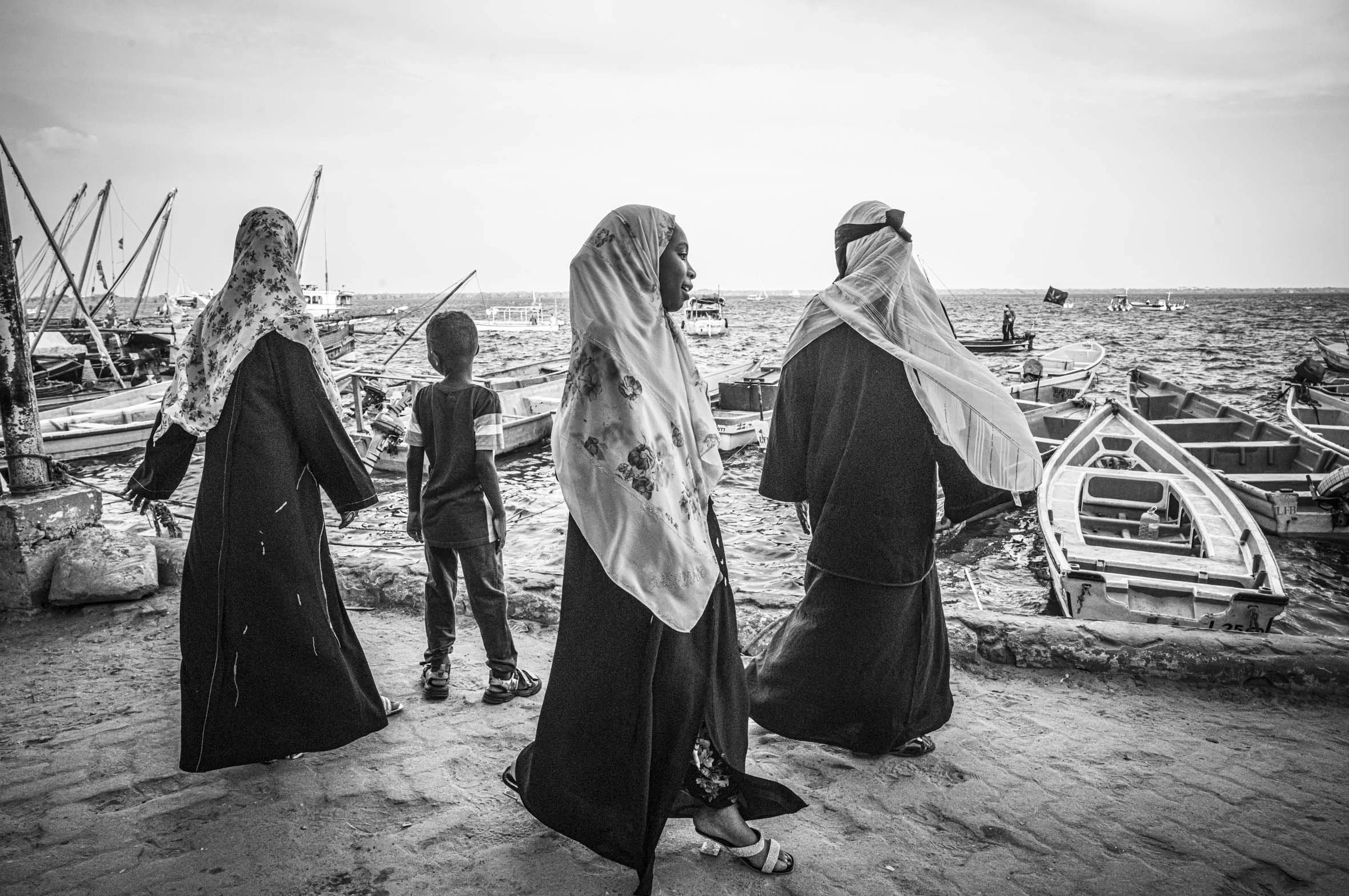
The small Swahili coastal town called Lamu is UNESCO heritage listed site of cultural significance. The labyrinth of narrow laneways is crowded with people and donkeys going about their business, not for the tourists (who are few and far between) but carrying out the commerce that’s been going on here for a couple of millennia. (Click to Enlarge)
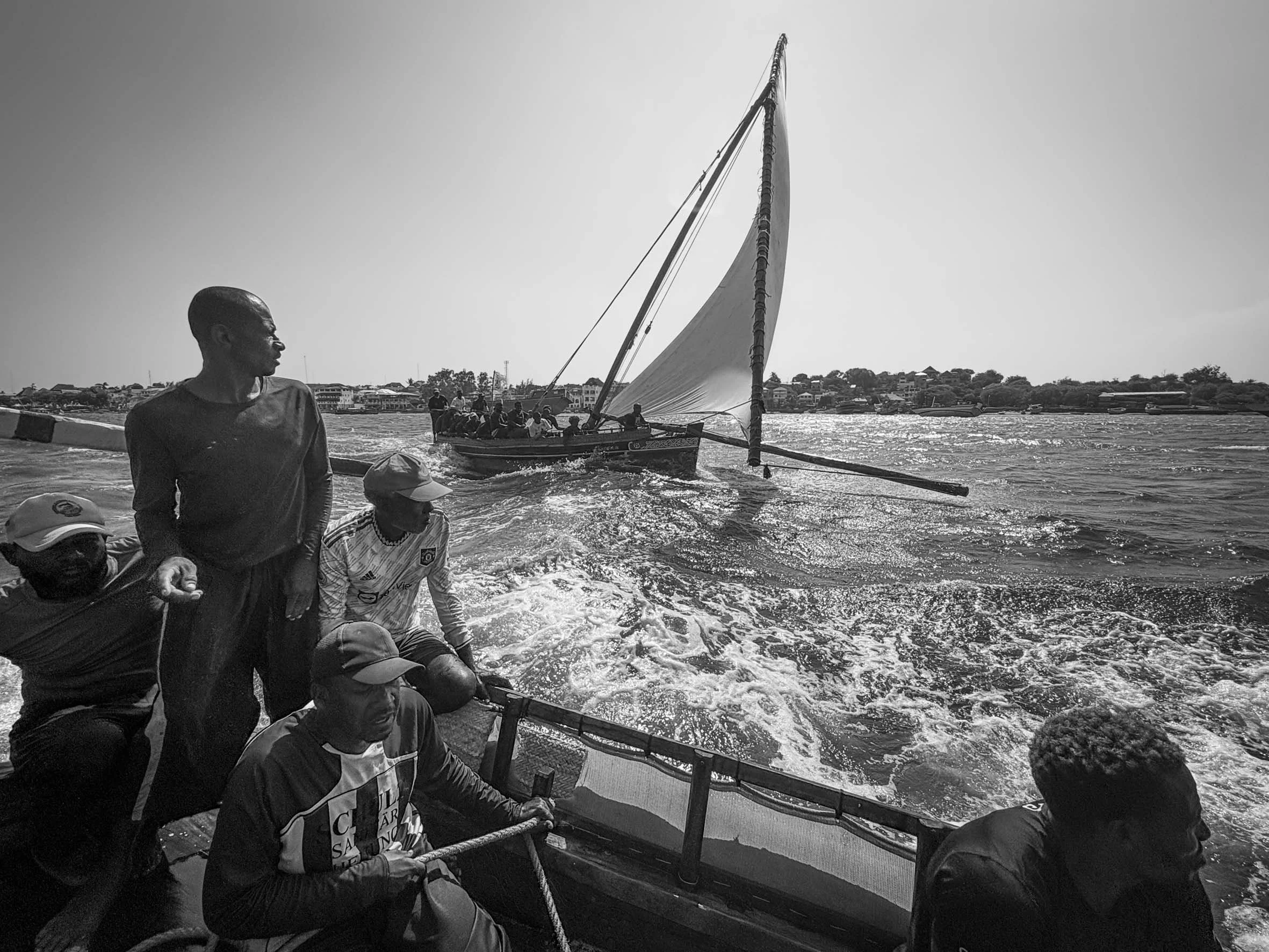

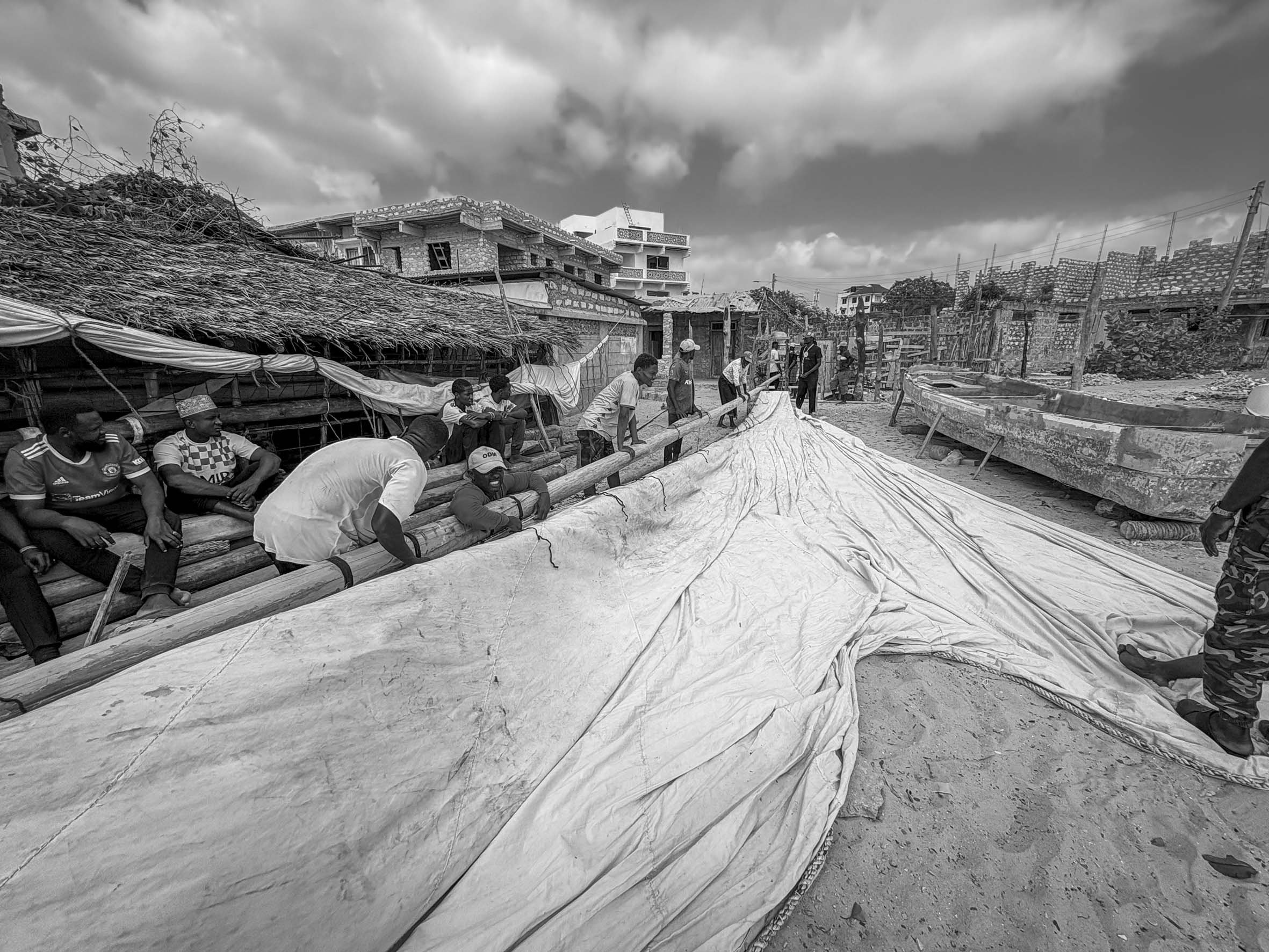
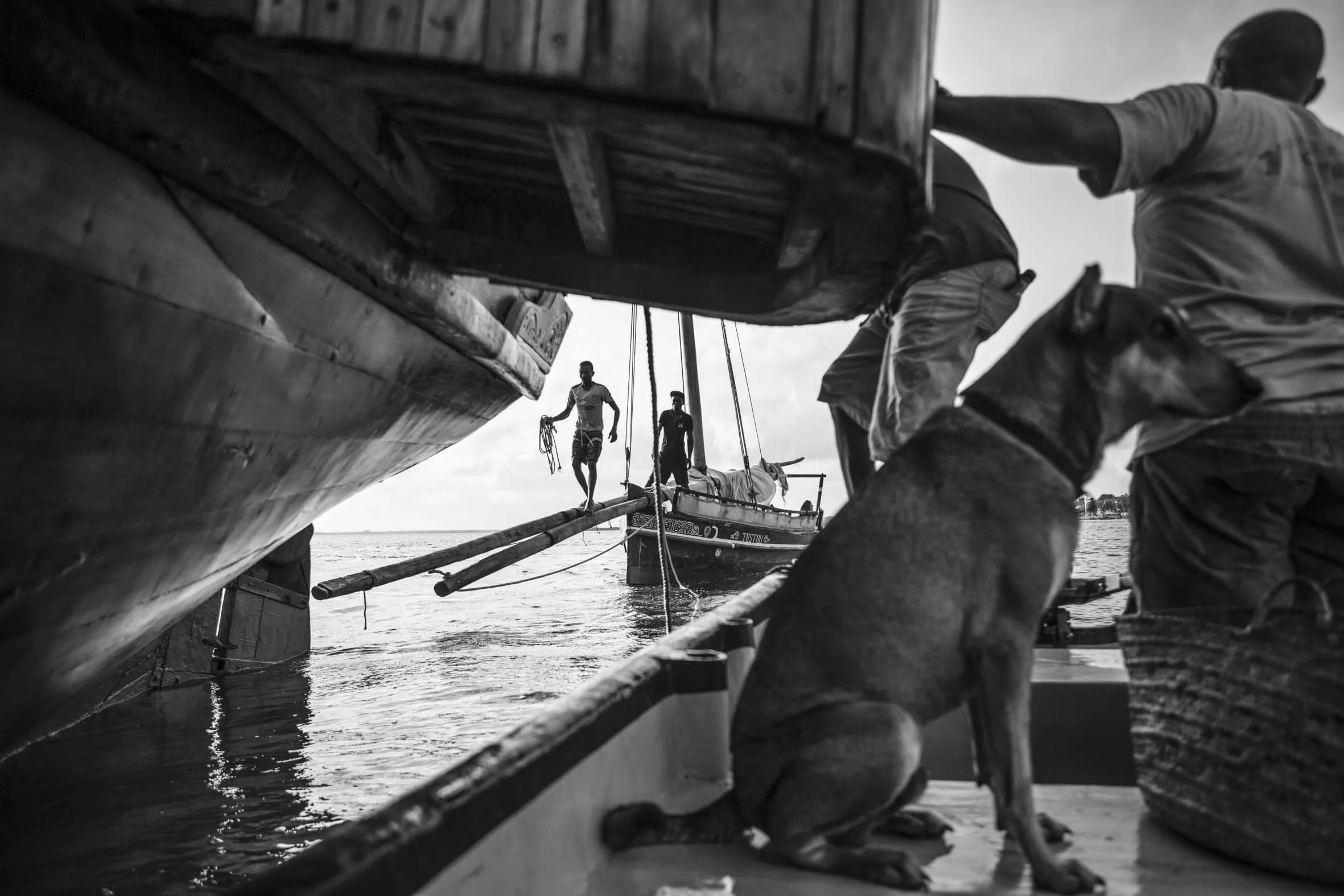
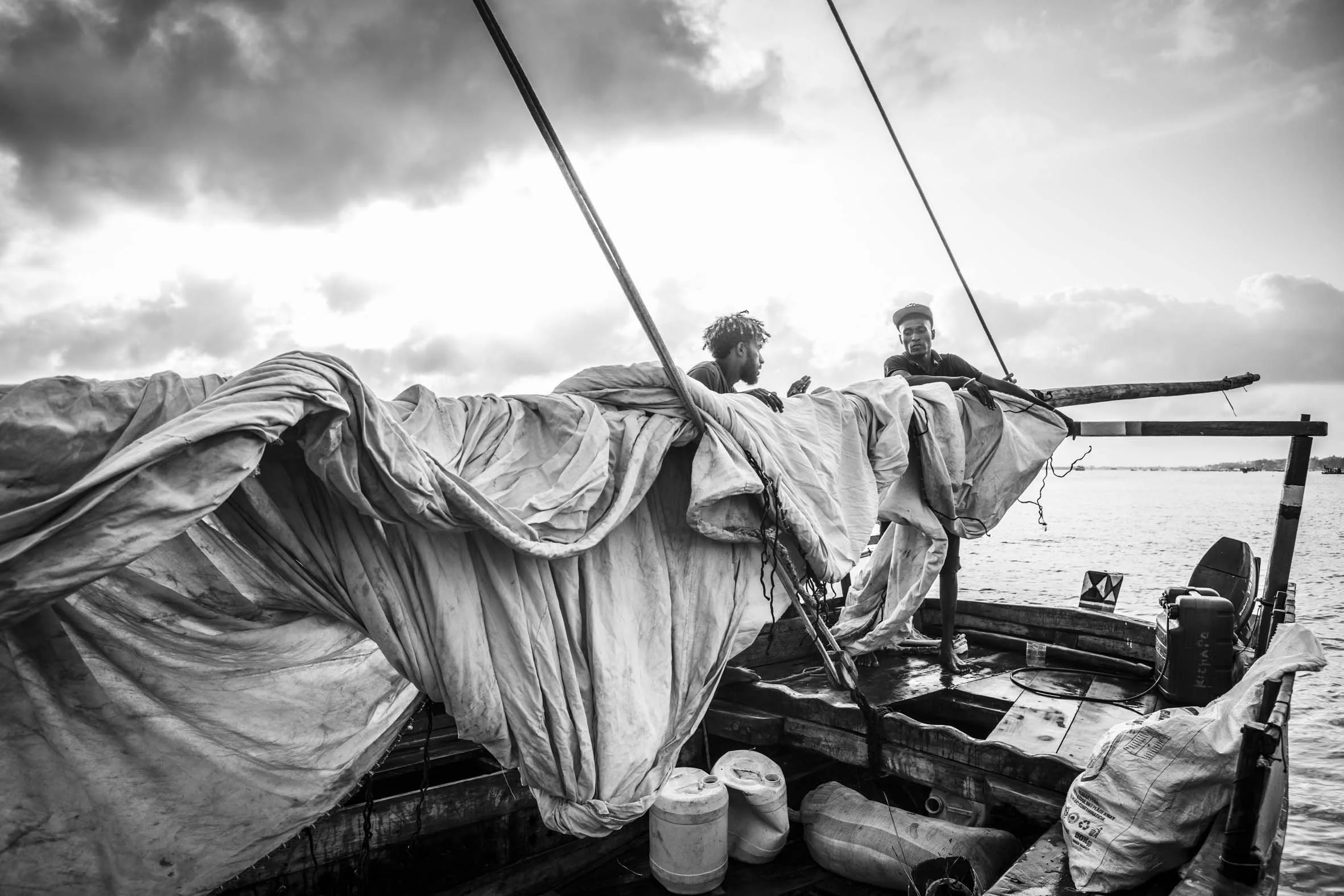
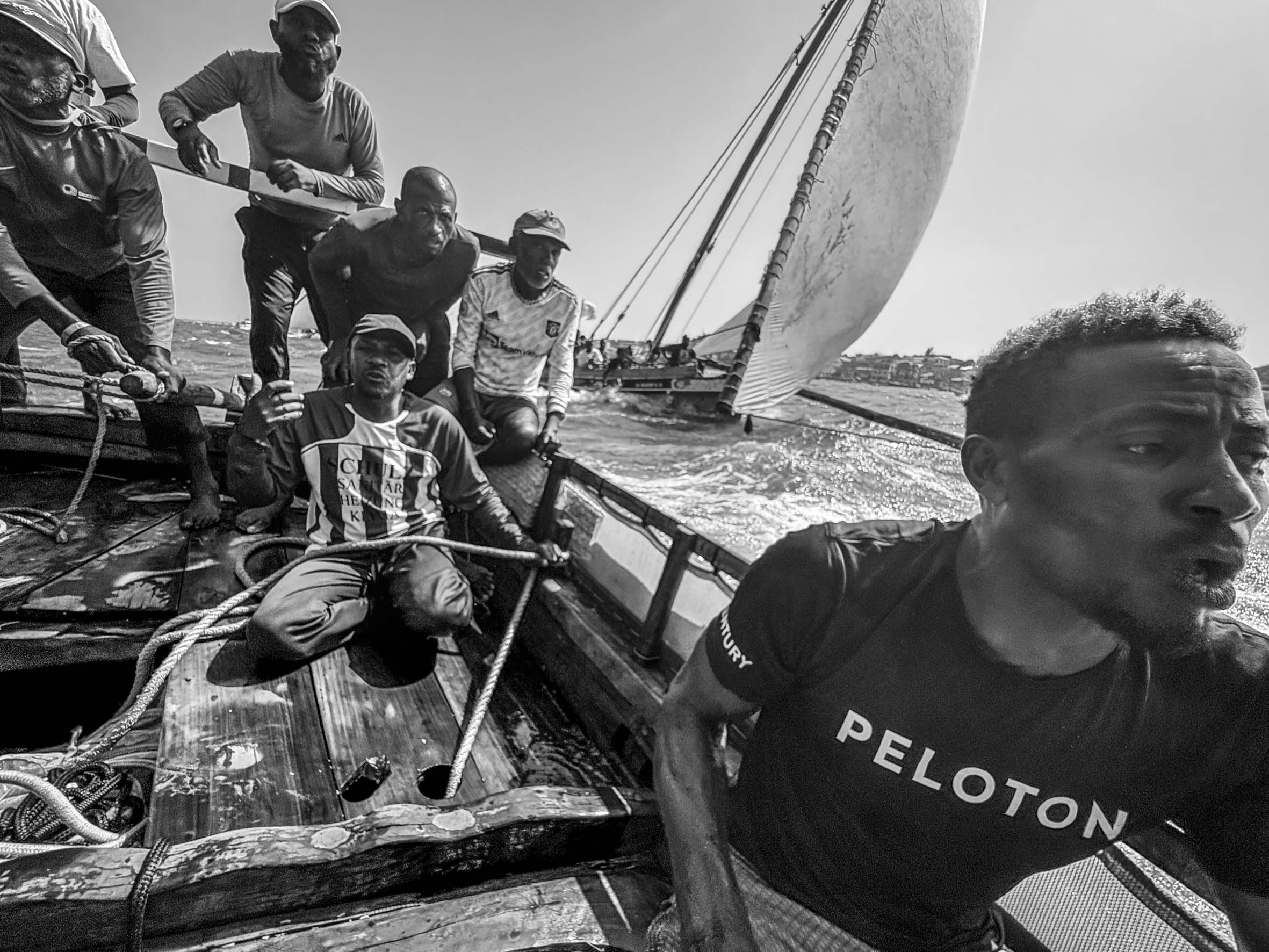
And for a few days each November, the largely Muslim community celebrates their culture by racing their dhows. These craft which first appeared on this coast five centuries before Jesus recruited his first fisherman, were designed primarily as trading vessels. They have a characteristic lateen sail, which hangs off a long boom, suspended at an angle from a short forward leaning mast. They are objects of beauty, but more importantly they are highly effective sailing craft, chiselled into their current form by two and a half millennia of practical experience. In Lamu, a few dhows still work under sail, delivering coral blocks, salt, sand and the occasional tourist to where they need to be. Globally, the Indian Ocean Dhow is one of only a dozen types of wind powered craft that are still used for genuine commerce or subsistence.
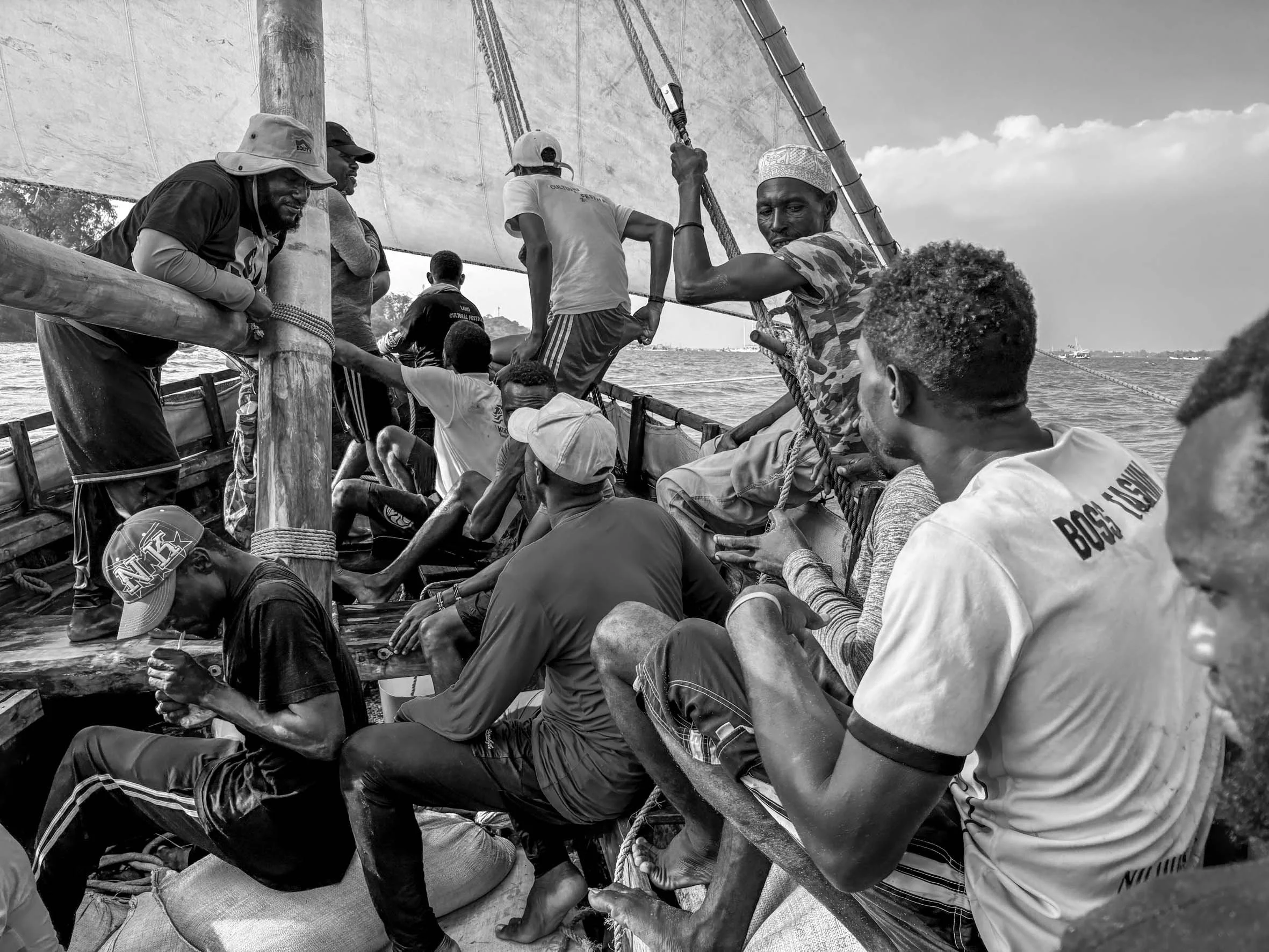
But, just as the easterly trade winds become established, the dhows are transformed to race! Their stout masts and booms are replaced with lighter racing versions, new sails are sewn from Indian cotton panels, and their hulls are patched and painted with whatever is available. With minuscule budgets, they rely far more on ingenuity and generations of unwritten seafaring lore, than technology to make each boat go fast! The lateen rig is labour intensive and the crews of twenty five or more crowd aboard a 30ft boat and sing as they wrestle their way around the course. Continual bailing is needed to stop the dhows sinking, while a respected afterguard perches on a small decked area above the transom, nursing the tiller and scanning the water for changes in wind and tide.
TUSITIRI’s afterguard
The dhows have no electrical power on board. No pumps, no winches, no instruments. Sheeting in the vast single sail is done by many hands working in unison. They often sail with the highly respected “Fundi” amongst the crew, the shipwright who designed built the boat. His reputation can be made or lost, depending on the performance of the boat.
The racing is intense and more than half the boats don’t finish, either because they sank, or their fragile rigs collapsed. Sailing these craft well, demands good judgement, bravery, technique and a good dollop of luck, but not a lot of money. The overwhelming sentiment aboard every craft is joy. Not fear or anger or resentment or aggression, but sheer pleasure, coming from efficiently moving through tropical waters, powered only by the wind (Click to Enlarge)
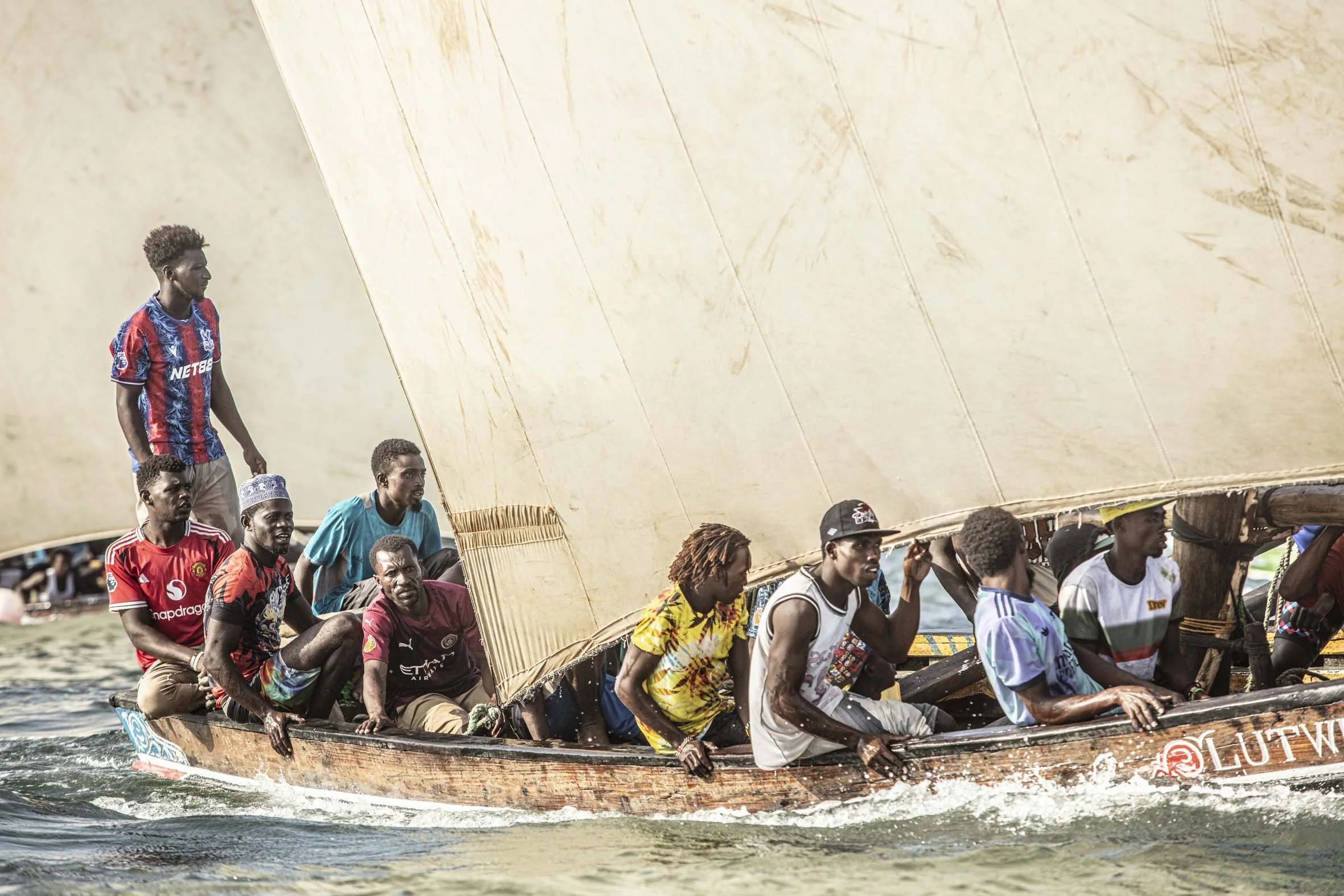
I arrived in Lamu on a Tuesday evening after a 90 minute flight from Nairobi via the coastal resort of Malindi. The airport is across the harbour from Lamu, on an Island called Manda, so all arrivals are required negotiate for a small boat to take them to their final destination, providing a gentle introduction to the waterways. I was staying in the old part of Lamu Town and my friend Mia Miji, who had invited me to the event, appeared at the airport with a beaming smile and a few crew members from TUSITIRI (the dhow we would be racing on), to carry my luggage which included 20kgs of spare rope and fittings from MATILDA our Swan 47. This stuff is hard to come by in the remote community and sailors cherish anything that could possibly help their dhows sailing prowess.
The following day was prep day, and I showed up at the “team base” which was an old sail strung over a couple of posts shading some work benches and trestles, on the beach a little way out of town. Here the fundi, was fashioning a new longer boom for the racing, made from a liberated telegraph pole that had been scarfed in two places. Dhow sails are made from Indian Cotton panels and last well in salt water but are ruined quickly by fresh. After rain the dhows along the foreshore can be seen soaking the fabric in the harbour to “wash off” the fresh water. The size of the sail is crucial to the performance of the dhow. With the forecast conditions, Mia and his brains trust had decided to go with a fourteen and a half panel sail, near the top end of what the 30ft dhow can carry. The sail size also dictates the mast and boom length, both of which must be changed out, if the sail is reduced or enlarged.
There were four classes of dhows racing over the three days of the regatta. Junior sailors, “Mozambique Style” Dhows, Large Lamu Dhows, and Small Lamu Dhows.
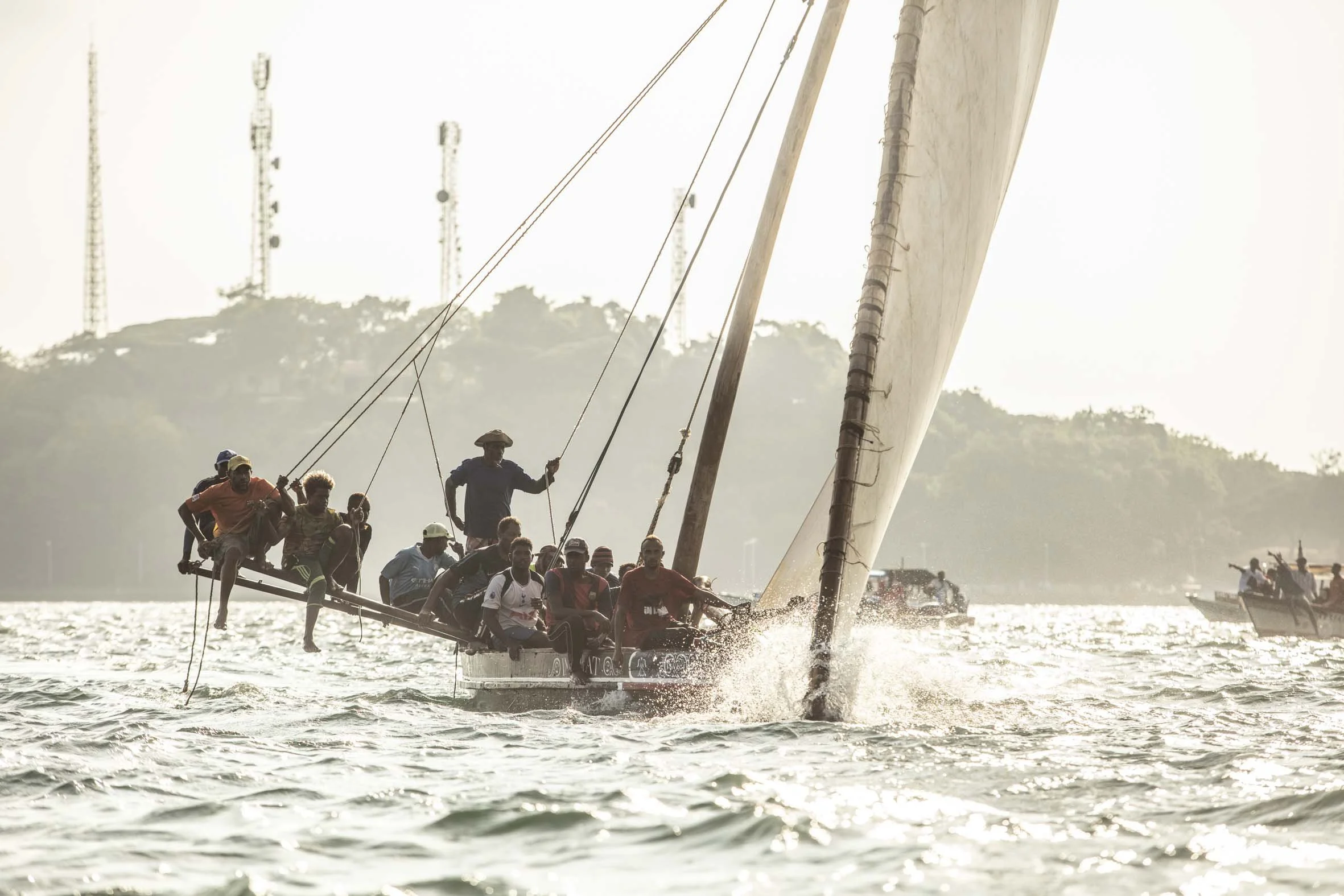
On Thursday the junior sailors went off first and set the tone with an exceptional display of sailing skill. Young boys powered their tiny craft round a tricky course with runs and beats and reaches. Even these miniature vessels have hiking boards and the crews struggle to keep them upright. Three of the fleet failed, and the swamped vessels were slowly swam ashore to be refloated later on.
Junior sailors bearing away around a top mark
The next class off that day was the Mozambique Style Dhows. These elegant double enders first made their appearance on this coast in 2000. They are beamier than the local boats and have more hull form stability, which makes them popular for tourist sunset cruises. They now outnumber the traditional Lamu design and although not quite as quick, have been instrumental in the revival of wooden boat sailing on the coast. How the design made its way 1000nm north from Mozambique is unclear. Like the junior sailors, the Mozambique style boats are also allowed hiking boards which adds to the drama of watching them sail!
Mozambique style SHABA in full flight
Friday dawned and there was tension in the air, as this was our big race day. TUSITIRI my ride, was in the prestige division of the larger Lamu style racing dhows and one of the favourites. But the trade winds were up, and the fourteen and a half panel sail was looking like it was going to be too much. On arrival at the base at 730am, the crew was already there, starting to unpick a panel from the sail and replacing a scarfed section on the lateen boom with a shorter one. The race start was scheduled for at 1330 and at 1100 we still didn’t have a mast in the boat, a completed boom or a finished sail. But with a crew of 25+ there are plenty of hands to make light work. In addition to the rig issues, because the boats are essentially designed for carrying cargo, we had to load 10 sandbags of about 25kgs aboard as moveable ballast. But, after a brief test sail, by 1230 we were heading to the start line with 18 other similar dhows. Of the four hundred sailors racing that day, I was the only Mzungu, but not for one moment did I feel like an outsider. I was given a simple job, (moving a sandbag from side to side when we tacked or gybed), expected to do it quietly and efficiently, and accepted as a worthwhile crew member.
Because dhows take a long time to tack, a sailing start would be impractical. So once the startline is laid, each boat anchors by the stern on the windward side of the line in such a way that the bow is not “OCS”. The lateen spar is hoisted, but the sail is bundled to it with many pieces of sisal. When the flag on the start boat comes down, a firm tug on the sheet breaks the sisal, the sail sets and the buoyed anchor is thrown overboard to be collected later. The race is on!
The course was about 20 miles long, starting with a long run down the harbour. We were slow off the start but soon started hauling in the leaders. The racing was tight and thrilling, even if the give way rules were unclear. Doing about nine knots we wove in and out of the local craft going about their daily business, and by the bottom mark we were coming third. When, on the first beat, the boat sailing just to windward of us shattered its boom sending splinters onto our deck, we moved into second. Because a full tack on a dhow is such a massive commitment, (losing about 15-20 boat lenghts) if a leg is short, they can make progress with the sail pushing against the mast from the “wrong side” They call this, less efficient set up “half sailing” and it’s a fine judgement as to when it’s worth sacrificing speed for quicker tacking.
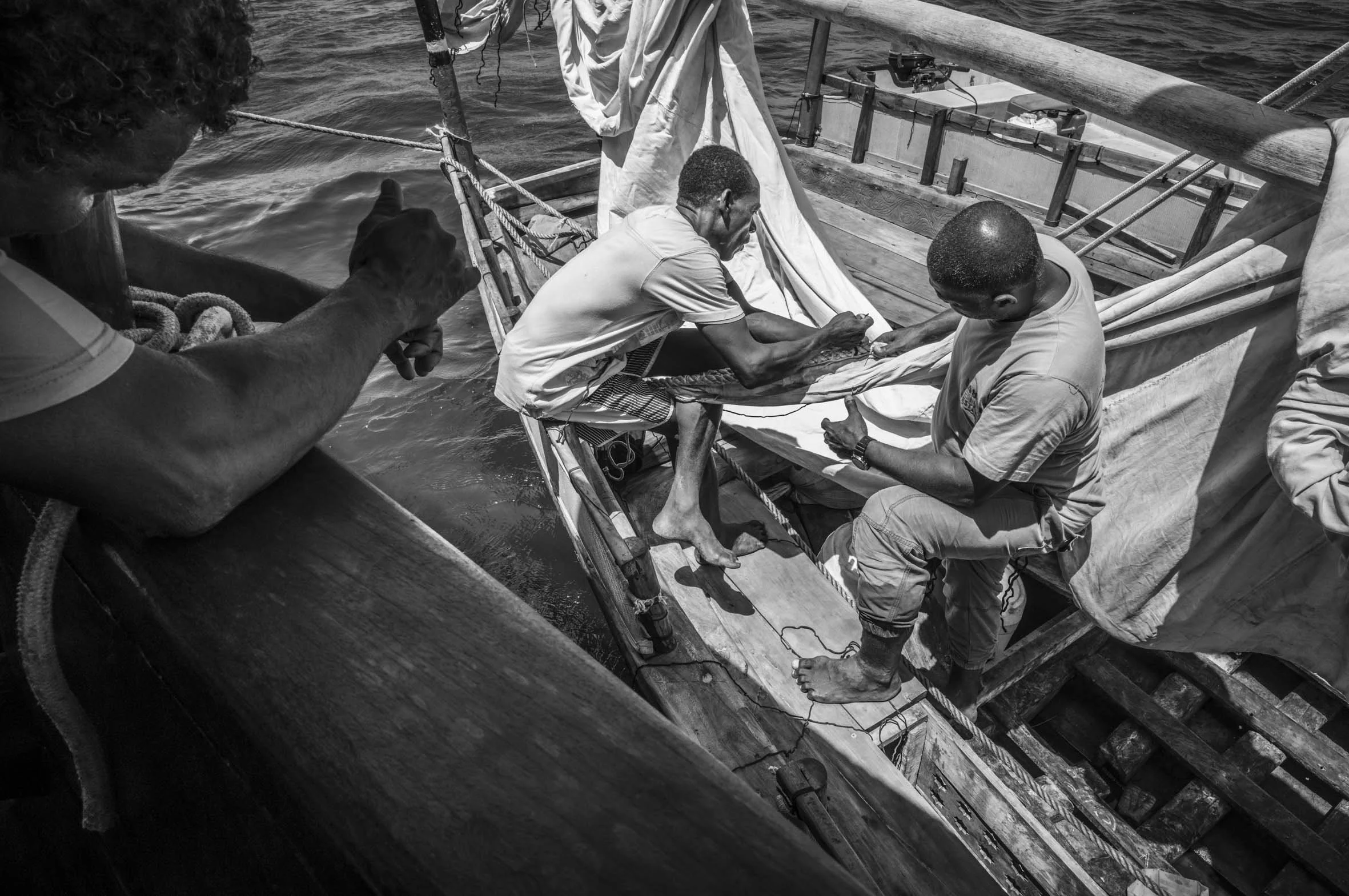
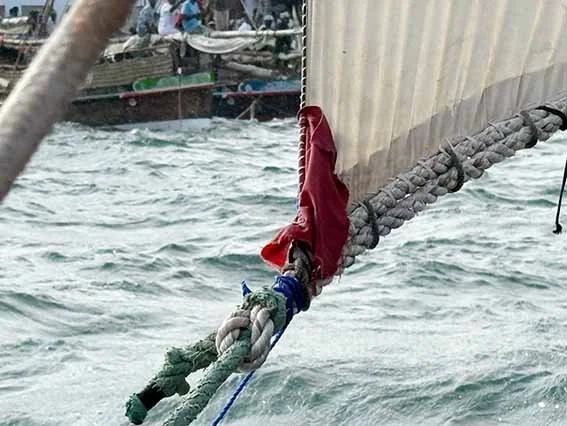
At this point one of the crew members approached me holding a panga, a small, heavy machete. “Emergency!” he shouted, “we need you!” With much gesturing, he explained that we needed a section of my strong red cotton shorts to reinforce the failing clew of the huge lateen sail. After three quick knife strokes, and some rapid stitching, the repairs to the sail were in place.
Witnessing this skilful improvisation, I realised that it typified the way the local sailors manage their beautiful dhows. With limited funds and equipment, they maintain and sail their craft with skill, passion, making the most of what´s available, drawing on 2500 years of experience.

Much of the race passed in a blur. Continuous bailing, occasional outbursts of crew singing, running repairs and tactical choices. The boat ahead would get away from us on the runs, but we would claw back the distance on the beats, but never enough to cross ahead. On the final run, once righting moment was no longer required, three of the crew were told to jump overboard to lighten the load. 100kgs of sand went over with them. But all to no avail. Second place was our destiny. As we passed through the finish line with hundreds of spectator boats weaving around us cheering , and the uproar from the shore reminded us that the result didn’t really matter.
Without wanting to be a cultural relativist, I find some of the traditions hard to come to terms with such as the complete absence of female competitors. How to change this I don’t know, but change it must. There is no consideration for safety …which is fun until something goes wrong. Large booms snapping over the heads of crowded crews is a recipe for major injury or worse, however surprisingly accidents seem rare given the regular sinkings and breakages.
But the dhow races, for all their parochiality and low-tech charm, provide clues as to what the elite sailing world needs. The sailing public are craving authenticity; they want stories of real and flawed human beings doing physically extraordinary things. They want to see crew members moving around the boats, sails being set and retrieved, they want close quarters action and decisions being made by people not computers.
I’ll remember my time racing in Lamu for ever. Not for the result, or the hardware, or the food or the non-existent alcohol, but because I was warmly invited into a community that was doing something I love, with passion and delight. The lessons I learned Lamu were not just about how to tack a lateen sail, but about how to find true joy in sailing for sailing’s sake.